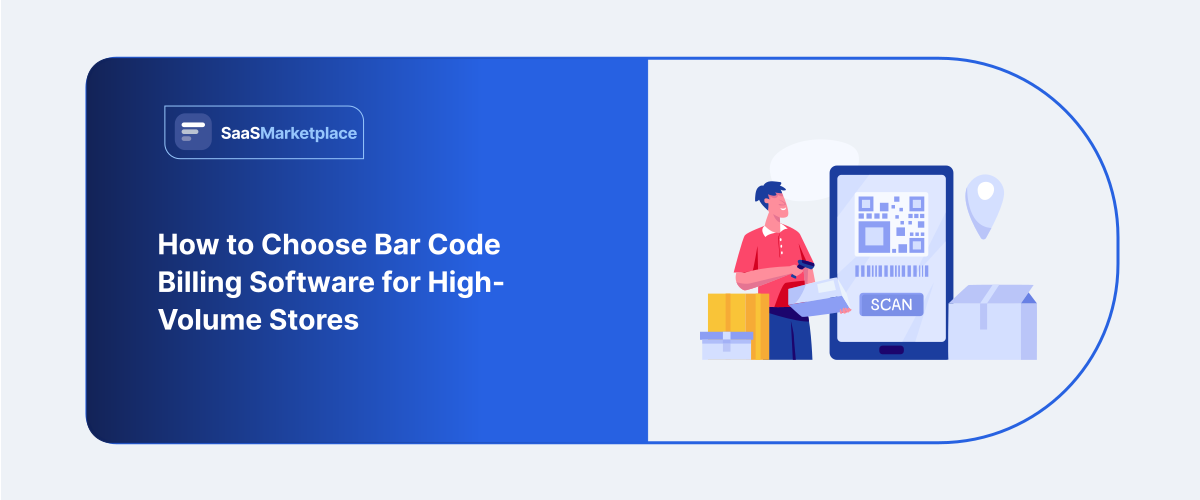
How to Choose Bar Code Billing Software for High-Volume Stores
-min.jpg)
When it comes to choosing effective software for barcode billing in a retail location in the U.S., one primary consideration is checkout throughput. In U.S. retail stores where customers have little patience, and peak hours can clog customers in seconds, a point of sale (POS) system must grab any opportunity to show customers their items. Businesses that experience high volumes, including busy supermarket chains in New York or major discount stores, cannot afford to have an everyday off-the-shelf system but must employ robust enterprise solutions that facilitate fast data processing and online transactions during offline time. The software must be chosen so that it is able to provide a strong digital backbone that eliminates the possibility of human error, allows for seamless integration into the U.S. commerce system, and ensures optimum service speed.
What Is Bar Code Billing Software?
The emergence of barcode billing technology allowed cashiers and customers in the USA to complete financial transactions whenever they scanned items. A grocery cashier passes the Universal Product Code (UPC) through a scanner, and the barcode billing system then reads it. The system then updates the database according to the information it gets from the barcode. Subsequently, the barcode billing software confirms prices, discount offers, and taxes to be collected and shows the total amount owed to customers.
The barcode billing software not only processes sales but also acts as the nervous system of business operations at any American retail store. Retailers who sell thousands of different products need to use inventory control software that enables them to track stocks of their goods as they make sales. The barcode billing technology gives its users updated information in real-time whenever a product is scanned.
Why Do High-Volume US Stores Need Bar Code Billing Software?
1. Resolve Line Contention
The retention rate in brick-and-mortar retailers is indeed unmatched when lines start to grow. The delivery of products and services in barcode-based systems streamlines the operations, minimizing the time spent in line to less than thirty seconds per customer.
2. Helping Avoid Mistakes on a Large Scale
As for human typing errors, it's always among the main reasons that the stores lose revenues due to wrong prices, wrong SKUs, and wrong tax rates for different states. With the use of barcode systems, all information is retrieved from a host computer with no possibility of a mistake being produced. Thus, instead of losing a lot of money daily because of wrong calculations, the average store saves a few thousand dollars a day on the losses related to wrong prices and SKU errors.
3. Synchronized Inventory Management Across Different Channels
If a retailer faces thousands of transactions on a daily basis, it cannot afford to perform cycle counts traditionally. The modern barcode systems allow a store to get the updated information about the state of the inventory on the spot with the help of a scanner.
What Features Should You Look for in Bar Code Billing Software?
1. Fast Scanning and Support for Multiple Formats of Barcodes
A good lane should have software that is capable of instant scan processing without any time lag. The system in question must support various barcode types: the traditional 12-digit American UPC-A and its smaller analog UPC-E, Global Trade Item Numbers (GTIN), and information-rich 2D QR codes. The advanced software will also provide an opportunity for bulk scanning, which enables scanning of similar items one after the other without any need for cashiers to stop and change their quantity on the screen.
2. Sturdy Hybrid Architecture with Offline Function
Internet disconnections are a common phenomenon, but a high-volume checkout line should never come to a halt. Therefore, one should look for software that has a solid offline backup that makes it possible for cashiers to continue the transactions and provide customers with digital receipts in case of a network failure. The software must keep track of transaction details internally and upload them to the online database automatically once the connection is restored.
3. Inventory Synchronization in Real-Time across Multi-Registers
In busy retail stores,eCommerce inventory management levels are constantly being reduced. The software must ensure stock levels are updated throughout every point of sale in the establishment at the same time. This real-time synchronization is effective in preventing regional fulfillment mistakes and ensuring automated reorder thresholds are accurate, eliminating issues with making a purchase in the store while the product is being marked available for a buy online, pick-up in-store order at the same time.
4. Sophisticated Promotion Engines and flexible Pricing
High-volume retail makes extensive use of dynamic prices, multi-deals, and region-based loyalty points. The software must include an auto-pricing engine that can quickly analyze the cart contents of customers so that existing promotions, such as two for the price of one or flash sales, can be applied without waiting for approval from floor managers to enter authorization codes. This enhances customer experience and maintains profit margin by avoiding errors in discounting due to manual operations.
5. Native Connection with U.S. Payment Infrastructure and EMV Security
To achieve the fastest possible line speeds, billing software should communicate efficiently with payment terminals. This type of software should have built-in API integrations with major U.S. payment processor gateways (like Clover, Square Financial, or Adyen) to transmit the precise dollar amount of the invoice to the card machine. The software should provide full support for EMV chip cards, contactless NFC payments (like Apple Pay and Google Pay), and complete end-to-end encryption in order to adhere to PCI-DSS requirements.
How Does Bar Code Billing Software Handle High Transaction Volumes?
1. Edge Computing and Local Databases
High-quality software applies edge computing instead of making all bar codes pass through the internet to a remote cloud server for price display purposes. The software keeps a local copy of the price database in the cash register hardware. Thus, whatever product is scanned, the look-up takes place locally in milliseconds, ensuring that checkout is unaffected by internet availability or cloud service outages.
2. Asynchronous Multi-Threaded Processing
Upon making a payment, many processes take place at the same time: receipt printing, inventory updating, loyalty program tracking, and financial CRM software transfer. With the help of asynchronous processing, sophisticated billing software subdivides these processes into different threads. The software focuses on customer service, approving a payment card and printing a receipt, before completing the more complicated tasks such as inventory and analytics processes.
3. Microservices and Horizontal Cloud Scaling
Modern retail platforms in the U.S. replace monolithic architecture with microservices in the cloud. Inventory systems, loyalty systems, and payment gateways are independent digital units. When thousands of customers use a loyalty program module, this microservice automatically scales up on a cloud server horizontally, securing an uninterrupted operation of the billing engine.
Which Bar Code Billing Software Options Are Popular in the US Market?
1. Zoho Invoice
Zoho Invoice is a widely used cloud invoice platform designed for small and mid-sized businesses in the USA. Although it performs mainly as a digital payment solution for billing purposes rather than a highly functional grocery store point of sale system, it has the ability to use barcodes to identify inventory. The company handles all the states’ taxation configurations, accepts online payment through payment systems like Stripe and PayPal, and helps to automate billing processes for its customers. Its easy-to-use software makes it suitable for small order retail, wholesale, and light inventory companies wanting to save money and maintain cost-efficient operations. Moreover, the software can grow with a business and integrate into the whole Zoho ecosystem, including Zoho Books and Zoho Inventory.
2. AFAS Software
AFAS Software is an enterprise-level ERP (enterprise resource planning) company located in the Netherlands and servicing large global operations. Unlike a classic check-out solution, it offers an all-in-one system that incorporates finance, orders, and HR processes. In retail, it acts as a high-volume company system, making use of the large number of sales from the connection of retail arrivals. It is utilized for a wide variety of corporate needs, providing advanced automated bookkeeping and effective supply chain solutions.
3. Boekhouden
In Dutch, the term Boekhouden means bookkeeping. The term refers to automated bookkeeping systems that have been specifically designed for European accounting and tax processes. The primary use of this accounting solution is to ensure compliance with the bookkeeping practices adopted in Europe rather than the fast-paced checkout process of the United States. When implemented in the retail industry, the system aids in generating reports such as z-reports and monitoring daily sales through the cash registers. The system is great for performing tasks such as recognizing invoices automatically, reconciling accounts, and analyzing profits and losses. For businesses operating strictly within the United States, there is hardly a chance these systems could be used unless they are involved in transactions requiring direct reporting to parent companies in Europe.
4. FreshBooks
FreshBooks is considered to be one of the most popular cloud-based accounting and billing services in the U.S., and it has been created with small businesses and service-oriented retailers in mind. The program is incredibly easy to operate and includes the feature of scanning an item barcode using the camera of a smartphone to create invoices in no time. The platform connects easily with the leading payment processing platforms in the U.S. and gives customers the possibility of making payments via credit cards and Apple Pay. Moreover, even though FreshBooks does not have the local edge database for handling a typical ten-lane supermarket when the network goes down, its back-office reporting is still the best possible. The software allows following up on the fluctuating costs of projects, keeping an eye on clients’ retainers, and preparing profit and loss reports for tax purposes easily.
How Much Does Bar Code Billing Software Cost for US Retailers?
When budgeting for barcode billing and Point of Sale (POS) software in the United States, high-volume retailers must look past basic sticker prices. The financial reality involves a combination of fixed software fees, upfront hardware investments, and variable payment processing costs that scale with transaction volume.
To properly evaluate your total cost of ownership, break down your budget into these six core expense categories:
1. Software Subscription Bases
Presently, the market features an increasing number of cloud-based billing solutions, mostly subscribing to the Software-as-a-Service (SaaS) model. The lowest subscription plans designed for small shops cost around $40 to $100 a month, whereas systems for large retail companies with several locations (such as Lightspeed, Revel Systems, or POS Pro) typically charge about $60 to $250 or more per month, for every location or register. Large enterprises, which need dedicated offline-first architecture and building integration into the ERP system, can rely on annual packages priced depending on the specific demands of the customer.
2. Interchange Plus vs. Flat Rate Payment Processing Fees
Ongoing processing fees are probably the biggest operational expenses for most stores in the USA. Some providers (e.g., Square or Shopify) operate on a flat rate basis, charging about 2.4% - 2.6% of the total amount processed, plus $0.10 - $0.15 for each transaction. However, high-volume merchants generating millions of dollars in their sales should negotiate the interchange plus pricing model, where the merchant pays the original cost of the Visa/Mastercard system plus a tiny markup of several fractions of a percent, thus minimizing their transaction costs significantly.
3. Bundles of the POS Checkout Equipment at the Front End
To run an installation with high barcode productivity, special equipment at checkout needs to be used. A heavy-duty one-lane setup, which would include the main terminal monitor, cash register, speedy thermal printer, and omnidirectional laser barcode scanner, costs from $750 to $1,700 upfront. Smartphone scanning devices with the Android system for the “queue-busting” function would cost between $200 to $400.
4. Integrations and Additions in the Enterprise Software
Regular accounting solutions do not solve complicated tasks on their own. Businesses with lots of turnover will need to add more software to fill the gaps in the data processing. Using server software for barcode programming together with accounting software from providers, along with email marketing or shipping solutions, also means extra expenses of $20-100 and more per application per month from the perspective of expenses all over the enterprise.
5. Mandatory PCI Compliance and Cyber Security Responsibility
Retailers in the United States must adhere to the strict Payment Card Industry data center security software when processing credit card transactions. Consequently, while those using simple payment aggregators can obtain the necessary levels of security as part of the fee charged by the aggregator, huge businesses with proprietary software must set aside $1,000 to $10,000 and more per year for such services such as network security scanning, data encryption compliance testing, and vulnerability audits to remain compliant.
How Do You Integrate Bar Code Billing Software with Existing Store Systems?
1. Create the Middleware And API Layer
RESTful APIs or GraphQL are the most advanced integration technologies adopted by modern POS systems. When connecting a newly created cloud billing application to an old ERP (Enterprise Resource Planning) system, it is necessary to implement an integration middleware Logic Apps system.
2. Set Up Bidirectional Inventory Management
It is necessary to provide clarity on how product master files move from one location to another. Real-time bidirectional synchronization should be established in such a way that data on product specifications, pricing updates, organizations globally, and changes in local taxation are transmitted from corporate servers to checkout points, and at the same time, any deduction of a product (e.g., 1 unit of SKU X deducted) gets to the warehouse management system immediately.
3. Incorporate Integrated Customer Loyalty Hooks
Link your Customer Relationship Management (CRM) system using secure API keys. The billing system should detect a customer’s phone number or app QR code and contact the CRM service to assess current loyalty levels and return the relevant discount codes to the grocery bill.
4. Join Consolidated U.S. Payment Links
Create secure, semi-integrated links between the billing solution and card readers. When a transaction occurs, your software will send the relevant amount to the payment processor (like Adyen or Clover), securing the terminal. Once the processor sends back a secure token confirming the payment, the system will officially close the sale.
5. Implement EOD Accounting Automation
It is necessary to introduce an automation process for end-of-day (EOD) batching. Set up your billing software to automatically gather all daily Z-reports as well as unique tax pools, tip amounts, and cash drops as soon as midnight comes in order to eliminate manually entering these values into your ledger.
How Do You Choose the Best Bar Code Billing Software for Your Store?
- Define Specific Requirements for Your Retail Category: Each retail segment has its own data needs. Ensure that the application can handle your aspect of inventory. For instance, the application should handle clothing store items a bit differently from how it tackles grocery items. For clothing stores, it should handle matrix products; for groceries, handle weight information; and for pharmacies, it should keep tabs on expiration information.
- Test Offline Checkout System: Don't just assume that the system will run well over the internet. You want a system to have an embedded local database at each point, enabling it to process transactions even when the internet is down. It is logical to test the system when interrupted by a lack of Internet and check if cashiers can scan barcodes, apply discounts, print receipts, and collect the needed information for the cloud operation once the network is available again.
- Make Sure the Application Really Tracks Inventory in Real Time: Avoid any software that processes inventories at the end of the day. The application should automatically decrease inventory counts at all points of sale right after one barcode has been scanned, which will help avoid BOPIS problems and give an accurate live view of the situation in stock.
- Check User Interface Speed and Learning Curve of Staff: A system with a cumbersome user interface results in long lines during checkout. Check during the demonstration how many taps or keystrokes are required for the cashier to carry out an exchange, make a refund, remove an error from a product line, or perform split-payment operations. The interface should be simple enough for seasonal workers to learn within one hour.
- Investigate Compatibility of Payment Processor and Hardware: Ensure that you do not get locked into a software application that requires you to use its own expensive processor. Choose a payment processing program with open architecture that is capable of cooperating with all main U.S. processors and communicating with standard plug-and-play USB/Bluetooth omnidirectional scanners and thermal printers.
Conclusion
The process of choosing the right barcode billing software for a busy storefront implies the necessity of weighing processing speed, local offline capabilities, and seamless integration of data. Choosing a platform featuring decentralized edge-first database solutions will allow you to maintain operations at your checkout desks, which will help avoid delays at checkout. When it comes to term selection, refer to the SaaS Marketplace to Discover, Compare, and Purchase any kind of Business Software. Your tech stack choice will contribute to the effective functioning of your retail system, shorter transaction times, and efficient inventory management.
FAQ's
A decentralized, edge-first local database structure is vital because it processes barcode scans locally in milliseconds, entirely independent of internet speed or cloud stability.
Yes, top-tier platforms feature a native offline mode that securely saves sales logs and prints local receipts, automatically executing a background cloud sync the moment connection returns.
The software directly matches 12-digit U.S. Universal Product Codes (UPCs) to an absolute database master list at the moment of scan, completely bypassing human data entry.
High-volume stores should avoid flat-rate aggregators and negotiate an Interchange-Plus pricing model to pass raw credit network costs directly through with a minimal fraction-of-a-percent markup.
The system utilizes granular Role-Based Access Controls (RBAC) that lock high-risk actions like line-item voids, cash drops, or returns behind mandatory manager authorization credentials.