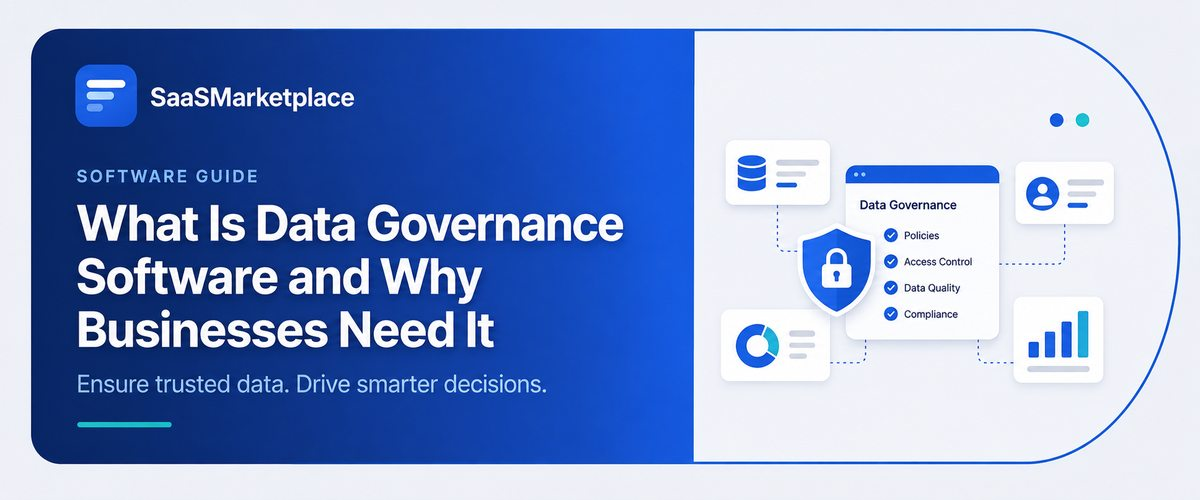
What Is Data Governance Software and Why Businesses Need It
-min.jpg)
Most companies don't have a data problem because they collected too little. The real issue is usually simpler and more annoying than that: nobody in the building can agree on which version of a customer record, a sales number, or an inventory count is the correct one. That disagreement costs real money, and closing it is the entire reason data governance software exists. Instead of the rules living in spreadsheets or in whatever the longest-tenured employee happens to remember- who owns which data, how it's defined, who's allowed to touch it all of that gets written down somewhere, enforced, and tracked automatically. For a mid-sized US company juggling a handful of disconnected systems, that move from informal habit to an actual structured process tends to be the thing separating a data team people trust from one that gets second-guessed by every department it's supposed to be serving.
 Looking for Data Governance Software? Check out SaaS Marketplace’s List of the Best Data Governance Software in the USA for your business.
Key Takeaways
- Data governance software gives company data clear owners, clear definitions, and clear access rules across every department and system that touches it.
- It works alongside data management software, data quality software, and data catalog software rather than replacing them.
- Regulatory pressure from state privacy laws to industry-specific compliance rules has pushed governance from an IT concern to an executive priority.
- Poor governance quietly damages business intelligence software output, since flawed source data produces flawed dashboards no matter how good the analytics tool is.
- Most failed governance programs collapse not from bad tools, but from unclear ownership and no enforcement.
What Data Governance Software Actually Does
Boil it down, and data governance software is answering three questions most companies genuinely can't answer with any confidence: who owns this data, what does it actually mean, and who's allowed to touch it. Sounds simple in theory, right up until you picture a company running a CRM, an ERP, a marketing platform, and a warehouse system, each one keeping its own private definition of something as basic as "active customer."
What governance platforms actually do is give an organization a way to standardize those definitions, put a name to who's accountable for each piece of data, and set real policies around access and usage. Instead of a data steward chasing down the same answer by email every few weeks, the rules live in one place other tools can point back to. When someone in finance and someone in sales run reports and end up with two different revenue numbers, that's usually the exact gap governance software is meant to fill.
It's worth separating this from data storage or processing. In most cases, the governance tool isn't holding the data at all; what it manages is the rules, the metadata, and the oversight sitting around data that actually lives somewhere else. That distinction trips people up early on, and it's part of why governance projects sometimes stall before they even really start.
Why This Became a Business Priority, Not Just an IT Task
Governance used to be a conversation that stayed almost entirely inside IT. A few different forces pulled it out of there and into the boardroom instead. State-level privacy laws, starting with California's CCPA and spreading from there, forced companies to actually know where personal data lives and who can get to it. There's no answering a data deletion request honestly if a company doesn't even know which systems hold that person's information. That one requirement alone turned governance from a nice-to-have into a legal necessity for anyone handling consumer data.
Industry regulation piled on more pressure from a different direction. Healthcare, financial services, and insurance companies were already operating under strict data-handling rules, but enforcement got sharper, and the cost of getting caught failing to comply climbed right along with it. Boards started asking pointed questions about data lineage and access controls that IT teams couldn't answer with a policy document alone anymore.
There's also a quieter driver: bad data is expensive in ways that are hard to see until someone measures it. Sales teams chase leads based on outdated segments. Marketing spends against inaccurate customer counts. Executives make decisions off dashboards built on data nobody verified. None of that shows up as a single dramatic incident it shows up as a slow erosion of trust in every report the company produces.
The Compliance and Trust Connection
Two things tend to happen once a company starts taking governance seriously. Compliance reporting speeds up, mostly because audit trails and data lineage are already sitting there documented instead of getting reconstructed in a scramble under deadline pressure. And trust in the data itself improves internally too teams stop quietly keeping their own private version of "the real numbers" and start pulling from one source everybody's actually agreed on.
How It Fits Into the Broader Data Software Stack
Governance software almost never operates by itself. It sits at the center of a whole set of tools, each one handling a different piece of the data lifecycle and understanding how those pieces connect matters a lot more than obsessing over which single product to buy.
Data Management Software
Data management software handles the broader work of storing, organizing, and moving data across systems. Governance software layers policy and oversight on top of that infrastructure it defines the rules, while data management software handles the mechanics of applying them at scale.
Data Quality Software
Governance sets the standard for what "correct" data looks like; data quality software does the ongoing work of checking data against that standard, flagging duplicates, and catching inconsistencies before they spread into reports. Without quality tools enforcing the rules governance defines, those rules stay theoretical.
Data Catalog Software
A searchable inventory of what data exists, where it lives, and what it actually means that's what data catalog software provides, and it's usually the very first tool a company deploys when kicking off a governance initiative, for the simple reason that nobody can govern data they can't even locate. A catalog turns "we think we have this somewhere" into an actual, browsable index.
Master Data Management Software
For companies juggling multiple systems with overlapping records, this is the tool that builds one single, authoritative version of core entities customers, products, vendors, whatever matters most. Governance sets the policy for how that master record should get created and maintained in the first place; the MDM tool then does the actual technical grunt work of reconciling all the conflicting entries into one trusted version.
Database Management Software
Underneath all of this sits database management software, the systems that actually store and retrieve the data day to day. Governance doesn't replace this layer it defines who can access which databases, under what conditions, and with what level of oversight.
Privacy Management Software
Privacy management software has turned into a close partner of governance platforms, largely thanks to all that regulatory pressure mentioned earlier. It handles consent tracking, manages data subject requests, and helps make sure personal information gets treated according to both internal policy and whatever external law applies. Quite a few organizations have started folding privacy management directly into governance rather than running it as its own separate compliance silo.
Business Intelligence Software
This is where governance's value finally becomes visible to people outside the data team. Any BI tool is only as trustworthy as whatever's feeding it and a genuinely well-governed data environment means the dashboards executives lean on for real decisions are built from consistent, verified figures instead of five conflicting exports pulled from five different systems.
Common Mistakes Companies Make
Governance gaps almost always get discovered the hard way a bad report lands in front of a client, or a compliance audit turns up a hole nobody saw coming. Treating governance as a one-time project. It's tempting to assume governance is something a company sets up once and moves on from, but data changes constantly in the real world, and the rules governing it need regular review to keep up. Skip that maintenance, and a governance program decays within a year or two, sometimes faster.
No clear data ownership. When nobody's explicitly on the hook for a given dataset, quality issues get noticed and then just sit there, unfixed. Smaller companies especially tend to assume whoever originally built the spreadsheet is still quietly tracking it, usually a bad bet.
Buying a governance platform without a catalog first. Governance software only works if teams actually know what data exists in the first place. Skip the cataloging step, and the governance tool ends up with a stack of policies and nothing concrete to apply them to.
Overcomplicating the rollout. Some companies try to govern every dataset across the entire organization on day one. That usually stalls out fast. Starting with the highest-impact data customer records, financial figures, anything compliance-relevant tends to produce results faster and builds the internal buy-in needed to expand later.
Ignoring the privacy angle until forced to. Companies often treat privacy management as its own separate initiative, only to discover during an audit just how much it overlaps with governance overlap that should've been planned for together from day one.
Building a Governance Program That Actually Sticks
There's no single blueprint for this; the right structure depends on company size, industry, and how scattered the existing data environment already is. Even so, a handful of habits show up again and again in programs that actually hold up over time. Build visibility first, with a data catalog, before layering formal policy on top of it. Knowing what exists has to come before deciding how to govern it.
Assign specific data owners for the major domains: customer data, financial data, product data, instead of leaving accountability vague and hoping it sorts itself out. It's usually only after the first few months that companies realize a named owner is what actually gets issues resolved, not just documented somewhere.
Connect governance policy to data quality software so the rules enforce themselves automatically, rather than depending on someone manually checking spreadsheets. Automated checks catch drift long before it ever makes it into a report someone presents to leadership.
Pull privacy requirements into the governance conversation from day one instead of bolting them on afterward. Given how much the two genuinely overlap, planning them together up front saves a lot of rework later. Finally, connect governance outcomes to something visible, like business intelligence software dashboards. When teams can actually see that governed data produces more reliable reports, the program starts earning support instead of getting written off as a compliance burden handed down from above.
When a Governance Platform Alone Isn't Enough
Buying the software doesn't automatically create a culture of good data habits: Governance tools enforce rules; somebody still has to write those rules, settle disputes between departments, and decide what "acceptable data quality" actually means for a particular use case.
Company size shapes the right approach quite a bit here: A large enterprise with a dedicated data governance team can run a full program across multiple platforms. A smaller company usually gets more value starting narrow, governing just the data that feeds customer-facing decisions or regulatory reporting rather than attempting an organization-wide rollout right out of the gate.
There's also a trade-off worth naming plainly: strict governance can slow down teams that are used to moving fast with loosely managed data. The right balance depends on how much risk a company is actually carrying. A healthcare company handling patient records needs tighter controls than a small e-commerce business tracking inventory counts, and the governance program should reflect that difference rather than applying the same rigor everywhere by default.
Conclusion
Data governance software was never going to fix bad data by itself; what it actually does is give a company the structure to define what good data looks like and hold it to that standard consistently. The organizations that get real value out of it usually aren't running the most sophisticated platform on the market; they're the ones who put clear ownership in place, started with whatever data mattered most, and treated governance as an ongoing discipline rather than a project they could finish and walk away from.
FAQ's
Data governance sets the rules, ownership, definitions, and access policy. Data management software handles the technical work of storing, organizing, and moving data according to those rules.
Yes, especially if they handle customer data subject to privacy regulations. A smaller company may not need an enterprise-scale platform, but basic governance practices around ownership and data quality still apply.
Business intelligence software pulls from underlying data sources, so if those sources are inconsistent or poorly defined, the resulting dashboards will be too. Governance improves the reliability of the data feeding those reports.
No. A data catalog inventories what data exists and where it lives. Governance uses that inventory to apply ownership, policy, and access rules on top of it.
Most companies see measurable improvement in data consistency and audit readiness within the first few months, though building full organizational buy-in typically takes longer, often a year or more for larger companies.