What Is Local Listing Management Software and Why It Matters for Local SEO?
-min.jpg)
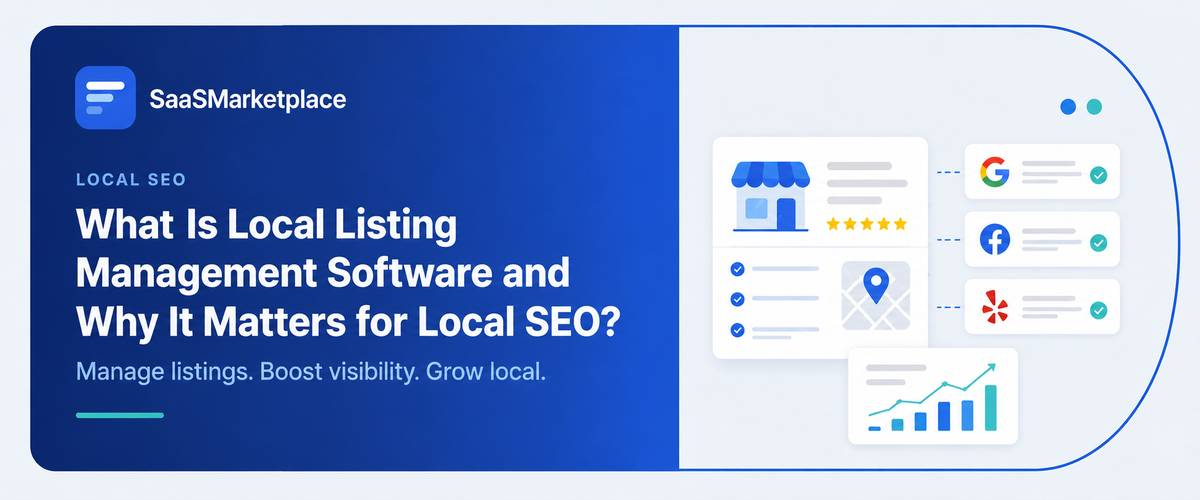
Local listing management software refers to a platform that disseminates, updates, and oversees a company's operating details on various online directories, map providers, and search engines. Location-based companies must ensure their digital presence is up to date and consistent on various sites such as Google My Business and Apple Maps. Discrepancies in operating information can create unnecessary hassle for customers.
 Looking for Local Listing Management Software? Check out SaaS Marketplace’s List of the Best Local Listing Management Software in the USA for your business.
This tool is very important for the local SEO process since search engines regard identical NAP listings on various online directories as one of their main trust signals. The closer the NAP listings of a particular business match, the higher the search engine confidence regarding the existence of the company and its presence at the specified location; thus, it will rank higher both in the local pack and map pack. Business listing management, hiding duplicate listings, and collecting reviews from all online directories in an automated fashion can help any business to earn high research, information, shopping, and purchasing traffic.
Key Takeaways
- Local Listing Management Software syncs business details across Google Business Profile, Yelp, Bing Places, and dozens of smaller directories.
- Inconsistent listings hurt local search rankings more than most business owners realize.
- It works best paired with broader Marketing Automation Software, not as a total replacement for it.
- AI Marketing Tools are starting to flag listing errors automatically, before they cost a business its ranking.
- Multi-location businesses need this far more than single-location ones; the math on manual updates just doesn't hold up.
Why Listings Break Down in the First Place
A business rarely sets out to have messy listings. It happens gradually a phone number changes, someone forgets to update three of the eleven directories the business is listed on, and a customer calls the old number six months later wondering why nobody answers. Multiply that by every location a company operates, and the mess compounds fast.
Google, Bing, and the directories that feed into them cross-reference these details constantly. When they don't match, the algorithm doesn't necessarily assume malice, but it does get less confident about which version is accurate, and that uncertainty shows up as a lower local ranking. Nobody flags this to the business owner directly. It just quietly costs them visibility.
How Local Listing Management Software Actually Works
Most platforms in this category work off one core idea: a business enters its correct information once, and the software pushes that same information out to dozens, sometimes hundreds, of directories automatically. Change a phone number centrally, and it updates everywhere instead of requiring someone to log into Yelp, then Google Business Profile, then Apple Maps, one at a time.
Better platforms go further and monitor for changes that weren't made by the business at all a customer edit suggestion on Google, for instance, or a scraped listing on a smaller directory that picked up an old address. Catching that early matters. A stale listing sitting uncorrected for months does real damage to how confidently search engines rank that location.
Local Listing Management Software vs. Marketing Automation Software
|
Feature / Aspect |
Dedicated Local Listing Management Software |
Marketing Automation Software & All-in-One Suites |
|
Primary Objective |
Managing location accuracy, directory synchronization, and local SEO presence. |
Managing broad marketing workflows, lead generation, customer nurturing, and multi-channel campaigns. |
|
Core Capabilities |
Multi-directory NAP synchronization, duplicate listing suppression, review aggregation, and local category management. |
Email sequences, lead scoring, landing page creation, campaign triggers, and social media scheduling. |
|
Directory Coverage & Sync Speed |
Deep, real-time API integrations with dozens of major and niche local directories; rapid detection of unauthorized edits. |
Basic listing sync limited to major search engines (e.g., Google Business Profile); bundled as an auxiliary feature. |
|
Data & Insights Focus |
Local search rank tracking, profile view analytics, driving direction requests, and local phone call tracking. |
Lead conversion rates, email open/click-through rates, campaign ROI, and customer journey tracking. |
|
Best Suited For |
Regional chains, multi-location franchises, and local SEO agencies managing complex physical footprints. |
Small businesses with single locations, online-only brands, or marketing teams prioritizing general campaign automation. |
Where AI Marketing Tools Fit In
This is one of the faster-moving parts of the category. A few years ago, listing management was mostly reactive; someone noticed an error and fixed it. Now, AI Marketing Tools built into these platforms are starting to catch inconsistencies before a human would ever spot them, scanning for mismatched hours, duplicate listings, or suspicious edits across the web on a rolling basis.
That doesn't mean the tools run unsupervised. A flagged discrepancy still usually needs a person to confirm which version is correct, especially when two directories disagree and neither one is obviously wrong. What's changed is the speed of detection, not the need for judgment.
Fitting Listings Into the Bigger Marketing Stack
A business rarely runs local listings in isolation. Most are also tracking performance through Marketing Analytics Software, trying to figure out which channels are actually driving revenue through Marketing Attribution Software, and mapping out campaigns months ahead using Marketing Planning Software. Listings feed into all three, even if it's not obvious at first glance.
Marketing Analytics Software, for instance, can show a spike in local search traffic right after a listing correction goes live proof that accuracy has a measurable effect, not just a theoretical one. Marketing Attribution Software takes that a step further, connecting a corrected listing to actual foot traffic or phone calls, which is often the number that finally gets a skeptical stakeholder on board. And Marketing Planning Software is where a business decides, ahead of time, when a listing audit needs to happen relative to a bigger seasonal push say, before a holiday sales period, when local search volume spikes and a wrong holiday hours listing costs real revenue.
None of this requires one platform to do everything. Most U.S. businesses run listing management alongside these other tools rather than expecting a single dashboard to cover it all, and that's usually the more realistic setup anyway.
Local Listings and Mobile Marketing Software
Here's a connection that surprises people the first time it's pointed out. A huge share of "near me" searches happen on a phone, often from someone standing a few blocks away deciding where to walk. That's squarely Mobile Marketing Software territory: location-based push notifications, geofenced offers, that sort of thing.
A wrong address in a business's listing doesn't just confuse a desktop searcher scrolling through results later. It sends a mobile user, phone in hand, to the wrong building right now. Coordinating listing accuracy with whatever a Mobile Marketing Software platform is doing for local push campaigns closes a gap a lot of businesses don't think to check until a customer complains.
Social Media Marketing Software and Local Visibility
Treating Listing Management as a One-Time Setup:
Setting up listings at launch and never revisiting them leaves profiles vulnerable. Phone numbers change, locations close, or unverified customer-submitted edits get accepted on platforms like Google without internal review.
Manual Operational Overhead:
Having internal teams manually copy updates across dozens of directory sites wastes valuable labor. Routine NAP updates across multiple channels are precisely what listing automation software is designed to handle efficiently.
Misallocating Effort Across Directory Tiers:
Failing to prioritize high-impact platforms creates misaligned effort. While broad directory consistency matters, core platforms- primarily Google Business Profile, Apple Maps, and Yelp- drive the vast majority of local search visibility and must be prioritized before secondary directories.
Overlooking Micro-Inconsistencies:
Ignoring minor details like dropped suite numbers, missing holiday hours, or subtle category mismatches (e.g., listing a business as a "Coffee Shop" instead of a "Bakery") quietly suppresses local rankings across multiple locations over time.
When You Might Not Need Dedicated Listing Software Yet
A single-location business with one address that hasn't changed in years, and only a handful of directories to manage, can often keep things accurate manually without much trouble. The math changes once a company opens a second location, or a third at that point, manual updates start eating hours every month for something software could handle in minutes.
Choosing the Right Tool
Location Volume & Scaling Limitations:
Pricing for platforms generally scales according to overall number of locations and breadth of directory distribution. Prospective solutions designed for one-location businesses or small franchise models tend to be prohibitively expensive or administratively unmanageable as locations number in dozens or hundreds.
Ecosystem Integration:
Based on your current tech stack, evaluate if a dedicated platform is required or your current system offers sufficient coverage:
- Marketing Planning Tool: By integrating listing management into the central planning tool, scheduling directory audits, seasonality adjustments, and location launches is integrated into the campaign calendar rather than the day-to-day.
- Marketing Attribution Software: Integrating data from listing performance into attribution tools enables teams to tie these high-intent local activities (such as clicks-to-call or directions) directly to revenue.
- All-in-One Suites: Analyzing current marketing centers can identify bundled listing services so there's no requirement for one use software.
Conclusion
Local Listing Management Software solves a narrow but costly problem: keeping a business's core details consistent everywhere a customer might look for them. It works alongside a business's broader automation and analytics tools rather than replacing any of it. Whether a business needs a dedicated tool or can manage listings manually depends mostly on how many locations it runs and how much that inconsistency is already costing it and that's usually the question worth answering first.
FAQ's
No. An All In One Marketing Platform typically bundles email, social, and analytics tools together, while listing software focuses narrowly on keeping business information consistent across directories.
Not necessarily. Basic syncing across directories works without AI, though AI-driven error detection catches problems faster than manual checks would.
Yes, generally. A spike in local search traffic or profile views after a correction is usually visible in standard analytics dashboards.
Usually not directly. It handles content and posting, but the contact details on a social profile still need separate attention.
Monthly is reasonable for most businesses; multi-location companies often benefit from continuous monitoring instead of periodic manual checks.