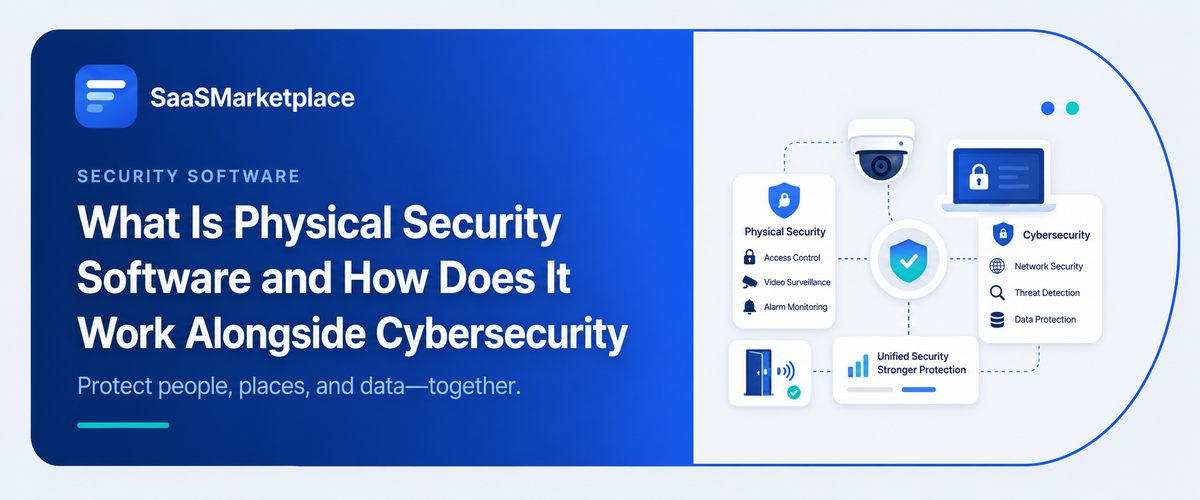
What Is Physical Security Software and How Does It Work Alongside Cybersecurity
-min.jpg)
When a badge reader grants access to a server room to someone not authorized, it does not represent a cybersecurity failure in the usual way, yet it can cause such a problem just as readily as a phishing message might. This specific intersection explains precisely why tools for physical security and those for cybersecurity have begun merging instead of functioning as separate units.
 Looking for Cybersecurity Software? Check out SaaS Marketplace’s List of the Best Cybersecurity Software in the USA for your business.
Software handles physical security controls devices, determining entry rights into structures, deciding which doors open for specific badges, and capturing video footage when anomalies appear. Standing alone, it safeguards tangible areas. Linked with the larger security environment, it transforms into a component of a significantly expanded view where a card tap occurring at 2 a.m. alongside a questionable sign-in from the identical user account within moments reveals a narrative each system could miss individually.
Key Takeaways
- Physical security software manages access control, video surveillance, and alarm systems that protect physical spaces and assets.
- Convergence with cybersecurity software lets organizations correlate physical events with digital ones, closing gaps neither system catches alone.
- Access control software and video surveillance software form the operational core of most physical security deployments.
- Visitor management software and identity and access management software increasingly share data to keep physical and digital permissions aligned.
- Security Information and Event Management (SIEM) software is where physical and cyber signals often get correlated into a single, unified alert.
What Physical Security Software Actually Does
Physical security software handles the systems governing and watching entry points into physical sites, office blocks, server rooms, storage facilities, and locked zones inside those places. Fundamentally, this spans three primary roles: access regulation, determining who may go inside a room and at what time; camera monitoring, capturing and often examining behavior inside watched spaces; and alert handling, spotting and reacting to illegal entry or strange states.
Current installations appear quite distinct compared to the isolated key-card and camera arrangements firms employed ten years back. Access terminals currently record each entry try electronically, surveillance tools employ analysis to highlight odd conduct instead of merely storing clips for subsequent inspection, and detection units link to oversight stations capable of notifying security workers instantly instead of depending on a person spotting a blinking lamp on a board.
What makes this software distinct from a simple lock-and-key approach is the data it generates. Every badge swipe, every camera alert, every door left open too long produces a record that can be reviewed and audited, and this is the part that matters most for the cybersecurity connection, correlated with other events happening across the organization at the same time.
Why Physical and Cyber Security Are Converging
For most of their history, physical security and cybersecurity operated as entirely separate departments with separate budgets, separate staff, and separate reporting lines. That separation made sense when the two threats looked genuinely different: someone breaking a window versus someone exploiting a software vulnerability from across the world.
That distinction has become harder to maintain. Most organizations suppose that risks from the physical world and those from digital realms remain separate, yet when reality sets in, stealing a staff ID card might grant immediate internet connection should that same card unlock the door to the main computer closet. A criminal obtaining hands-on entry to a workspace may connect cables to a forgotten socket, skipping outer security layers which usually demand significant work to penetrate from afar.
Insider risk sits at the center of this overlap. Teams usually discover this connection after an incident a former employee's badge still working weeks after termination, or a contractor's building access outliving their system credentials by months. Smaller companies often overlook this gap entirely, treating badge deactivation and account deactivation as two separate offboarding checklists managed by two different teams that rarely communicate.
The Data Center Example
One issue that often appears during security assessments involves data centers specifically. A company might have excellent network segmentation and strong endpoint protection, but if physical access to the server room isn't tightly controlled and logged, all of that digital protection sits behind a door that a determined person could talk their way through. The strongest cybersecurity controls in the world don't help much if someone can simply walk up to the hardware.
How It Fits Into the Broader Security Stack
Physical security software increasingly operates as one connected piece within a company's full security environment, rather than an isolated system managed independently.
Access Control Software
Access control software forms the backbone of most physical security deployments, managing badge credentials, door schedules, and entry permissions across a facility. When this system shares data with digital identity platforms, an employee's physical access and system access can be provisioned and revoked together, closing the gap that causes so many offboarding failures.
Video Surveillance Software
Video surveillance software has moved well beyond passive recording. Modern platforms use analytics to detect specific events someone lingering near a restricted door, an unusual after-hours presence and can trigger alerts automatically rather than requiring someone to review hours of footage after the fact.
Visitor Management Software
Visitor management software tracks who enters a facility as a guest, contractor, or vendor, logging their presence and often restricting their access to specific areas and time windows. This matters for cybersecurity too, since visitors with building access sometimes also receive temporary network credentials, and keeping both systems synchronized reduces the risk of forgotten, lingering access.
Identity and Access Management Software
This is often where physical and digital security genuinely connect. Identity and access management software governs digital account permissions, and when integrated with physical access control, a single identity record can govern both what an employee can log into and which doors they can open. Provisioning and deprovisioning happen together instead of through two disconnected processes.
Cybersecurity Software
Physical security software functions as one component within a company's broader cybersecurity software environment when the two are properly integrated. Neither replaces the other physical tools protect spaces and hardware, while cybersecurity tools protect networks, applications, and data. The value comes from how they inform each other.
Security Information and Event Management (SIEM) Software
Security Information and Event Management (SIEM) software is frequently where physical and digital signals actually get correlated. A badge swipe combined with a network login from the same person, occurring in a pattern that doesn't match their normal behavior, is far more meaningful when a SIEM platform can see both events together rather than each system flagging them in isolation.
Common Mistakes Companies Make
Convergence between physical and cybersecurity sounds straightforward in theory, but most organizations run into the same handful of obstacles.
- Managing offboarding as two separate processes: This is consistently the most common gap. Many businesses assume HR and IT handle badge and account deactivation in sync, but in practice, physical access often outlives digital access, or the reverse, simply because the two systems were never connected in the first place.
- Treating physical and cyber teams as unrelated departments: When security staff managing cameras and badges never talk to the team managing firewalls and endpoints, incidents that touch both domains get investigated in silos, and connections between the two get missed entirely.
- Underinvesting in video analytics: Smaller companies often overlook the value of analytics-driven surveillance, sticking with basic recording systems that require someone to manually review footage after an incident rather than catching unusual activity as it happens.
- Ignoring visitor and contractor access: After the first few months of a converged security review, many organizations discover that temporary visitor credentials, both physical and digital, were never properly revoked and had been active far longer than intended.
- Assuming physical security is "solved" once cameras and badges are installed: Physical security software, like any security tool, requires ongoing configuration review and monitoring. A system installed correctly five years ago may no longer reflect current staffing, facility layout, or access needs.
Building a Converged Security Program
There's no single correct structure, since the right approach depends on company size, facility complexity, and how sensitive the physical and digital assets actually are. A few practices consistently show up in programs that work well.Start by connecting identity systems so that a single employee record governs both physical and digital access. This single change closes the most common gap companies discover during security reviews: mismatched offboarding. Bring physical and cybersecurity teams into the same conversations, even if they remain organizationally separate. Shared visibility into incidents, even informally, catches connections that isolated teams miss.
Audit visitor and contractor access on a regular schedule, checking that both physical and digital permissions expire when they're supposed to, rather than assuming the initial configuration holds indefinitely.Treat data centers and other high-sensitivity physical spaces as a shared priority between physical and cyber teams, since the strongest network protections don't help if the underlying hardware isn't physically secured.
When Physical and Cyber Systems Should Stay Separate
Full convergence isn't the right fit for every organization. A small business with a single office and straightforward IT needs may find that basic access control and standard cybersecurity tools cover its risk adequately without the added complexity of a fully integrated platform.
The calculation shifts for organizations with sensitive physical assets data centers, manufacturing facilities with valuable equipment, healthcare facilities handling regulated information where the consequences of a physical breach extend directly into digital risk. At that scale, the coordination effort required for convergence tends to be worth the investment.
There's a trade-off worth naming honestly: integrating physical and cyber systems takes real coordination between teams that may not be used to working together, and rushing that integration without proper planning can create new gaps rather than closing existing ones. The goal isn't integration for its own sake it's connecting the specific systems where physical and digital risk genuinely overlap.
Conclusion
Physical security software and cybersecurity software address different threats, but the line between them keeps getting thinner as badges, cameras, and network credentials increasingly touch the same underlying risk. The organizations handling this well aren't necessarily running the most advanced platform on either side they're the ones who connected identity systems, got physical and cyber teams talking to each other, and stopped treating offboarding as two disconnected checklists.
FAQ's
Physical security software manages access control, surveillance, and alarms for physical spaces. Cybersecurity software protects networks, applications, and data. They increasingly connect, but they address different types of risk.
Physical access to a server room or unattended network port can bypass digital security controls entirely. Coordinating physical and digital access reduces this risk significantly.
Not always. Smaller businesses with limited physical assets may be fine with basic, separate systems. Integration becomes more valuable as facility complexity and asset sensitivity increase.
Security Information and Event Management software can correlate physical events, like badge swipes, with digital events, like network logins, helping security teams spot patterns neither system would catch on its own.
Unmanaged visitor and contractor access, both physical and digital, is a common source of lingering, forgotten permissions. Visitor management software helps ensure that access expires when it should.