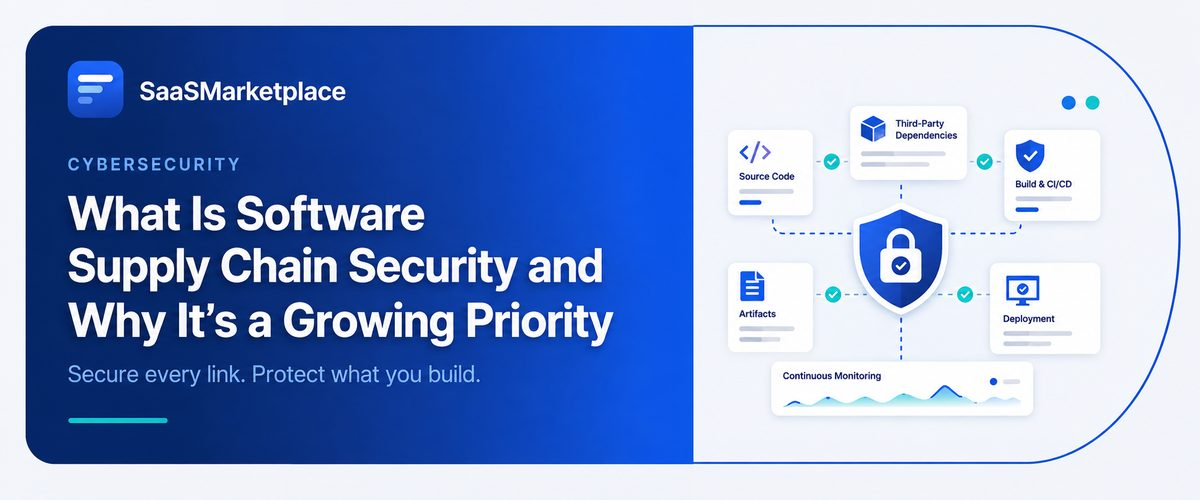
What Is Software Supply Chain Security and Why It's a Growing Priority
-min.jpg)
Software supply chain security is about protecting everything that goes into building and shipping software: every component, every tool, every step along the way. Barely anything ships from scratch these days. An application leans on open-source packages, third-party code, build pipelines, cloud services a whole stack of pieces nobody in-house wrote. Let one vulnerability or malicious injection slip into an upstream dependency, and it can take down thousands of downstream systems before anyone notices.
 Looking for Cybersecurity Software? Check out SaaS Marketplace’s List of the Best Cybersecurity Software in the USA for your business.
This stopped being purely an engineering concern once boardrooms started paying attention. Attackers have figured out it's easier to go after the supply chain directly than to fight through a company's fortified outer defenses. A handful of high-profile breaches have made the case for them: compromise one trusted open-source library, or one software vendor, and you get silent, widespread access to critical data across every customer downstream. Add growing regulatory pressure and increasingly tangled code dependencies, and securing the full lifecycle stops being optional. It becomes a matter of business survival.
Key Takeaways
- Software supply chain security covers every stage of how code gets built, packaged, and delivered, not just the finished application sitting in front of a user.
- Incidents involving compromised build pipelines and open-source dependencies have pushed cybersecurity software budgets toward supply chain visibility.
- Application security software, tools for tracking known weaknesses, and SIEM software increasingly work as a connected set rather than sitting apart as isolated point solutions.
- Protection now has to extend to wherever code actually runs, not just where it's written, which is the job cloud security software and endpoint security software share.
- Most breaches come down to a short list of avoidable gaps: third-party code nobody verified, weak access controls, patches that went out too slowly.
What This Actually Covers
People hear "supply chain" and picture trucks, ports, warehouses. Software's version looks nothing like that on the surface, but the logic holds it's built from open-source libraries, third-party APIs, container images, build tools, and whatever a company's own developers wrote.
The job of supply chain security is making sure none of those pieces smuggle in risk before the finished product reaches a customer. That covers the source code, the systems that build and test it, the pipelines pushing it into production, and every vendor supplying a component along the way. A weak point anywhere in that chain threatens everything downstream of it which is exactly why attackers now go after the chain itself instead of attacking the finished product head-on.
Traditional application testing usually happens near the end of a development cycle, and that's a fundamentally different mindset from this. Supply chain security starts much earlier and never really stops it tracks the code from the first commit, through deployment, and into whatever maintenance comes after.
Why It Became a Boardroom Issue
For years, this stayed a quiet concern buried inside engineering teams. Then a string of incidents made it painfully clear how much damage a single compromised update could do to an entire industry at once.
Ask any security professional for the go-to example and SolarWinds comes up first. The attackers didn't bother breaking into thousands of individual companies why would they, when compromising one vendor's build process let the trusted update mechanism do all that work for them. Around the same time, Log4j drove home a related point: a widely used open-source component, buried several layers deep inside countless applications, left organizations exposed to a vulnerability plenty of them didn't even know they had.
Federal attention followed not long after. Executive Order 14028 pushed US government agencies and their vendors toward stronger software integrity practices, including new requirements around a Software Bill of Materials (SBOM). That single policy shift rippled well beyond government contractors, since any company selling into government or regulated industries suddenly had to prove its own supply chain held up.
What used to be an engineering concern is now something CFOs and general counsel ask about directly. Insurance underwriters factor supply chain risk into cyber policies. Procurement teams request documentation before signing vendor contracts. None of that happened because supply chain risk suddenly got more technical it happened because the financial and reputational fallout got too big to ignore.
What the Worst Incidents Have in Common
A few patterns keep repeating across the major supply chain incidents:
- Attackers go after a trusted vendor instead of hitting the end target directly.
- The malicious code rides in inside an update that's otherwise legitimate and properly signed.
- The affected component sits several dependencies deep, so nobody notices until real damage has already been done.
- Detection tends to arrive weeks or months after the initial compromise rarely within days.
How It Connects to the Broader Cybersecurity Software Stack
Supply chain security rarely stands alone. In practice, it's stitched together from several categories of tools that each cover a different piece of the problem.
Application Security Software
This is where most supply chain protection starts. Application security software is where most of this protection starts, scanning source code, dependencies, and containers for known vulnerabilities before any of it reaches production. Static analysis catches problems in code a company's own developers wrote. Software composition analysis handles the other half, digging into whatever open-source packages that code leans on. Skip this step, and it's common to find out about a vulnerable dependency only after somebody's already exploited it.
Keeping Track of Known Weaknesses
Getting code live isn't the finish line. Ongoing vulnerability tracking keeps tabs on known weaknesses across an organization's entire software inventory, ranks them by severity and exposure, and helps teams figure out what actually needs patching first. Skip that layer, and security teams end up reacting to whatever's making headlines instead of working off a real, risk-ranked list.
Network Security Software
Supply chain attacks don't stop once they've landed in the code they move laterally the moment they're inside a network. Network security software limits how far an intrusion can spread, segmenting systems, watching traffic patterns, and blocking suspicious connections between build environments and production. A compromised CI/CD pipeline does a lot less damage if it can't freely talk to everything else on the network.
Cloud Security Software
Cloud environments are where most modern software actually gets built, tested, and deployed now so naturally, a lot of supply chain risk has followed it there. Cloud security software watches for misconfigurations, enforces identity and access policies, and flags unusual activity inside the pipelines that build and ship code. A cloud storage bucket holding build artifacts, left open by mistake, is exactly the kind of supply chain vulnerability this layer exists to catch.
Endpoint Security Software
Developer laptops and build servers count as part of the supply chain too, whether or not a team thinks of them that way. Protecting those machines from malware and unauthorized access matters because a single compromised workstation can become a direct route into source code repositories and build systems.
Pulling It All Together with SIEM
Everything mentioned so far generates its own signals, logs, alerts, and anomalies. Pulling all of that into a SIEM platform is what lets security teams catch patterns that any one tool, working alone, would miss. A SIEM won't stop a supply chain attack on its own, but it's frequently what turns a handful of scattered warning signs into an actual investigation before the damage spreads any further.
Where Companies Usually Trip Up
Teams usually find the gaps in their supply chain security after something's already gone wrong, not before. A few mistakes come up again and again. Trusting open-source components without verification. A lot of businesses assume a widely used library must be safe simply because it's popular, but popularity says nothing about how well-maintained or secure a package actually is. Some of the most damaging vulnerabilities in recent memory came out of components that nearly everyone was already using.
Treating SBOMs as a compliance checkbox. A Software Bill of Materials only does any good if someone actually reads it and acts on what it turns up. Generating one purely to satisfy a contract requirement, then filing it away and forgetting about it, defeats the whole point of having one. Overlooking build and CI/CD environments. Security teams tend to pour attention into production systems while giving the pipelines that build and deploy code far less scrutiny. That's precisely where several major attacks have started, since a compromised build server can slip malicious code in well before any scanner ever lays eyes on the final product.
Slow patch cycles. Vulnerability management software can flag a critical issue within hours of it surfacing. None of that speed matters if the organization's actual process for deploying a fix takes weeks. Smaller companies especially tend to miss this treating "we found the problem" as functionally the same thing as "we fixed it."
When Off-the-Shelf Tools Aren't Enough
Commercial cybersecurity software covers a lot of ground, but it was never going to be a complete solution on its own. Tools flag risk; they don't eliminate it. Somebody still needs to understand which findings actually matter for their specific environment, and somebody needs the authority to slow down a release when something looks off.
Company size changes this calculation quite a bit. A large enterprise with a dedicated security engineering team can afford to layer multiple tools and staff people to interpret all that output. A smaller company usually can't, and often does better leaning on managed services or a narrower set of tools that cover the highest-risk areas first, typically dependency scanning and access control, rather than trying to stand up everything at once.
There's also a real trade-off between coverage and noise. Bolt on more tools without a plan for triaging what they produce, and alert fatigue sets in fast; the warnings that actually matter get buried under a pile of low-priority ones. More often than not, fully implementing a smaller set of tools beats partially deploying a large one.
Conclusion
Software supply chain security was never really about buying one more product and declaring the problem solved. It's about knowing what's actually inside the software a company builds and ships, watching those components continuously, and having a process that turns a warning into a fix before it turns into an incident. The companies handling this well aren't necessarily spending the most; they're the ones who treated visibility and ownership as the starting point, not an afterthought.
FAQ's
Application security software focuses on scanning and testing the code you write and use. Supply chain security is broader it covers the entire process of building, packaging, and delivering that code, including third-party components and the systems used to ship it.
Yes. Attackers often target smaller vendors specifically because they have weaker defenses but still connect to larger customers or supply widely used components. Size doesn't remove the risk.
A Software Bill of Materials lists every component inside an application. It's increasingly required for companies selling to US government agencies, following Executive Order 14028, and many private-sector customers now request one as part of vendor due diligence.
Not SIEM software correlates data from other security tools to help teams detect suspicious activity faster, but it works best alongside application security, vulnerability management, and endpoint protection tools rather than as a standalone defense.
Most mature programs scan on every code commit or pull request, not just before a release. Catching a vulnerable dependency early in development is significantly cheaper than finding it after deployment.