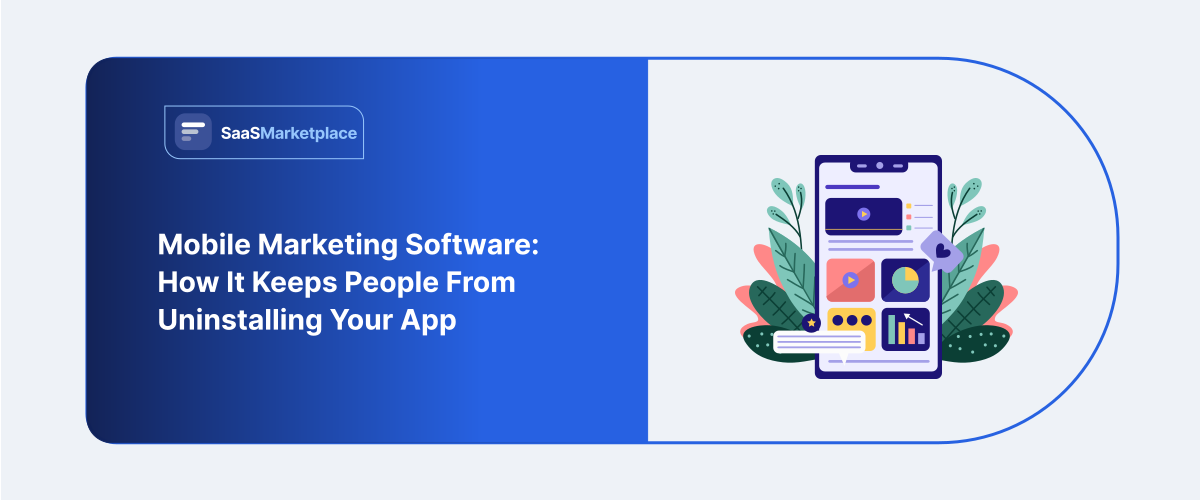
Mobile Marketing Software: How It Keeps People From Uninstalling Your App
-min.jpg)
Someone downloads software, runs it once, gets thrilled for around ninety seconds, then never opens it again. Multiply that by thousands of downloads, and a company has an amazing installation count but almost no one really using the product a month later. The program itself might be fine. Usually absent is anything reminding the person why they first installed it after the download. This is exactly the gap mobile marketing software is built to close.
 Looking for Mobile Marketing Software? Check out SaaSmarketplace’s List of the Best Mobile Marketing Software in USA for Your Business.
Mobile marketing software isn't really about getting more downloads. Many programs have excellent download statistics but far worse retention figures. It's about getting to individuals on the device they actually check frequently, via the correct channel, at the proper moment; therefore, an install transforms into a person who truly remains. Since it is simple to count, acquisition captures all the focus. Retention is less obvious, more difficult to follow, and often where the actual value is left on the table.
What Is Mobile Marketing Software?
Instead of depending just on a website or email marketing, mobile marketing software is a system designed to reach and engage people particularly through mobile channels, push notifications, SMS messaging, in-app messaging, and occasionally location-based marketing. It is based on the reality that a phone acts differently than an inbox. Though users check it all the time, they are also fast to silence, ignore, or remove anything that seems intrusive.
Fundamentally, this kind of software does three things. Through push notifications or SMS messaging, it enables a company to contact consumers personally on their device. It keeps an eye on in-app activity so that messages can be started depending on what someone really does within the app instead of being delivered on a set schedule to everybody. And it records what follows, whether a message really brought someone back or was just swiped away.
This is a different job from general mobile app marketing, which covers everything from app store listings to paid acquisition. Software in this category focuses specifically on the part after someone already has the app installed, keeping them engaged instead of just getting them in the door. Mobile app marketing gets someone to install; mobile marketing software gives them a reason to stay.
Do you know?
Most of the app users who plan to drop an app do so within the first few days following installation. Since a well-timed communication during that first window usually counts much more than anything delivered months later, this makes the first week after download among the most high-leverage times for mobile marketing software to actually work.
Signs Your App Has an Engagement Problem
Not every app needs a dedicated platform right away. A small, early-stage app can often get by without one for a while. But certain signs usually mean mobile marketing software is overdue:
- Download numbers look healthy but active user counts drop off sharply within the first week
- Push notifications go out on a fixed schedule regardless of whether anyone's actually opening them
- There's no way to message someone based on what they did or didn't do inside the app
- SMS marketing and in-app messaging exist as separate, disconnected efforts rather than one coordinated strategy
- Nobody can say which messages are actually bringing users back versus getting ignored or muted
If a couple of these sound familiar, it's rarely a product problem. It usually means sales engagement is being left entirely to chance instead of something the business is actively managing.
How Mobile Marketing Software Actually Works
Tracking user activity within the app comes first. Mobile marketing software monitors what individuals really do, what they open, what they skip, and where they drop off, rather than treating every user equally. Relying on clear marketing analytics allows messaging to answer actual behavior instead of relying on a blanket mobile marketing campaign given simultaneously. A single, well-targeted mobile marketing campaign based on real usage data often performs better than a dozen general messages sent on a set schedule.
From there, push notifications get triggered based on that behavior. Someone who added an item to a cart but didn't check out gets a different nudge than someone who hasn't opened the app in two weeks. This kind of targeted app engagement tends to perform far better than a blanket notification blasted to the entire user base at the same time, and steady app engagement is really the whole point of running any of this in the first place.
For really important messages, SMS marketing typically runs alongside push notifications since a text is more likely to be seen even when a push notification is buried beneath a dozen others. App messaging serves a distinct purpose, appearing as a user is already using the app to draw attention to a feature they haven't explored or gently guide them towards an in-session action.
For companies where physical closeness actually matters, location-based marketing adds another layer by triggering a message when someone is close to a pertinent store or location instead of delivering something unrelated to their actual location.
Finally, everything rolls into reporting. Which messages get opened, which get ignored, and how user retention shifts after a campaign all get tracked through marketing attribution so a team can actually see whether their mobile marketing efforts are working or just adding noise.
Core Features Worth Looking For
A few characteristics of mobile marketing software usually count more than the others:
- Behavior-triggered push notifications instead of fixed, scheduled blasts
- For time-sensitive or high-priority communications, SMS marketing
- In-app messages that react in real time to a user's current activity
- For companies whose physical closeness counts, location-based marketing
- Segmentation based on actual app behavior, not just basic demographics
- Analytics tracking user retention and message performance over time
- A/B testing to compare message timing, content, and channel
Though not every program requires all seven right now, as the user base expands, every one becomes more important for keeping people truly involved.
How Mobile Marketing Software Changes the Day-to-Day Work
The honest change is less about sending more messages and more about sending significantly fewer, more timely ones. Behavior-based targeting means that the app only contacts a user when it is really pertinent to them, rather than sending them the same push notice. This alone tends to cut down on the kind of notification alert fatigue that pushes people to uninstall.
Teams that see actual value from mobile marketing software usually prioritize retention as much as acquisition, if not even more so. It's only half the battle to persuade someone to download an app. A mobile marketing platform takes care of the continuous aspect, providing users with a reason to keep opening it without requiring a person to manually determine who receives which message every single day.
Common Mistakes When Using Mobile Marketing Software
Even solid mobile marketing software can backfire if it's used carelessly. A number of errors recur time and time again:
- Sending push notifications too often, which causes people to delete or silence instead of interact
- Thinking of in-app messaging and SMS marketing as distinct channels instead of one coherent plan.
- Ignoring behavior data and sending the same generic message to every single user
- Skipping the first-week window, when new users are most likely to disengage or leave entirely
- Choosing software based on push notification volume alone rather than actual retention impact

Pro-tip
Before scaling up notification volume to boost engagement, check whether your uninstall rate is climbing alongside it. A short-term bump in opens isn't worth it if it's quietly driving more people to delete the app altogether.
How to Choose the Right Mobile Marketing Software for Your Business
Begin by identifying which communication channels your user base genuinely engages with. A system relying heavily on pushes offers little benefit if your target group silences alerts quickly yet consistently reads text messages. Determine beforehand if push notifications, SMS campaigns, internal app comms, or geo-targeted ads hold greater significance for your particular software before evaluating alternatives, because the optimal combination varies between a retail application and one designed for scheduling services.
From there, narrow down several mobile marketing tool choices and verify how effectively each handles behavior-driven triggers instead of merely timed broadcasts. Should wider campaign alignment be relevant as well, examine its integration with current marketing automation systems, because the most potent mobile initiatives typically draw upon identical consumer information utilized in other areas.
Volume counts, yet the crux lies in determining if the system truly bolsters user stickiness instead of merely inflating notification frequency. A mobile advertising solution dispatching greater alerts does not inherently constitute a superior option.
Conclusion
A strong download number rarely tells the whole story. What truly counts is if users remain engaged following that initial opening, which largely depends on someone contacting them at the correct time with content deserving their focus. Mobile marketing tools bridge this divide by converting standard alerts into communications that genuinely address user activity, allowing an installation a genuine opportunity to evolve into a routine rather than a neglected symbol.
FAQ's
It allows a company to connect with and interact with mobile application users via push alerts, SMS campaigns, and internal chat functions.
Yes, even tiny applications gain advantages from using behavior-driven messaging rather than timing identical alerts for all users.
Yes, even diminutive applications gain advantages through behavior-driven communication rather than broadcasting identical alerts to all users at fixed times.
Yes, relevant, well-timed messages with timing attached help lower the annoyance from alerts, which frequently causes people to delete applications.
It's mainly useful for businesses with a physical location, so purely digital apps typically rely more on behavior triggers.