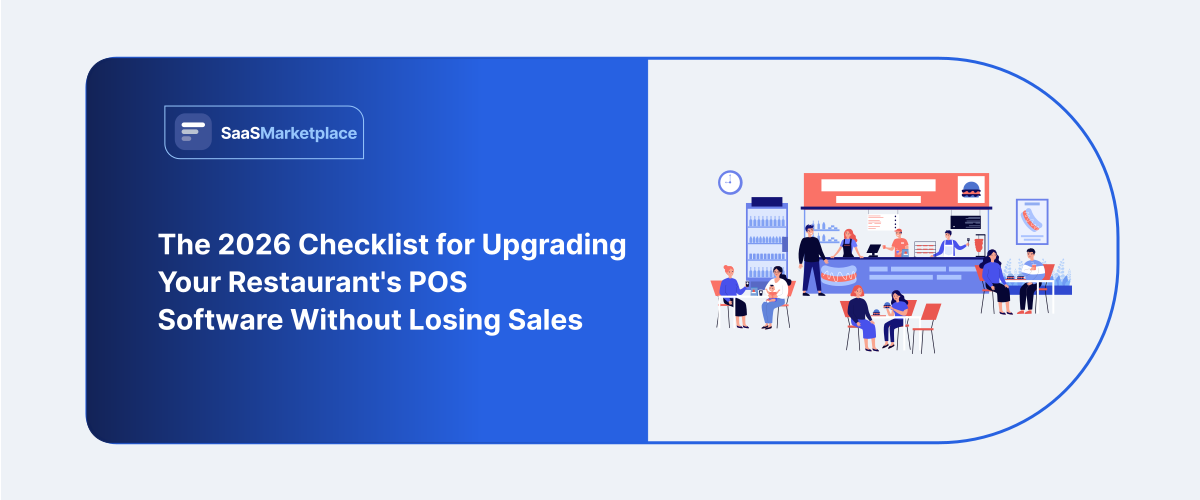
The 2026 Checklist for Upgrading Your Restaurant's POS Software Without Losing Sales
-min.jpg)
For a restaurant owner, upgrading the POS system is one of the most challenging operational obstacles, particularly considering the low-profit margins and high-volume sales of the United States market. There is a lot of anxiety associated with the prospect of mismanaged orders, malfunctioning systems during busy evening hours, or even losing access to the loyalty data obtained over years of diligent work. Nevertheless, sticking to older operating systems in 2026 is likely to result in expensive losses associated with failure to introduce the required new automations that can save time and increase profits. This comprehensive guide will help you eliminate downtimes and, therefore, maximize your chances to enjoy all the advantages and benefits of efficient POS systems.
Why Should You Upgrade Your Restaurant POS Software in 2026?
As of 2026, operating a restaurant in the United States is becoming a war of profit margins due to incredibly high labor costs, various state-level changes in laws relating to tips, and high levels of inflation in the food sector. If your waiters are still going from site to site on foot towards a central terminal, or your host is manually writing down orders into your old computing machine, it means you are losing money during every shift. Implementing a new point of sale system in 2026 is not about keeping up with the latest technological innovations, but about staying afloat in business. It involves using new cloud-based point of sale systems with advanced tablet features that help decrease the time it takes to serve diners by 15% to 20%, organize kitchen processes automatically, and prevent substantial food and cash losses.
In addition to back-end calculations, modern American patrons are looking for total convenience when it comes to payments. Whether they need to pay using tap-to-pay in the restaurant POS software, make use of special rewards, or make their orders online, old technology will only add to the frustration of customers. Transitioning to new technology in 2023 allows restaurants to unify their ordering and payment systems in a single entity. As a consequence, they can obtain relevant information and ensure a constant flow of customers.
What Signs Show Your Restaurant POS Software Needs an Upgrade?
- You are going through tablet hell at the host Stand: If you're dealing with four different proprietary tablets and Uber Eats that require your hosts to enter delivery orders manually in your main cash register, you are using obsolete technology. In modern times, the best point-of-sale systems send orders from all third-party delivery platforms directly into their kitchen.
- A short Wi-Fi breakdown brings everything to a Halt: If your internet is down for ten minutes and suddenly your servers are unable to send tickets to the kitchen or charge credit cards, your offline capabilities are clearly lacking. The right cloud POS should be able to operate in offline local network mode without any problems, so you can continue serving food and accepting credit card payments without any interruptions.
- Your servers have to walk miles to enter orders: If your waiters have to go to a table, walk all the way to a stationary terminal to place the order, and wait in line to enter the order, in this way you are wasting time and losing tables. Proper point-of-sale systems have handheld tableside devices that speed up order taking and allow
- You keep telling customers that: Unfortunately, we are unable to accept Apple Pay. Today's customers in America are used to having digital wallets on their phones and the ability to pay without touching anything. Without the necessary hardware or software for systems like tap-to-pay, modern EMV transactions, or tableside QR, static code analysis tools, you are inconveniencing your customers.
- Calculating your food and labor costs requires a spreadsheet and three Hours: If tracking your profit requires going through multiple procedures like exporting sales, logging into a scheduling app, and running an inventory app, you are not getting the right data. Your POS should allow you to obtain prime costs in an instant.
How Do You Choose the Right Restaurant POS Software for Your US Restaurant?
- Define your specific service model: A busy coffeehouse needs very fast ticket entry and prompt customer-facing tipping suggestions, while a full-service steakhouse requires a strong table heat map, course-firing controls, and straightforward check-splitting.
- Analyze the total cost of ownership (TCO): Think about more than just the monthly software fee. You need to include hardware installation costs, implementation costs, and credit card processing costs (i.e., fixed price vs interchange-plus pricing).
- Require protection of Offline Mode: Internet failures happen. It is important to pick a system with the ability to store credit card authorizations and send tickets to the kitchen display system (KDS) even in case of system malfunction.
- Give preference to mobile and tableside hardware: It is mostly about speed in the US diners’ experience. Use waterproof hand-held devices, allowing servers to execute their orders without delay, increasing turnover rate.
- Make sure about the compatibility of integrations: Your POS should be treated as the single source of truth. Ensure it easily integrates with the accounting software and online ordering systems.
- Get an actual stress test demo: Avoid the typical sales video and get your hands on the tablet. Let your employees test the tablet to see how many taps it takes to complete a complicated process, eliminate an order, and split a bill.
- Check for 24/7 technical support: A POS malfunction that takes place during the rush of Saturday night dinners can be an emergency. Be sure to include round-the-clock phone support provided by US staff in your contract, thus ensuring that help is a call away.
What Should You Back Up Before Switching Your Restaurant POS Software?
- All the details of the gift card registry and balances: This is a primary cause of customer inconvenience during the process. Get complete information about each active card: its number, the remaining balance, and the date the card was issued. It is required to load the balance into a new system in advance or do it manually to avoid the situation of a loyal customer being declined during payment.
- All the information related to customers and their points of loyalty: Do not let your regular customers start providing all the required information again. Get details about customer names, phone numbers, emails, history of orders, and accrued amounts of loyalty points for each customer. Such actions will allow launching an email marketing campaign informing everyone that they have changed the system and that customers will be able to use their rewards.
- Sales reports for the past three to seven years: Your present service provider does not have the process of importing the sales history. For tax purposes, get the reports for annual and monthly sales for each year. Keep them in the form of secured files on the hard drive or in cloud security and use them for taxation purposes.
- Having a list of your menu, modifiers, and what's in stock: Trying to recreate your menu without any information is quite a challenge. Get everything out of your system, including your entire menu structure (prices, taxes, and modifiers such as temperatures, side items, and add-ons). If you manage your stock with a POS system, then get your numbers for the inventory of raw materials, costs per unit, and supplier contacts so that implementing your menu in the new system is much quicker.
How Do You Train Staff on New Restaurant POS Software Without Losing Sales?
- Use the Software’s built-in Training Mode: Ensure staff never practice on your live, active database where they may mistakenly charge actual credit cards or change live inventory. You can switch your terminals to Training Mode or Sandbox Mode, so your staff can learn how to make mock orders, give discounts, and split bills without risking your actual finances.
- Keep FOH and BOH Training Separate: FOH and BOH staff use the POS differently. FOH staff need training on tableside ordering and payment processes, while BOH staff need to learn how to work with the KDS and to manage the tickets.
- Pick and train the Super Users: Choose one or two tech-savvy group leaders or managers from both the front and kitchen staff, and send them to undergo advanced training with your vendor. Pay them for their extra training hours so they can work during shifts and solve minor issues without the need for management.
- Carry out a trial stress test: Before officially opening to the public, arrange for a paid two-hour practice service on a slack period where half your staff pretends to be difficult patrons, causing tricky scenarios involving anything from returning food, insisting on paying differently, or changing food orders during preparation so that your team experiences genuine high-pressure situations.
- Gamify the learning Process: To make your employees quick enough to handle busy Friday nights, make your staff go through some speed drills by competing to see who can take the longest order quickly and accurately, while offering cash rewards or access to prime shifts as prizes.
- Ensure a staggered rollout of the System: Ensure that you do not put the new system into action on the busiest weekend of the month. Instead, begin the pilot program on your slowest morning of the week, typically Monday or Tuesday morning breakfast or lunch, and reduce the number of reservations for the first two days of operation.
Is Your Restaurant POS Software Upgrade Worth It in 2026?
- Handheld POS systems help speed up table turnover and higher tips: With the help of handheld POS devices, wait staff can take orders and even process payment while customers are seated at their tables. This saves time spent walking to and from the general terminal and saves customers 15% to 20% in the restaurant overall. Increased table turnover permits additional guests to be seated during busy Friday and Saturday evenings and consequently increases top-line revenue.
- Inventory tracking integration eliminates wasted food from shortages: Old inventory systems were based on manual monthly measurements. As such, they did not provide any information on theft of food or excess preparation before the end of the month. State-of-the-art POS systems can track inventory in real time and compare it against menu sales results. As a result, these systems reduce food expenses by 2%-4% a year for small- to mid-size restaurants.
- One-click online orders help eliminate delivery tablet agony: Entering orders from various online delivery tablets (for example, DoorDash or Uber Eats) typically takes a lot of time and frequently leads to mistakes in the ordering process.
- Automated staff scheduling optimizes your labor margins: Labor is one of the biggest operating expenses. The modern POS system considers past sales data and can forecast the guest count for the future. Managers can form an excellent schedule that saves costs on labor by avoiding too many or too few employees during slow or rush hours.
Conclusion
You will make a significant move in improving your restaurant's POS system in 2026. Using this zero downtime checklist, you can guarantee an easy transition that will keep your kitchen working and your customers satisfied. Are you ready to discover the right technology for your restaurant? Visit the SaaS marketplace; the best place to find, evaluate, and buy quality business applications. Make sure that your outdated legacy system does not eat away at your profits, and look for the best upgrade solution today!
FAQ's
A standard rollout takes two to four weeks of backend preparation, with the actual system swap taking only a few hours during off-hours.
No, POS databases do not directly talk to each other, so you must manually export and archive your tax and sales reports before canceling your old subscription.
Export a clean registry of active gift card codes and loyalty points from your old system, then pre-load them into your new software prior to launch day.
Schedule your launch for a Monday or Tuesday morning during your slowest shift of the week to minimize the impact of any first-day team hiccups.
While standard iPads and kitchen impact printers can often be repurposed, credit card readers and terminal stands are almost always proprietary and must be replaced.