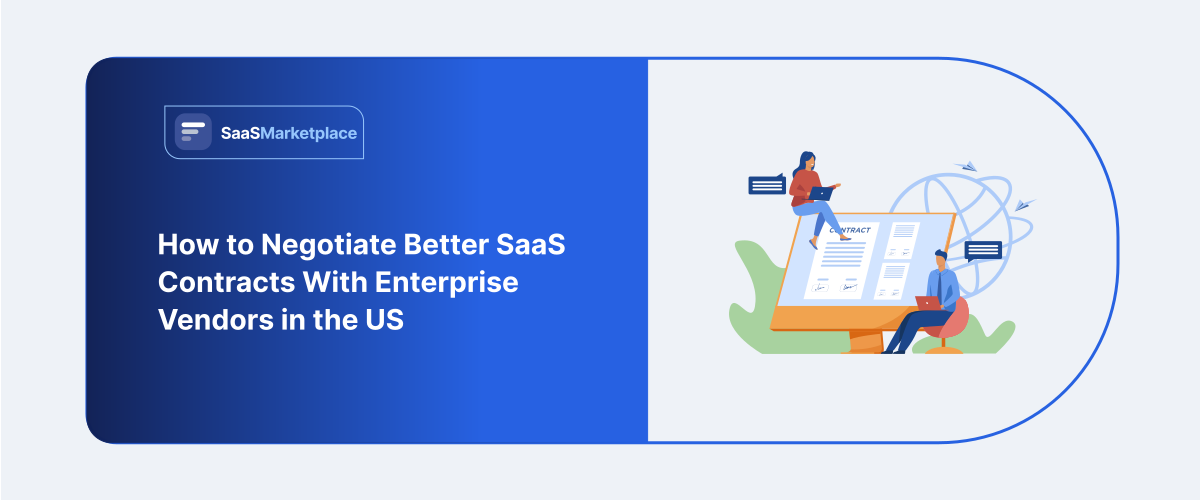
How to Negotiate Better SaaS Contracts With Enterprise Vendors in the US
-min.jpg)
Signing a standard, off-the-shelf software agreement with a major vendor is one of the fastest ways an organisation drains its operating budget. Many corporate procurement leaders and IT managers treat software pricing pages as fixed realities. In practice, enterprise software sales models are inherently flexible, leaving significant room for strategic adjustments that favour the buyer.
If an organisation relies on the standard terms of a vendor to manage its software environment, it faces significant risks related to money and operations. For a business to avoid overpaying for licenses that nobody uses or entering into agreements that renew automatically for many years, the organisation must use a formal review process. As a result of this process, the business maintains its required standards. To create a technical system that is efficient, the finance and engineering departments must work together.
Why SaaS Contract Negotiation Matters More Than Ever in 2026
The corporate tech landscape has undergone a major shift. The era of unchecked software acquisition, where individual departments routinely added specialised tools via corporate credit cards, has caused severe application sprawl. Today, managing executive budgets requires aggressive cost containment and operational efficiency.
Unmanaged tech stacks heavily impact a company's financial flexibility. When organisations let duplicate software tools run concurrently or fail to track active user counts, their software margins erode. Modern SaaS Management is no longer just a backend administrative task; it is a critical component of executive financial strategy.
Enterprise software vendors frequently adjust their packaging models, phase out legacy tier structures, and increase renewal rates to maximize their own contract values. Organizations that treat purchasing as a passive transaction lose substantial capital. Dedicated Procurement Software tracking reveals that companies actively engaging in strategic SaaS pricing negotiations regularly capture significant discounts, gain stronger data security, and secure flexible growth terms that safeguard corporate resources.
Key SaaS Contract Terms Every Buyer Should Review
By the time a formal negotiation begins, the procurement teams must look at more than the promotional documents. At this stage, the staff must analyze the legal and financial rules that are present within the master services agreement.
-
Pricing and Subscription Structures
You mustn't judge the cost of software based only on the price for each user. For a complete understanding, you should examine how the vendor organizes prices for different amounts of usage. On those documents, you can calculate how the fees change when the number of users increases. With this information, you can confirm if your team is able to move accounts that are not active to other departments. If you do this, you avoid fees that occur for administrative changes.
-
Service Level Agreements (SLAs)
As you evaluate a tool, it is useful only when it is available for the employees to use. To verify this you should look at the specific promises for how often the system stays online. There is a need to see how the vendor measures the percentage of time the service is available each month. If the vendor has a service failure that lasts a long time or if the vendor does not answer support requests by a specific time, the agreement should include financial credits - those credits are payments that go to your account automatically.
-
Data Ownership and Security Requirements
Your company data is quite important intellectual property. The contract has to make it very clear that your business has complete, sole ownership over all entered data and produced marketing analytics. Moreover, while defining explicit responsibilities in case of an outside security event, be sure the supplier follows strict local security standards, including SOC 2 Type II certifications and HIPAA rules.
-
Contract Length and Renewal Clauses
Examine the operational differences between yearly promises and multi-year commitments. Watch for covert automatic renewal windows that often demand a written cancellation notice 60 or 90 days before to expiration. Not monitoring these dates might unintentionally bind your company into an overpriced contract extension you no longer require.
-
Termination and Exit Conditions
A decent offboarding plan is just as important as the first deployment phase. If you choose to cancel, make sure the contract specifies a simple, low-risk process for getting your data in a clear, organized format, such as a regular CSV or JSON file. The agreement ought to also forbid the provider from charging exorbitant data extraction costs during your changeover period.
Proven Strategies to Negotiate Better SaaS Vendor Agreements
Getting good conditions means changing your approach from emotional bargaining to one that is organized and data-driven. These tested strategies can help procurement executives to negotiate active vendor contracts:
|
Step |
Core Strategy |
Target Objective |
|
1 |
Gather Market Pricing Benchmarks |
Establish baseline realistic costs before initial outreach. |
|
2 |
Acquire Competitive Alternative Quotes |
Create authentic leverage by positioning vendors against rivals. |
|
3 |
Propose Flexible, Usage-Based Tiering |
Protect margins against unutilized seat allocations. |
|
4 |
Lock In Price Caps for Upcoming Renewals |
Stop compounding year-over-year price spikes early. |
-
Research Market Pricing Before Negotiations
Never start a conversation without external benchmarks. Utilize specialized Contract Management Software data and industry networks to discover what peer companies with similar user volumes are actually paying for the same solution. Knowing a competitor's true net price shifts the leverage back to your procurement team.
-
Leverage Competitive Vendor Quotes
Enterprise sales reps are strongly motivated to reach their three-month targets. Always assess at least two different platforms at once and let suppliers know they are taking part in a formal request for proposal (RFP) process. A viable alternative lets you bargain from a position of strength and get better financial benefits.
-
Negotiate Multi-Year Agreements Carefully
A three-year agreement offers substantial initial discounts but also raises your long-term operating risk. Should you decide on a multi-year path, guard your company by demanding a yearly right-to-size clause. Once a year, if your staff levels or company demands shift, this structural protection lets you lower seat counts or downgrade service levels.
-
Request Usage-Based or Flexible Pricing Models
Stay away from flat-rate per-user models that penalize transient interior downturns for applications with very erratic use patterns. Ensure your monthly costs match exactly to real company results by pushing for pricing arrangements tied directly to actual consumption metrics, including data storage utilized, API calls made, or processed transactions.
-
Secure Additional Services and Support
Should a provider decline to cut their basic membership fee, turn your attention to capturing other kinds of business value. Ask them to forgo execution fees, throw in free bespoke API connections, or offer committed premium technical account management (TAM) help at no further expense.
Common SaaS Contract Mistakes That Cost Businesses Money
Even seasoned procurement teams can miss minor operational snares that cause long-term budget inflation. Knowing these frequent mistakes helps you maintain a very effective tech stack:
- Accepting the First Pricing Offer: Initial sales quotes are purposely inflated to leave room for discounting. Treating the opening proposal as a final offer leaves significant money on the table.
- Overlooking Automatic Renewal Terms: Forgetting to track contract notification deadlines allows underutilized platforms to silently renew, draining corporate budgets for another full calendar cycle.
- Ignoring scalability and user base development Costs: If the provider charges outrageous, non-discounted costs the instant your business adds its 51st team member, getting a discount for your first 50 customers counts for nothing.
- Failing to Review Compliance Requirements: Not reviewing compliance requirements, that is, skipping a full legal review by your internal IT Management team, can result in costly operational delays if the tool conflicts with industry data-handling norms.
- Underestimating Vendor Lock-In Risks: Selecting a platform that needs months of custom deployment or uses proprietary data formats makes changing to another quite challenging, and so gives the supplier full pricing power for the following renewals.
-
Building Long-Term Vendor Relationships While Maximizing Value
Good SaaS spend management is not about hostile, shortsighted negotiations. True negotiating perfection is about creating long-term environmental connections that guarantee your software suppliers and your internal company divisions flourish jointly over several financial years.
|
Strategic Management Focus |
Legacy Purchasing Habits |
Advanced Optimization Practice |
Long-Term Operational Outcome |
|
Vendor Collaboration |
Treating suppliers as short-term transactional utility providers. |
Establishing clear, multi-year performance and growth expectations. |
Reliable product roadmaps and priority executive support access. |
|
Utilization Tracking |
Auditing software usage only when a renewal contract arrives. |
Continuous, real-time tracking of license adoption and seat activity. |
Proactive reduction of waste and eliminated application bloat. |
|
Budget Protection |
Accepting arbitrary year-over-year rate increases blindly. |
Negotiating strict renewal price caps during the initial purchase. |
Highly predictable software expenses across multiple quarters. |
-
Creating Win-Win Negotiations
An excessively hostile procurement approach that deprives a supplier of all profitability might boomerang, causing sluggish engineering reactions and poor customer service. Offer obvious trade-offs to start the talk, for example, signing a longer commitment in return for tight price-increase protection or consenting to serve as a public case study.
-
Establishing Performance Review Processes
Incorporate formal, recurring evaluation windows directly into your Vendor Management Software workflows. Review technical stability, ticket resolution speeds, and overall platform adoption rates with your account representatives every two years, holding suppliers completely responsible to their initial SLA requirements.
-
Monitoring Contract Usage and ROI
A software tool is a bad investment if your workforce rarely opens it. Task your Business Operations leads with tracking active log-in frequencies and internal feature utilization metrics. If software adoption stays low, use that data to downsize your tier allocation well ahead of your next renewal cycle.
-
Preparing for Future Renewals and Expansion
Never start a renewal negotiation the week the contract expires. Initiate your internal performance assessments and market benchmarking at least 90 days before termination. This runway gives your team the necessary time to run an alternative selection process if the incumbent vendor attempts to impose unreasonable rate hikes.
Conclusion
Modern corporate executives must have a thorough understanding of the subtleties of SaaS program procurement. Your company may safeguard its data, maximize its operational processes, and stop needless budget waste by departing from conventional provider templates and actively influencing the terms of your technology contracts. The real worth of a software platform is set on how intentionally it is run. Although implementing the proper tracking systems guarantees visibility, your management has to create a culture of thorough, ongoing contract review. Collaborate with your legal and finance teams to transform every significant corporate software acquisition choice into a deliberate, strategic investment that advances long-term organizational development and ongoing commercial value.
FAQ's
It is a formal, legally binding framework between a business buyer and a software vendor that defines the licensing, pricing, data security, and support terms for a cloud-based application.
It allows companies to eliminate unnecessary subscription costs, minimize operational risks, and tailor default legal and uptime terms to match their actual corporate standards.
Prioritize adjusting seat pricing tiers, securing strict renewal price-increase caps, clarifying data ownership rights, and establishing clear financial credits within the Service Level Agreement (SLA).
Organizations can lower costs by using specialized software to eliminate duplicate applications, cutting unutilized user seats, and leveraging competing vendor quotes during procurement.
Be cautious of hidden automatic renewal clauses, ambiguous data retrieval policies upon termination, and agreements that give the vendor unlimited freedom to raise subscription rates without notice.