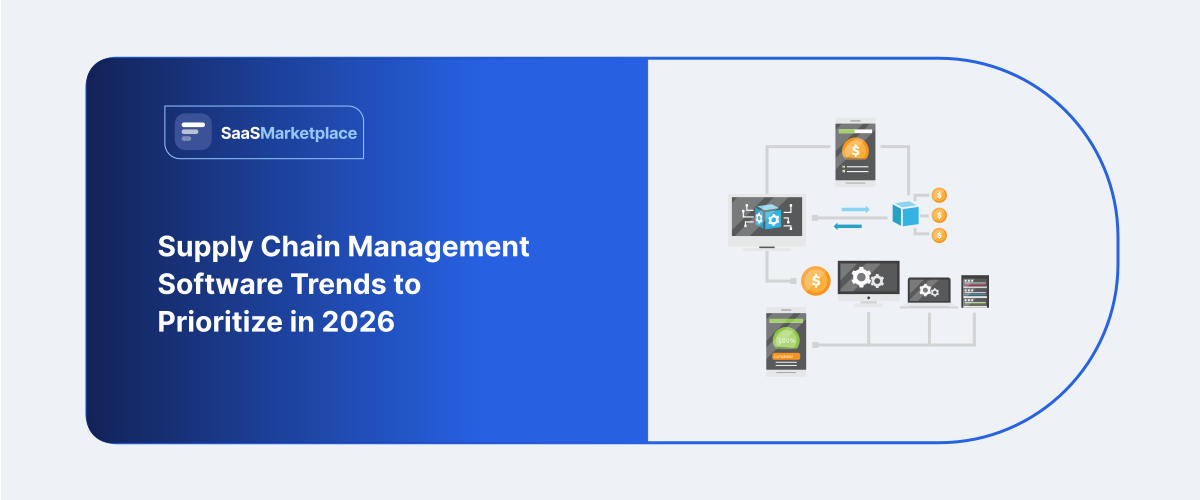
Supply Chain Management Software Trends to Prioritize in 2026
-min.jpg)
With geopolitical shifts, trade volatility, and those ever-changing global demands, global trade keeps getting reshaped, and so in 2026 the supply chain management software space is moving fast from passive systems of record into sort of active, intelligent control hubs. A lot of modern enterprises are quietly getting rid of those fragmented legacy setups for one unified platform that is powered by agentic AI, constant real-time execution, and multi-tier network visibility. In this kind of environment, picking the right software capabilities is not just another IT upgrade; it’s really a strategic necessity, because the goal is to go beyond reactive firefighting toward proactive, end-to-end orchestration.
What Is Supply Chain Management Software and Why Does It Matter?
Supply Chain Management software is kinda like a central digital kit; it helps businesses peek at every step, from raw ingredients to completed goods, and then eventually toward consumers. It stitches together procurement, inventory tracking, making, logistics, and order fulfillment into one connected digital ecosystem, so it’s not all separate and messy. With this, companies can get a sharper end-to-end view of how products, information, and money flow through their operations rather than staying spread out everywhere.
Without it, today’s global commerce can quickly stall, almost like it grinds down under the weight of spreadsheets, small misunderstandings, and those annoying blind spots. SCM software is important because it turns everyday operational data into real-time insight and practical anticipation. That means organizations can foresee material shortages, lower transportation costs, fine-tune warehouse stock levels, and respond fast when sudden market shifts happen. In the end, it’s what turns a messy network of suppliers into something more dependable, and yes, often a profitable competitive edge.
What Are the Current Supply Chain Management Software Trends in the US Market?
In the US market, supply chain management software has shifted from static systems of record to dynamic, AI-driven command centers. US enterprises are moving away from spreadsheets and isolated legacy applications in favor of highly connected, automated platforms designed to handle real-time volatility.
1. Move Toward Agentic AI and Autonomous Execution
Instead of only producing forecasts or fixed asset accounting reports, modern software is leaning into agentic AI, basically a sort of virtual workforce that can work on its own and actually carry out decisions. Like, if a port delay or some weather bottleneck is detected, the software doesn’t just fire off an alert. It tends to automatically reroute shipments, tune warehouse labor schedules, and shift inventory allocations using those preset rules, and you can kinda think of it as an extra layer of operational fluency.
2. More Multi-Tier (Tier 2 & Tier 3) Deep Visibility
Just tracking direct suppliers, the Tier 1 layer, is no longer enough for US risk management. The more current software platforms pull in IoT sensors, cloud networks, plus API integrations to get near real-time tracking across sub-tier suppliers, component makers, and even downstream logistics partners. That deeper view means teams can spot material shortages weeks ahead, before they quietly hit the assembly lines and start causing bigger disruptions later.
3. Digital Twin tech for live scenario simulation
More and more US companies are building digital twins basically virtual mirror images of their actual supply networks, tied to real-time operational info. In practice, SCM software leverages these digital models to run kind of what-if simulations, things like sudden tariff shifts, fuel price spikes, or regional demand surges. The point is to let planners stress test, and also to see what might happen before they commit to expensive strategic pivots.
4. Cross-system orchestration layers instead of giant monolithic upgrades
Rather than signing up for those long multi-year, multi-million-dollar ERP rip-and-replace efforts, US firms are moving toward orchestration layers. These are more lightweight, API driven software layers that sit above existing WMS, TMS, and older ERPs. Their job is to align data models and help connect the real-time operational holes, so everything can work together without yet another full platform rewrite.
5. Automated ESG, plus Scope 3 Compliance, Digitalization
With tighter US and international reporting requirements on sustainability, SCM software now often sprinkles in carbon accounting along with ethical sourcing tools. Automated data collection quietly maps product provenance, packaging waste, and Scope 3 emissions across transportation routes, so compliance stops feeling like that manual audit nightmare, and instead becomes some kind of always-on background metric.
6. Smart Yard and Warehouse Automation, Integration
To deal with stubborn labor shortages and warehouse delays around the country, yard and warehouse systems are starting to blend with real-world physical automation. SCM software now tends to integrate gate digital-ID checks, automated dock scheduling, Autonomous Guided Vehicles (AGVs), and wearable analytics into one dashboard. The goal is to cut turnaround time and keep operating overhead lower, which sounds simple but is usually harder in practice.
Which Supply Chain Management Software Technologies Should You Watch in 2026?
If you’re trying to evaluate tech stacks for the US market in 2026, Agentic AI and autonomous execution platforms should be right up there on your radar. But not like the earlier stuff that just spat out pretty reports; this agentic software kinda does the opposite: it actually makes and then executes decisions, like rerouting delayed freight across domestic shipping lanes, or rebalancing warehouse inventories without waiting for a human to manually step in.
Also keep watching how fast Supply Chain Digital Twins are being adopted, especially when they’re paired with intelligent simulation engines. Because of real-time IoT network feeds, these virtual models are basically “living” systems, and operators can run live what-if scenarios. So planners get the stress-testing muscle they need to respond quickly when tariffs suddenly shift, when reshoring decisions change, or when port bottlenecks pop up before any of it hits domestic assembly lines.
Then there’s the cloud-native orchestration software and the multi-tier visibility suites. Instead of replacing the huge, multi-million-dollar legacy ERPs, US companies are stacking these more agile tools on top. They help connect warehouses and transportation networks that used to feel disconnected, and they automatically capture Tier 2 and Tier 3 data to support product provenance, while also aligning with the latest ESG compliance standards.
How Are AI and Automation Reshaping Supply Chain Management Software?
1. Shift from Predictive Insights into Agentic Execution
Instead of only flagging delays for teams or spitting out those kinds of fixed forecasts, today’s SCM platforms are folding in agentic AI like autonomous digital agents that can actually do the work. When there’s a US port backup or a serious weather event, the system can reroute shipments by itself, rebook freight carriers, and also fine-tune warehouse management software receiving times based on a set of pre-set operational rules.
2. Hyper-Local Demand Sensing and Dynamic Inventory Rebalancing
Old school demand planning, which leans mostly on historical sales history, is slowly being swapped out for AI-driven demand sensing tools. In US retail and e-commerce, these platforms tie together hyper-local weather forecasts, economic signals, social media sentiment, and live point-of-sale updates to catch localized spikes. Then, without much waiting around, they push stock transfers to nearby regional fulfillment hubs automatically, almost like a nonstop adjustment loop.
3. Convergence of Physical Automation and Warehouse Management Software
To deal with ongoing warehousing labor shortages in the US, SCM software now directly choreographs physical robotics and automated equipment. Modern Warehouse Management Systems, or WMS, communicate natively with Autonomous Mobile Robots, AMRs, automated storage and retrieval systems, ASRS, and robotic picking arms, and this helps optimize order picking routes and labor allocation in real time.
4. Continuous AI-Powered Transportation and Route Optimization
With US diesel costs that keep shifting and driver capacity constraints, Transportation Management Systems (TMS) are embedding machine learning routines that keep optimizing delivery routes, always. The software reads live GPS feeds, traffic patterns, delivery windows, and driver availability, then it dynamically changes the sequence of stops and merges partial truckloads, reducing fuel burn and operating expenses.
What Challenges Do US Businesses Face With Supply Chain Management Software?
1. The heavy burden of legacy ERP and tech stack debt
A lot of US organizations still lean on decades-old legacy ERPs, plus heavily customized on-premises software. Trying to stitch modern cloud-native SCM tools into these rigid, fractured setups is notoriously hard, and you end up with pricey bespoke coding, plus high upkeep costs and slower data transfers that kind of ruin the whole “real time” promise.
2. Pervasive data siloes and poor sub-tier partner connectivity
SCM software is only as good as what actually gets pushed into it. US companies often trip up when it comes to untangling internal data siloes, like when sales, procurement, and warehouse teams each cling to different data formats. And then there’s the bigger problem: getting Tier 2 and Tier 3 suppliers to share real-time operational data because privacy worries show up, or because the tech limitation thing becomes a real wall.
3. Change Management and Tech Upskilling Resistance
Upgrading SCM software kind of changes day-to-day routines in a real way. When teams move away from manual spreadsheets and feel-based scheduling, toward automated, AI-powered execution, there's often pushback from seasoned logistics and procurement people who don’t fully trust automated suggestions or who just have trouble adapting to new software interfaces.
4. Rising Software Implementation and Licensing Costs
SaaS licensing fees, cloud storage overhead, and specialized implementation consultants stack up, so going after an enterprise-grade SCM platform can end up very costly. For middle market US businesses, it becomes a balancing act between the early capital spend and ROI timelines that nobody can confidently predict, and that gap blocks adoption of newer capabilities like digital twins or agentic AI.
How Do You Choose the Right Supply Chain Management Software for Your Needs?
1. Figure out what your core stuff is missing and pick the right planning horizon
Before you even glance at vendor feature pages, you need to tell yourself, clearly-ish, what business problem you’re actually trying to fix. Decide if your top focus is near-time execution (think Warehouse Management or Transportation Management), mid-term orchestration (Demand Forecasting, Sales & Operations Planning), or longer-range strategy network design. If you choose software only after this, you avoid ending up with an overly complicated platform that your team won’t really use.
2. Check how well it meshes with your current systems
A big reason SCM software fails is when it can’t integrate cleanly with your existing Enterprise Resource Planning (ERP), Point of Sale (POS), and older accounting setups. Make sure the solution includes solid, ready-made connectors, low-latency APIs, and flexible data ingestion so you can keep one single source of truth without paying for heavy custom middleware.
3. Check if the AI is actually deep past the vendor hype
A lot of vendors call basic rule-based alerts artificial intelligence, like it’s the same thing. But you want to look for more useful, real capabilities, not just slick wording. Focus on agentic execution, meaning automated task resolution, plus continuous demand sensing with real-time market signals. Also consider dynamic inventory optimization that adjusts as conditions shift. Get the vendor to show a live demo, and pay attention to whether their models deal with sudden lead time disruptions or unexpected demand spikes in a believable way.
4. Evaluate how well sub-tier suppliers and partners connect
Most modern supply networks lean hard on outside players, including external suppliers, 3PL logistics providers, and contract manufacturers. Pick a software platform that supports multi-enterprise connectivity. For example, look for an easy vendor portal approach, EDI support, and IoT integrations. The goal is to get visibility into Tier 2 and Tier 3 networks, while not forcing smaller partners to slog through complicated onboarding steps that slow everyone down.
What ROI and Benefits Can You Expect From Supply Chain Management Software?
1. Significant Inventory and Cost of Holding Reductions
With advanced demand sensing plus automated inventory optimization software, many companies can trim away surplus safety stock while still keeping a strong order fill rate. In practice, the SCM tooling figures out adaptive reorder points from live lead-time signals and local demand tempo, you know, the sales velocity that actually happens nearby.
In most cases, businesses see around 15% to 30% less in total inventory holding costs, and they also bring down write-offs tied to deadstock or expired goods, which is pretty significant.
2. Slashed Transportation and Logistics Expenses
Transportation Management Systems, or TMS, help squeeze transportation spend by running carrier selection more or less automatically, stitching together LTL loads, and re-planning routes on the fly based on current conditions. Sometimes they also improve freight audit workflows, so billing issues get caught earlier, or at least that’s the intent.
Companies commonly report about a 5% to 20% reduction in overall freight and logistics spending, mostly from better route efficiency, fewer expedited shipping charges, and those automated freight audit processes.
3. Lower Procurement Costs and Better Margin Protection
Procurement modules deliver that kind of complete spend visibility across both direct and indirect materials, and somehow it also helps surface volume discounts plus cut down on rogue spending. The platform can monitor supplier performance, contract adherence, and shifting raw material pricing more or less in real time, which is helpful when markets wobble.
Most organizations see procurement spend come down roughly 5% to 15%, and that tends to shield operating margins from material price swings and the unpleasant surprise of unexpected tariffs.
4. Maximized Warehouse Productivity and Reduced Labor Overhead
Modern Warehouse Management Systems, or WMS, streamline everyday warehouse activity by automating dock scheduling, optimizing picking paths and coordinating labor assignments more smoothly. And when you connect it with warehouse automation tools like AMRs, barcode scanners, and similar tech, the labor efficiency benefits tend to grow fast.
Firms commonly gain about a 20% to 35% improvement in warehouse throughput efficiency, plus better order picking accuracy, which then reduces the labor overhead per order shipped, kind of directly.
What Is the Future Outlook for Supply Chain Management Software Beyond 2026?
1. Mass Deployment of Fully Autonomous, Self-Healing Networks
Beyond plain task automation, next-generation SCM software will kind of manage self-healing supply networks. When disruptions show up like a localized geopolitical conflict, a port failure, or an extreme weather event, multi-agent AI systems will autonomously re-contract suppliers, send purchase orders, tune freight bookings, and rebalance global safety stock in real time, no need to wait for human sign-off.
2. Commercial Application of Quantum Computing Optimization
Classical computing has a hard time with the exponential variables found in multi-echelon global logistics. After 2026, providers will more often offer quantum as a service (QaaS) integrations to tackle combinatorial logistics problems. Quantum methods will compute optimal dynamic routes, production schedules, and multi-tier inventory allocations in seconds, which is something classical algorithms still take hours or even days to do.
3. Hyper-Personalized, Segment-of-One Supply Chain Execution
Mass forecasting models are going to get replaced by hyper-localized, segment-of-one execution engines. With edge computing mixed in, plus real-time consumer behavior signals, the next software layer will let manufacturers automatically tune their production lines all the way down to individual customized units, like really granular. It will also coordinate raw material sourcing and last-mile delivery routes, dynamically for each customer order.
Conclusion
As supply chains deal with more global volatility in 2026, modernizing your tech stack is not optional anymore, more like a strategic necessity. If you adopt advanced functions such as agentic AI, real-time visibility, and digital twins, you’ll see a clear separation between market leaders and organizations that just react after the fact. But picking the right tools to run this shift takes speed, and a bit of clarity, too. Using SaaSmarketplace, businesses can quickly check out top-tier solutions, discover, compare, and buy business software that fits their operational needs. When you choose software that supports adaptation and end-to-end integration, you can form a resilient, future-proof supply network.
FAQ's
The primary trend is the adoption of agentic AI, which shifts software from passive data reporting to autonomous decision-making and execution.
It uses IoT integrations and cloud networks to capture real-time data across Tier 2 and Tier 3 sub-tier suppliers, reducing unexpected material shortages.
It uses IoT integrations and cloud networks to capture real-time data across Tier 2 and Tier 3 sub-tier suppliers, reducing unexpected material shortages.
Digital Twins provide real-time virtual replicas of physical supply networks, enabling planners to simulate and stress-test "what-if" disruption scenarios before making operational changes.
It automates carbon accounting and ethical sourcing tracking across supplier tiers, turning sustainability compliance into a continuous background metric.