What Is Customer Feedback Software and How Does It Improve Customer Experience?
-min.jpg)
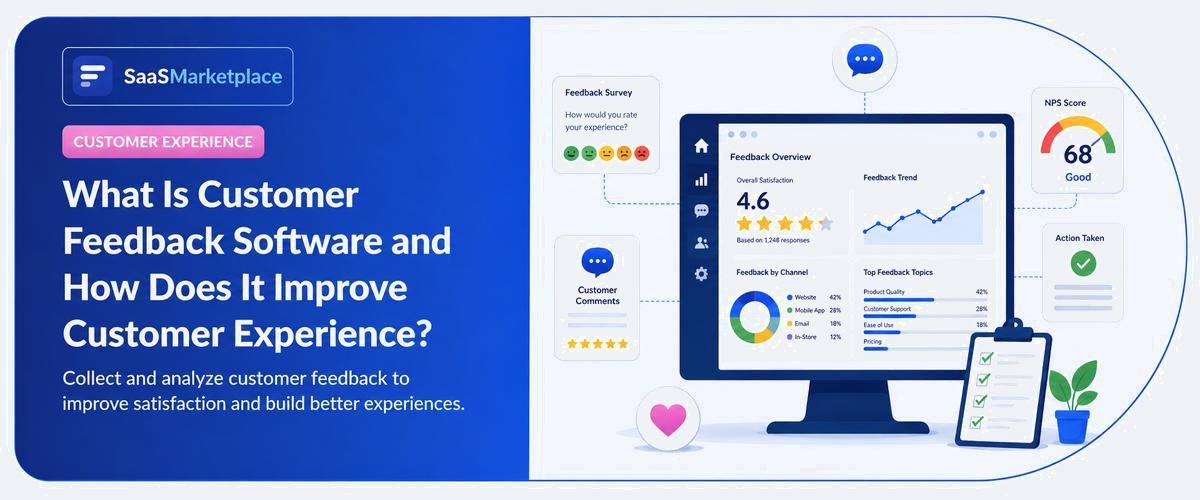
Three jobs sit inside customer feedback software. Gathering what customers tell you, working out what any of it means, and getting it in front of somebody who can act. The inputs come from everywhere: survey responses, NPS ratings, prompts fired inside the product, public reviews, and whatever came up during a support call last Thursday. Collecting all that stopped being impressive somewhere around 2024. The question worth asking a vendor in 2026 is narrower. Will this flag a problem while the customer is still a customer? Gathering feedback is rarely where companies fall down.

Looking for Customer Feedback Software? Check out the SaaS Marketplace list of the best customer feedback software in USA for your business.
A survey went out in March. Four hundred people answered it. Somebody exported the results, the numbers looked broadly acceptable, and the deck got presented once before everyone moved on. Then in December an account cancels, and the reason they give is sitting in row 213 of that export nine months earlier.
What Is Customer Feedback Software?
Strictly speaking, customer feedback software is a platform for collecting, analyzing, and acting on what customers say about you.
That third verb carries the definition. Google Forms collects responses perfectly well and costs nothing. What a proper customer feedback platform adds is the path connecting a score of three to a specific person's task list on Monday morning.
Why Businesses Collect Customer Feedback in 2026
Because the alternative is finding out at renewal, which is too late to do anything about it.
Most unhappy customers say nothing at all. They do not complain, they do not escalate, and the first indication anything was wrong arrives as a two-line cancellation email offering no reason.
Structured feedback pulls the problem forward into a window where fixing it still matters. That argument holds whether you sell software, furniture, or accounting services.
How Does Customer Feedback Software Work?
Feedback Collection Across Multiple Channels
Email surveys, prompts inside the app, SMS, a widget on the website, and a request that fires after a support ticket closes. All of it lands in the same queue.
Which channel you use shapes the answer more than most teams account for. Somebody answering a prompt while using your product is thinking about your product. Somebody answering an email on a Tuesday afternoon is thinking about lunch, and they will give you a different rating for the same experience.
Feedback Analysis and Sentiment Detection
AI stopped being a premium add-on here and became an expectation, a shift that happened across the category during 2025.
Volume forced it. A person can read two hundred free-text comments in an afternoon and come away with a decent sense of the themes. Nobody reads twenty thousand.
And the comments are where the information actually lives. A score of six tells you almost nothing on its own. The sentence somebody typed underneath it usually tells you everything.
Reporting and Actionable Insights
Reporting and routing are not the same thing, and the better platforms do the second. A detractor response should create a task assigned to whoever owns that account, rather than becoming line 40 of a monthly summary.
Key Features of Customer Feedback Software
Survey Builder and Templates
Drag-and-drop building, with conditional logic so people only get asked questions that follow from their earlier answers. Response rates improve noticeably once you stop showing everyone all twelve questions.
Most customer survey software ships with a template library. Treat those as starting points rather than finished surveys, since generic questions produce generic answers.
NPS (Net Promoter Score) Tracking
One question does the whole job here. How likely are you to recommend us to a colleague or friend? Answer on a scale running zero to ten.
Nines and tens count as promoters. Sevens and eights are passives and get ignored in the calculation. Everything from six downward is a detractor. Take your promoter percentage, subtract your detractor percentage, and the remainder is your score.
Dedicated NPS software still exists, though most feedback platforms bundle it now. Worth remembering what the metric is for: it tracks loyalty as a trend, not satisfaction with any single interaction.
CSAT and CES Measurement Tools
CSAT is the moment-level metric. Ask it the instant a support ticket closes or a delivery lands, and what comes back describes that specific interaction rather than how somebody feels about you generally.
CES asks about effort instead. How much work was that? The question sounds trivial and predicts churn better than most alternatives, because customers forgive imperfection far more readily than they forgive friction.
None of the three competes with the others. Strategy runs off NPS. Individual touchpoints get fixed using CSAT. And CES points at the processes that are quietly exhausting people.
Voice of Customer (VoC) Collection
Surveys only capture what you thought to ask about. Voice of customer software widens the net, pulling from support transcripts, public reviews, recorded sales calls, and social mentions.
Honesty is the advantage. People write things in a Trustpilot review they would never type into a survey field sent by the company they are annoyed with, and voice of customer software is how that reaches you.
Real-Time Feedback Alerts and Notifications
Anything below your threshold pings the account owner straight away rather than waiting for a weekly digest. Hours, not weeks, is the loop-closing standard the stronger platforms now build toward.
Integration With CRM and Help Desk Tools
Feedback attached to the customer record itself, visible to whoever opens that account next. Skip this integration, and your customer support software becomes one more browser tab that nobody remembers to check.
Types of Customer Feedback Software
Survey and Questionnaire Platforms
Typeform, SurveyMonkey, Jotform, and similar. Broad and flexible on the building side, comparatively thin once you want the responses analysed for you.
NPS Software Tools
Delighted and Retently are the names most people recognize. Narrower in scope than a general survey tool and noticeably better at the one thing they do.
In-App Feedback Tools
Prompts that fire inside the product while somebody is using it. Product teams gravitate here because the response arrives with context attached, so you know what screen they were on when they got annoyed.
Review and Reputation Management Platforms
Reviews across Google and the app stores, monitored and answered from one screen. A different discipline from surveying, working off overlapping data.
Social Listening and Sentiment Analysis Tools
Brand mentions across social channels, collected and scored for sentiment. The real use case is catching something spreading publicly before a single person thinks to contact your support team about it.
Plenty of customer feedback tools now stretch across several of these categories at once. Check the overlap before signing two contracts, because buying products that duplicate 60% of each other is easier to do than it sounds.
How Customer Feedback Software Improves Customer Experience
Six mechanisms account for most of the value:
- Problems surface before they become cancellations
- Customers see that saying something changed something
- Prioritisation runs off evidence rather than opinion
- CSAT, NPS, and CES get tracked consistently enough to trend
- Alerts fire the moment satisfaction drops
- Trust accumulates because the listening is structured
Identifies Pain Points Before They Cause Churn
Somebody rates you four out of ten in February and cancels in June. That is four months of warning, freely given. Whether anyone noticed is not a customer problem, it is a systems problem.
Closes the Feedback Loop With Customers
Easily the most underrated function in the category. Somebody complains, a human responds, and the customer discovers their input reached a person rather than a database.
There is a well-documented pattern here worth knowing. A detractor whose complaint gets properly resolved frequently ends up more loyal than a customer who never encountered a problem at all.
Helps Teams Prioritize Product and Service Improvements
No product team has ever had enough capacity for the requests in front of them. Feedback data turns that backlog into something rankable, which beats a meeting where the loudest opinion wins.
Measures CX Progress Over Time
One score in isolation tells you almost nothing. Four quarters of movement tells you a great deal, especially when you can point at the change that caused it and defend that claim in a review.
Builds Customer Trust Through Active Listening
Being asked for your opinion is mildly flattering. Watching that opinion change something is different, and only the second one builds anything durable.
Who Uses Customer Feedback Software?
Customer Experience and CX Teams
Program design sits with this group, along with whatever reporting reaches leadership each quarter. Where a CX function exists at all, the budget for this software usually sits there too.
Product Teams and Product Managers
Prioritization, mostly, plus working out which parts of the product create friction rather than delight. This group cares far more about in-app feedback than email surveys, for the obvious reason that context arrives with it.
Customer Success and Support Teams
Health scoring, churn signals, and satisfaction are captured immediately after an interaction. Support tends to sense a problem weeks before it shows up in a dashboard, which is the argument for wiring ticket data and feedback data together.
Marketing Teams Tracking Brand Sentiment
Review response and reputation monitoring, plus whatever the sentiment data suggests about how positioning is landing.
Key Benefits of Customer Feedback Platforms
Reduced Customer Churn
Spotting dissatisfaction early costs a fraction of winning back an account that already left. Retention economics being what they are, this is usually the strongest line in a business case.
Higher Customer Satisfaction Scores
Scores move when the underlying experience moves. Which requires knowing which specific part of that experience is currently broken, and that is what the software is for.
Faster Product Iteration Cycles
Shipping the right thing matters more than shipping fast. Feedback data is how a team distinguishes between the two before committing a quarter of engineering time.
Stronger Customer Loyalty and Retention
Customers who feel heard renew more often, which sounds like a soft claim until somebody splits renewal rates between accounts that got a response and accounts that did not.
Customer Feedback Software vs Customer Experience Software
Vendors use these two terms interchangeably, which helps nobody trying to compare products.
The narrower of the two collects and analyzes what customers tell you. Input-focused, metric-driven, and reasonably well-defined.
Customer experience software covers considerably more ground: journey mapping, personalization, and orchestration across every touchpoint a customer encounters. Feedback tends to sit inside that as one component among several.
Honestly, for most mid-market companies the label matters less than the question of what happens to the data. Buying full customer experience software to run a quarterly NPS survey is a lot of money for a job a $50 tool would do.
Future of Customer Feedback Technology in 2026 and Beyond
The market has consolidated sharply. Qualtrics picked up InMoment through the Forsta merger in late 2025 at $6.75 billion, and GetFeedback is being wound down entirely. Anyone shortlisting platforms right now should be checking vendor stability with the same seriousness they check features.
Predictive scoring is the other movement worth watching. Survey response rates have been falling for years, so rather than waiting for answers most customers never give, some platforms now infer satisfaction directly from conversation content.
Speed expectations have shifted too. Analyze the feedback, identify the trend, and route it to an owner, all within hours. That used to be a differentiator and is now roughly the baseline.
Conclusion
Everything that justifies the cost of customer feedback software happens after a response arrives. The collecting was never the hard part. Plenty of companies own a perfectly good survey tool and still get blindsided by churn every quarter. What separates them from the ones that do not is whether a low score reaches somebody with authority to act fast enough for acting to help. So before you shop, look honestly at what happens to the feedback you already have. If the answer is roughly nothing, your problem is process rather than tooling. Better software will simply produce better-organized data that nobody acts on. Worth reading alongside this: how help desk supports customer feedback loops covers the support side, and CRM tools that include feedback features explains where the two categories overlap.
FAQ's
A survey tool just collects responses, while feedback software also analyzes sentiment and routes issues to someone who can act.
NPS tracks overall loyalty, CSAT measures satisfaction with a single interaction, and CES measures how much effort something took.
It surfaces dissatisfaction months before cancellation, giving teams time to respond while the customer is still active.
It's a broader form of feedback collection that pulls from support transcripts, reviews, sales calls, and social mentions, not just surveys.
CX teams, product managers, customer success and support teams, and marketing teams tracking brand sentiment.