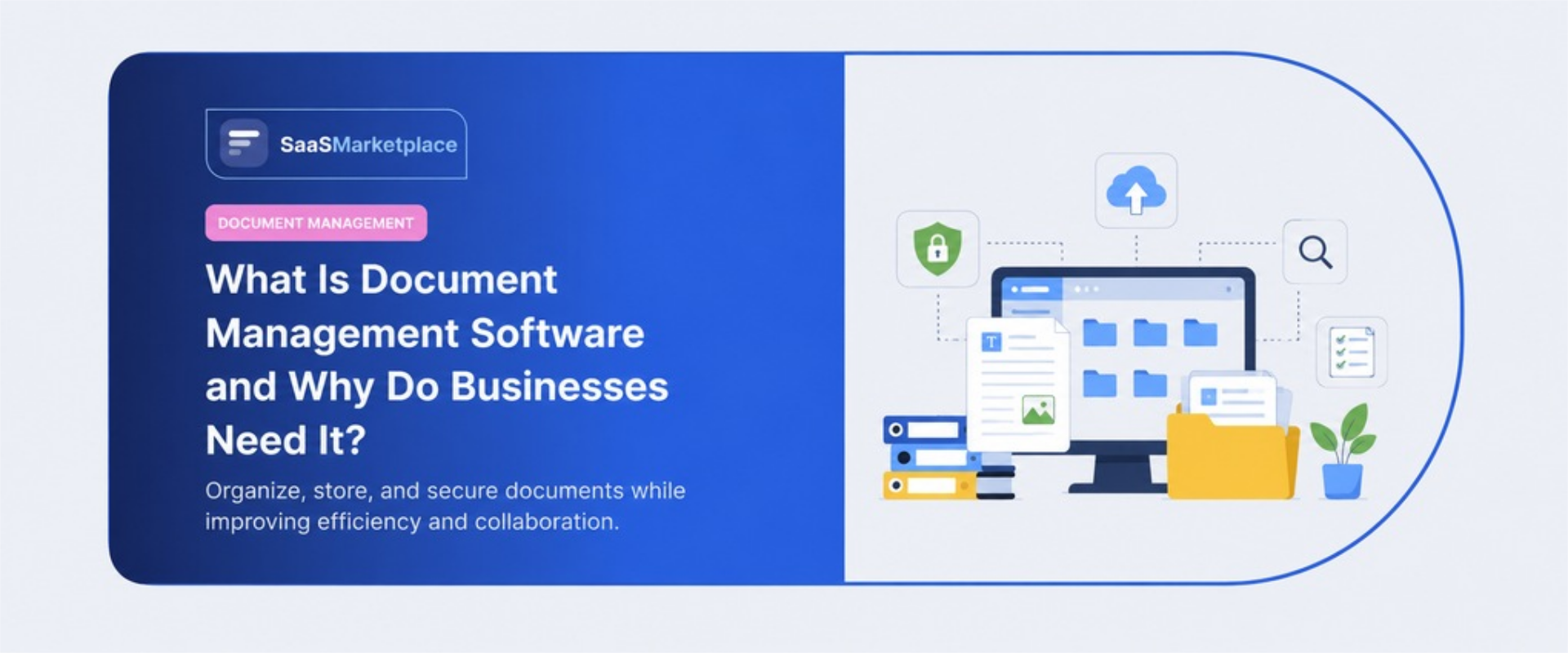
What Is Document Management Software and Why Do Businesses Need It?
-min.jpg)
One system for storing, organizing, searching, securing, and eventually retiring every digital document a business holds. That is document management software in a sentence. Five pressures explain why companies buy it in 2026. Hours disappearing into file searches. Rework caused by somebody using the wrong version. Auditors are asking for trails that do not exist. Sensitive files are sitting somewhere anyone can open them. And hybrid teams trying to collaborate by emailing attachments back and forth. That first pressure has real numbers attached.

Looking for Document Management Software? Check out the SaaS Marketplace list of the best document management software in USA for your business.
Adobe's workplace research put it at 48% of employees struggling to find documents quickly, with more than one in ten burning over four hours a week purely on searching. Four hours. Every week. On an activity that produces absolutely nothing at the end of it.
What Is Document Management Software (DMS)?
Document management software is the platform enforcing that control. A repository with version history, permissions, search, workflow, and an audit trail attached.
How Document Management Systems Work
Documents arrive by upload, by scanner, through email capture, or straight from whichever tool created them.
On the way, each one collects metadata. Type, owner, client, date, retention class, plus whatever else your taxonomy demands. Scanned paper runs through OCR here so the text becomes searchable rather than sitting there as an image.
After that, permissions decide who sees what. Version control keeps every change with rollback to any earlier state. Workflow rules push documents through approval chains, and the audit trail logs every view, edit, and deletion underneath all of it.
DMS vs. Cloud Storage: What Is the Difference?
Dropbox and Google Drive store files perfectly well. Neither is a document control machine, and the space is wider than it seems from outside.
Cloud storage software gives you folders, sharing links, and simple version history. A DMS provides search pushed by using metadata in preference to filenames and permissions set by using functions, retention rules that execute automatically, approval workflows, and audit trails designated enough for a regulator.
Put it this way. Document storage software answers where a file lives. Document management answers what happens to it across its entire life.
Key Features of Document Management Software
Centralized Document Repository
Everything in one system, which retires the shared drive, the desktop folder, and the sixty email attachments nobody can locate.
Version Control and Document History
Check-in and check-out stops two people editing the same file and overwriting each other's work. Behind that sits a full change history with rollback, which turns a bad edit into an inconvenience rather than a genuine loss.
Advanced Search and Metadata Tagging
If one feature justifies the purchase, this is it. DocuWare published a case study with AquaPhoenix Scientific showing search times falling from 30 to 60 minutes down to seconds.
Search pulls from metadata and full text together, which is why tagging discipline at upload matters as much as it does.
Role-Based Access Control and Permissions
View, edit, share, and delete all assigned by role rather than person by person. This is how salary data stays away from people who should not see it, without anyone maintaining a permissions spreadsheet that goes stale within a month.
Document Workflow and Approval Automation
Routing a contract through legal, then finance, then signature, without anybody chasing it by email on a Friday afternoon.
Document workflow software capability is increasingly what separates a genuine DMS from a well-organized repository. If a platform cannot automate an approval chain, it is storage with good search attached.
Audit Trail and Compliance Reporting
Every action logged against a user with a timestamp attached. Deeply dull as a feature, right up until a regulator asks who opened a particular file back in March, at which point it becomes the most valuable thing you bought.
Integration With Office and Business Apps
Microsoft 365 and Google Workspace at a minimum, plus your CRM and ERP. Any DMS that forces people out of the tools they already live in will be quietly bypassed inside a month, whatever the rollout email said.
Why Do Businesses Need Document Management Software?
Six reasons, and most companies recognize at least four of them:
- Hours disappear weekly into searching for documents
- Version confusion produces errors and rework
- Compliance requires audit trails and retention policies
- Sensitive documents need access controlled by role
- Hybrid teams need shared access that is actually secure
- Physical storage costs go away once you move to cloud DMS
Stop Wasting Time Searching for Documents
That Adobe figure of four-plus hours weekly for one employee in ten is the headline. IDC approached the same problem differently and landed on roughly 21% organisation-wide productivity loss from handling documents manually rather than digitally.
Take either number, multiply it by headcount and loaded salary cost, and compare it against a subscription. The arithmetic rarely favors doing nothing.
Eliminate Risk of Version Confusion
One person carries on working from v3 while everyone else moved to v5 last Thursday. In a marketing team that means a reprint. On a construction site it means something built to a superseded specification.
Meet Compliance and Regulatory Requirements
Compliance management software can help organizations manage retention policies, legal holds, audit requirements, and regulatory obligations. These capabilities have moved from premium tier to standard, largely because GDPR, HIPAA, and ISO requirements made them non-negotiable for so much of the market.
Protect Sensitive Business Documents
Encryption at rest and in transit, backed by access controls that genuinely restrict rather than politely suggest. A shared drive where everybody can open everything is a breach waiting for one careless afternoon.
Enable Remote and Hybrid Team Collaboration
Co-editing, commenting, and shared access, none of which requires emailing a version to anyone. Worth noting that the email-attachment habit is precisely where version confusion begins.
Reduce Paper and Physical Storage Costs
Filing cabinets sit on floor space you are paying rent for. Offsite storage swaps that for a monthly fee plus a retrieval delay measured in days rather than seconds.
Who Uses Document Management Software?
Legal Teams and Law Firms
Matter-centric filing, privilege protection, and retention obligations that carry professional consequences. Legal is frequently the department that forces the whole company to buy one.
Finance and Accounting Departments
Invoices, contracts, and audit documentation. Accounts payable workflows are the usual way this department gets started.
HR Teams Managing Employee Records
Contracts, performance records, right-to-work documentation. Every category here carries strict access limits and a defined retention period attached to it.
Healthcare Organizations
There is no optional version of this under HIPAA. Audit mechanisms and six-year retention are legal requirements rather than best practice suggestions.
Construction and Engineering Companies
Drawings, specifications, and revisions, where somebody working from a superseded version produces consequences you can walk up to and touch.
Any Business With High Document Volume
The honest catch-all category. Take document volume, add any regulatory exposure, add a distributed team, and the need exists whatever industry you are in.
Key Benefits of Document Management Systems
The document management system benefits are worth putting in a business case:
Faster Document Retrieval
The easiest gain to quantify, and one of the few backed by published case data rather than vendor estimates.
Stronger Data Security and Access Control
Granular permissions and encryption, plus the ability to cut somebody's access the same afternoon they resign.
Better Regulatory Compliance and Audit Readiness
Audit trails and automated retention do most of the work. Worth being clear though: software supports compliance and does not guarantee it, since policy and training carry the rest.
Improved Team Collaboration on Documents
Everybody working from one current version. Simple enough as a principle, and surprisingly uncommon in practice.
Significant Cost Savings on Physical Storage
Floor space, cabinets, offsite fees, courier charges. All of it either shrinks or disappears entirely, and of every item on this list of document management system benefits it is the one you can calculate to the dollar.
Types of Document Management Software
Cloud-Based DMS
The default for most buyers now. Cloud document management takes infrastructure off your plate, handles remote access without a VPN conversation, and updates without an IT project.
Expect $7 to $60 per user monthly, with tier and capability driving where you land.
On-Premise DMS
Servers you own, in a building you control. Suits organisations facing strict data residency rules, or contracts where physical control is written in.
Hybrid arrangements keep growing, holding sensitive categories in-house while everything else runs in the cloud.
Industry-Specific DMS
Legal, healthcare, and finance platforms built around the workflows and retention rules those sectors already operate under. It's more expensive, far less configured, and has fewer gaps for a regulator to find.
The best document management software for a law firm looks nothing like the right answer for a distribution business.
Document Management Software vs Enterprise Content Management
A DMS concerns itself with documents. Storing them, retrieving them, controlling versions, managing who gets access.
ECM reaches further, covering the full content lifecycle across an organization and adding workflow automation, records governance, and content types that are not documents at all.
That line has blurred considerably as DMS platforms absorbed workflow capability. For most mid-market buyers the distinction is largely academic, and buying enterprise ECM to fix a document retrieval problem is overspending by any measure.
How to Choose the Right DMS for Your Business
Search is where the value concentrates, so start there. Test OCR on your own scanned documents rather than the clean sample a vendor brings, because your actual paperwork is creased, photocopied, and occasionally upside down.
Compliance capability comes next, checked against the specific regulations you face. A vendor claiming strong security is not the same as one demonstrating HIPAA audit mechanisms or FINRA retention.
Integrations are third. A system that does not work inside Microsoft 365 or Google Workspace loses the adoption battle regardless of what else it does.
On budget, Fortune Business Insights projects the global DMS market at $9.74 billion in 2026, which tells you how many vendors would happily sell above your requirement. Smaller teams can find one-time purchase options from around $97.
Future of Document Management in 2026 and Beyond
Intelligent document processing is the change that matters most. AI now classifies documents as they arrive and pulls structured data out of them, which eliminates most manual tagging. Given that tagging was always the bottleneck, this is a bigger deal than it sounds.
Search is going semantic rather than keyword-driven. You describe what a document contains instead of trying to recall what a colleague named the file in 2023.
Compliance automation keeps expanding too, with retention policies and legal holds firing without anyone remembering to trigger them. Document workflow software absorbs a little more of that burden with each release cycle.
Conclusion
As software purchases go this is one of the easier ones to justify, because the cost of not having it can be measured rather than estimated. Run the Adobe figure against your headcount and set it beside a per-user subscription. Above roughly twenty people with any regulatory exposure, the comparison stops being close. Where companies go wrong is buying too much. A twelve-person firm has no use for enterprise ECM, and a healthcare provider has no use for a file-sharing tool with document management written in the marketing copy. Match the platform to your compliance obligations first. Also worth reading: ERP platforms with built-in document management covers the bundled option, and best AI document management software looks at where intelligent processing has matured.
FAQ's
Cloud storage just holds files, while document management software adds metadata search, permissions, retention rules, and audit trails.
It cuts hours lost to searching for files, prevents version confusion, supports compliance audits, and controls access to sensitive documents.
Cloud-based DMS typically runs $7 to $60 per user monthly, while smaller teams can find one-time purchase options starting around $97.
Legal teams, finance and accounting departments, HR, healthcare organizations, and construction companies are the most common users.
A DMS focuses on documents alone, while ECM covers the full content lifecycle, including workflow automation and non-document content types.