How Workplace Collaboration Improves Productivity and Team Performance
-min.jpg)
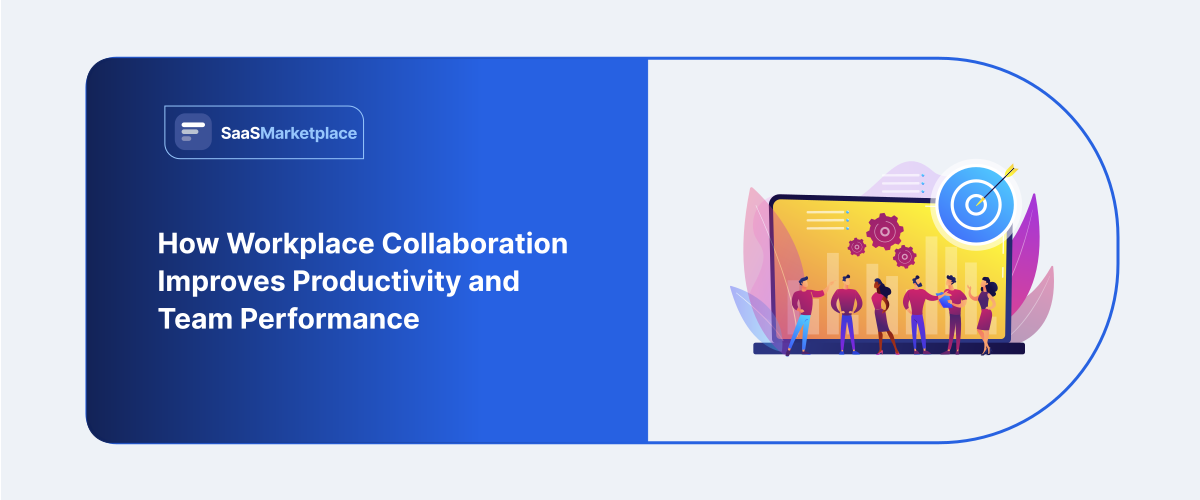
Step inside any successful technology company and you'll be flooded with pressure. Teams are scrambling to release the next update, land the big enterprise sale, and triage that urgent support request before a rival can muscle in and steal the win. In this new economy, sweat equity only takes you so far. Operational leverage comes down to how your people coordinate their daily efforts. Building a collaborative team culture is the key to growing a business. The moment you start to stop viewing them as separate entities and start viewing them as a unit, your progress towards expansion will accelerate.
 Looking for Project Management Software? Check out SaaS Marketplace List of the Best Project Management Software in USA for Your Business
 The days of professionals working in completely closed-off silos are officially over. In our interconnected business landscape, a single employee working in total isolation cannot solve complex client problems or build a modern tech platform. True survival requires an ongoing, transparent dialogue across your entire office. It means sharing raw data, calling out project blockers early, and stepping up to support cross-department initiatives without being asked. When you build a culture where information flows freely, your business creates a natural shield against market volatility.
What Is Workplace Collaboration?
This operational process is the way in which different experts are allowed to apply their skills, data, and ideas to create something specific for the company. People need to exclude their egos, show their ideas transparently, and be responsible for the result they created. It does not exist as a one-time initiative that your managers check off a spreadsheet after a product launch. Rather, it acts as a permanent cultural habit that dictates how your company executes work every single day.
1. Collaboration vs. teamwork
While corporate teams frequently scramble these phrases during boardroom meetings, they describe completely different dimensions of workplace culture. The baseline concept of teamwork centers around personal harmony, positive group morale, and supportive relationships within a single department. On the flip side, strategic workplace collaboration is the actual functional engine and tactical framework used to merge distinct, specialized skill sets to build a final corporate asset. You can look at daily teamwork as the welcoming environment, while the overall alignment process is the technical machinery that drives the actual execution.
2. Collaboration vs. coordination
It is equally critical to separate high-level joint problem-solving from basic administrative tracking. Basic coordination is a mechanical logistical task focused on aligning team schedules, assigning clear deadlines, and ensuring team calendars do not overlap.
How Workplace Collaboration Improves Productivity
1. Reduces Communication Gaps
Misunderstandings and missed messages drain valuable business hours and create immense frustration across your teams. By prioritizing open, direct dialogue, companies eliminate the dark information vacuums where costly project errors typically breed. Implementing transparent, reliable communication loops through Video Conferencing Software ensures that every developer, marketer, and designer stays completely aligned on current project parameters from day one.
2. Makes Information Easier to Access
Forcing your employees to search through the clutter of a personal hard drive or text messages to find a file that can't be found is a huge waste of human capital. By using Document Management Software to condense the resources of an entire company into one easily accessible location, all of your data is available for all who need it, when they need it. This radical visibility accelerates daily research tasks and keeps your operational momentum steady.
3. Improves Problem-Solving
A single professional, working in complete isolation from others, may find his or her ability to solve certain technical difficulties severely limited. By contrast, diverse expertise applied collectively within a brainstorming meeting has the potential to produce dramatically enhanced analytical power. Challenging each other’s ideas can help the team to identify alternate approaches, thus quickly overcoming complex hurdles.
4. Reduces Duplicate Work
When different corporate divisions fail to talk to each other, two separate teams often spend weeks building the same internal report or tool. Structured workplace collaboration keeps every ongoing initiative completely transparent across your organizational chart. This continuous visibility ensures your business never wastes precious capital or engineering hours reinventing the wheel.
5. Speeds Up Decision-Making
Slow decision-making processes and a number of approvals to be taken drain the productivity of an organization and lead to frustrations among employees. Business Intelligence Software can help executive management access the right information at the required moment, enabling time-sensitive decision-making and improving organizational agility. Doing away with these hurdles will significantly improve agility in responding to changes in the market.
6. Helps Teams Share Skills and Knowledge
A growing company cannot expand its market reach if the specialized expertise of its senior management is siloed within a small group of individuals. Joint cross-departmental projects enable the establishment of peer-to-peer knowledge exchange and sharing of practical trade secrets between more experienced and less experienced employees.
How Collaboration Improves Team Performance
To drive premium business results, you must guide your workforce through a natural lifecycle of mutual reliance. When an entity develops a convenient environment for people to perform their daily activities, every worker becomes responsible for achieving the best results within their departments. Individuals work together while pursuing common business goals and clearly defined targets for every team member. Such a strategy leads to creating a friendly environment where people do not compete with each other, thus resulting in bringing best-value products/services internally and externally.
Finally, it becomes possible to provide high-quality products/services for internal and external clients only when they are comfortable communicating with each other. Therefore, if employees know that their idea will neither be heard, mocked, nor will it make them a laughing stock of the team, the chances of getting the best performance by working in cooperation will increase.
Cross-Functional Collaboration in the Workplace
1. What cross-functional collaboration means
This operational concept refers to the method of combining the efforts of people who are working in different spheres within the company in order to address one comprehensive objective. It aims to dismantle the established workplace barriers and enable various departments to come together and unite their diverse expertise in order to achieve greater efficiency in terms of the overall performance of the firm.
2. Marketing + sales
When these two teams operate in separate worlds, marketing spends budget on leads that sales cannot close. Syncing their daily operations allows sales insights to refine target messaging. This direct alignment ensures your marketing assets attract high-value enterprise accounts.
3. HR + management
Having verbal agreements and talking down the hallway is a scary proposition. Any decisions, technical aspects, or changes should be put in some shared place for documentation.
4. Product + engineering
System engineers require absolute clarity to construct stable codebases, while product managers focus on feature value. Building a continuous loop between these two departments with DevOps Software helps development teams improve collaboration, maintain stable codebases, and avoid building features that users do not want, saving months of capital.
5. Customer support + product
Help Desk Software helps your support staff organize and share real-world user frustrations with product teams every single day. Passing these technical data points directly to your product design teams shapes your software development roadmap. This user-focused alignment directly elevates long-term retention metrics.
6. Benefits and common challenges
While cross-functional work holds the power to maximize organizational efficiency, poor coordination often breeds dangerous duplicate work and massive miscommunication. Left unmanaged, separate teams can quickly develop competing internal priorities that drag down production.
How AI Is Changing Workplace Collaboration
1. AI-assisted communication
Modern language models can instantly clean up rough project drafts or adjust internal memos to hit the perfect professional tone. This simple automation removes writing anxiety, allowing your technical specialists to share their insights with extreme clarity.
2. Meeting summaries
Advanced transcription software can analyze an hour-long strategy meeting in seconds. It generates concise summaries, lists clear action steps, and highlights specific owners. This technical upgrade allows absent teammates to get updated instantly without wasting time watching long recordings.
3. Knowledge discovery
Searching through years of corporate files to find a specific policy or old technical solution is an immense waste of human capital. Intelligent indexing tools let workers query your internal databases using natural language, serving up the exact answer in a flash.
4. Task automation
By letting computers handle the mundane tasks associated with project management, an organization can save time on administrative work. This allows them to dedicate more of their human hours towards getting the actual work done.
5. Human-AI collaboration
Humans working in harmony with computers can have a beneficial effect on the workers. Teams that are able to use the tools provided by computers can finish their projects in a fraction of the time they originally took.
6. Maintaining human decision-making
While automated analytics tools bring incredible speed, they must never make the final executive call on strategic directions. Keeping human judgment at the center of your shop safeguards your corporate ethics.
How to Improve Workplace Collaboration
Building a highly integrated workplace requires your leadership team to implement deliberate, structured changes across your daily workflows. First, you must set shared goals that get every single department moving in the same direction. When your teams share a common destination, petty cross-department friction disappears entirely. Next, define roles clearly from day one to eliminate project confusion and duplicate efforts. Every employee should know clearly about his or her ownership and the boundaries of their responsibility, as high personal accountability is usually defined by the former.
Moreover, it would be essential to develop rules of communication by providing a brief, one-page guide of the social networks that they should use for specific tasks. Setting these boundaries protects your workforce from notification exhaustion and preserves their daily energy for heavy execution tasks. Centralize information now by cutting off the temptation to save project files on personal hard drives and private conversations. Create an environment where people can feel safe admitting ineffective processes. People would do better if they knew you trusted your experts to handle things without constant control and oversight.
Conclusion
Building a highly profitable modern enterprise means moving far past cold, transactional daily task lists. Real corporate survival is driven by understanding how to orchestrate meaningful team collaboration across every department. When a growing firm commits to investing in its shared communication spaces, every single business unit benefits from increased clarity and sharper execution.
FAQ's
This represents a structured action framework where corporate teams merge their unique professional skills, data systems, and creative insights to achieve a specific business milestone, vastly improving the overarching corporate output.
It reduces daily operational costs by minimizing communication delays, shortening the time to communicate critical project-related information necessary for decision-making, reducing duplication of effort in large projects involving several teams, and shortening approval chains, enabling line workers to make decisions with minimal bureaucracy.
Teamwork fosters a sense of belonging that improves employee engagement, which, in turn, increases productivity, improves the sharing and utilization of resources among workgroups, improves psychological safety at the workplace, and speeds up the exchange of trade secrets and other vital information between workgroups.
Organizations can optimize their internal alignment by establishing clear, shared business targets, setting explicit boundaries around off-hours communication, removing useless meetings from calendars, and centralizing all files inside a single database.