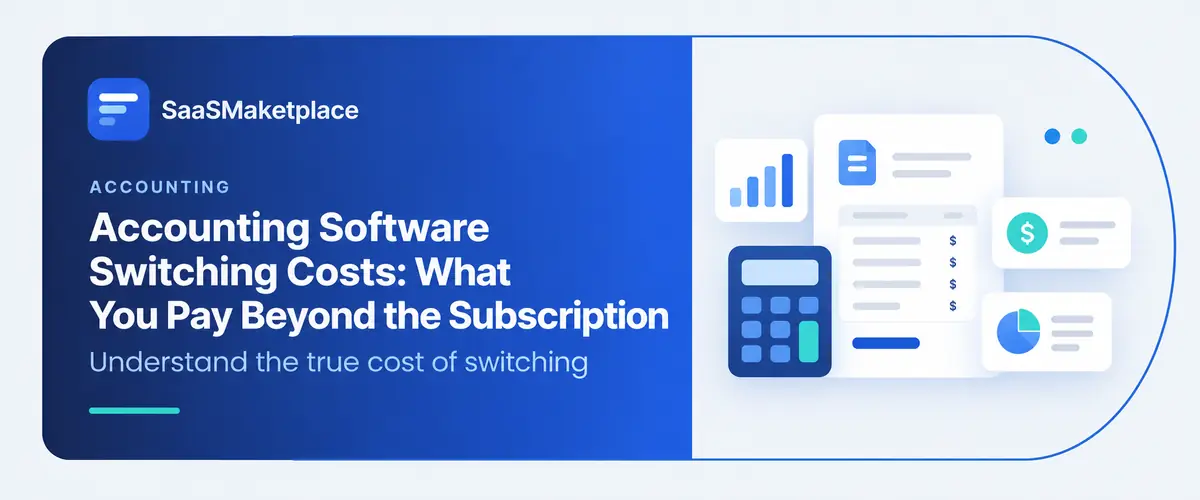
Accounting Software Switching Costs: What You Pay Beyond the Subscription
-min.jpg)
Changing accounting software does not merely mean substituting the monthly subscription with another fee, as the majority of firms in the US face higher costs that are a result of hidden friction associated with their operations and switching expenses. Even if a new service provides lower prices on a monthly basis and better options, the real costs related to the migration process include the transfer of historical data, retraining employees, lost productivity during switching, and the need for rebuilding integration with third parties. Moreover, the time that is spent on duplicate books reconciliation, checking migrated chart of accounts, and the fees for consulting services means that in most cases, the companies will realize that the subscription only corresponds to a small part of all the expenses associated with implementation of a new accounting service.
What Is Accounting Software Switching Cost?
A switching cost of accounting software means a total monetary, operational, and organizational burden that businesses bear when transitioning their core financial management platform. Switching costs include various hidden costs, such as the formation of a new system, data extraction, historical migration, and reintegration of third-party APIs. In addition, accounting software solutions influence all aspects of revenues, expenses, payrolls, and regulations which leads to immediate consequences for the whole organization upon any changes.
Switching costs are not limited to monetary procedures; they also involve indirect costs related to time, productivity, and human mistakes. Thus, during the process of migration, finance teams should retrain while running parallel payrolls and other systems in order to reconcile numbers. The dropping efficiency of employees during migration and the risk of errors in processing of historical accounts leads to a phenomenon known as a switching barrier, and, thus, businesses evaluate switching costs by not only the number of invoices they receive but also the extent of organizational disruption they will undergo.
Did You Know?
Switching costs refers to a major economic barrier for software providers in the financial services sector. Studies show that for businesses, the cost of enterprise software implementation may include additional non-software costs such as data cleansing, custom interface development, and employee training that can amount to 3-5 times the price of the software license purchased. Given that the switching costs can be quite high and associated with significant risk, it is possible for companies to retain their outdated accounting software long after they should move onto effectively new programs.
What Are the Hidden Migration Costs?
1. Cleaning, Extracting, and Transforming Data
Historical data rarely comes ready for use in new applications; one must first verify, clean, and reformat the accounts and financial records before initiating the new system.
- COA Alignment: Carrying out the process of mapping old codes, classes, and cost centers into the ledger structure of a new platform takes time and effort.
- Data Cleaning: This process refers to eliminating the duplicated vendor profiles, solving unallocated transactions, and correcting the misformatted past client records.
- Collection and Transformation: Extracting years of data from outdated databases sometimes requires writing custom scripts or using paid services of migration.
2. Cost of Implementation and Setup
Setting up the accounting system for enterprise compliance involves more than creating the account.
- Consultancy Fees: The services of specialized implementation companies, as well as certified accountants and software consultants, are needed for developing workflows, updating approval hierarchy, and setting up customized reporting templates.
- Costs of Parallel Running: Old system and new system should work in parallel for several billing cycles which increases administrative efforts considerably during changeover process.
3. Merging Third-Party Ecosystems
Accounting software is the core component of the company's technology system. If it is disconnected, all connected tools will fail.
- Custom API and Integration Reconstruction: Restoring secure connections between your accounting software and customer relationship management system, e-commerce store, payroll system, or inventory management system.
- Payments Gateway Reconfiguration: Updating merchant processors, reccurring customer bills, or automatic banking feeds to avoid banking errors.
What Does Data Transfer Really Cost You?
When transferring financial and accounting data to a new platform, financial costs exceed merely the cost of data extraction. The real costs incurred by financial data transfer are:
- Export and API Access Fees: Legacy software vendors will charge export fees, exit penalties or simply say goodbye (it's a little more complicated than that of course) and access to the raw data such as a database may be prohibited so you are forced to either pay money for property management migration tools or have developers build custom scripts to extract historical records.
- Third-Party Migration Services: The sophisticated data mapping, conversion and transfer of multi-currency ledgers, inventory balances and open invoices take specialized tools to execute safely costing thousands of dollars at times with technical consultants frequently needed.
- Historical Data Clean-Up & Sanitisation: Moving unstructured data results in costly mistakes in the new system by requiring billable staff (or consultants) to spend hours auditing, de-duping and standardising historical transactions ahead of the move.
- Mapping Schema & Chart of Accounts: Cross-verifying mismatched account structure, tax categories, & customer/vendor fields between two completely different software architectures is a manual enterprise-level line-by-line comprehensive job.
- Keeping Costs for Maintenance of the Old System: During the migration and validation period, companies frequently have to retain duplicate subscriptions within their legacy systems as well as in the new one to guarantee that operations are not interrupted.
- Post-Transfer Reconciliation and Audit Checks: To ensure that every starting balance, trial balance or historical ledger line matches perfectly across systems requires significant amounts of paid labor and internal audit cycles post-migration.
- Compliance & Cold Storage Archiving: Not all data can always be seamlessly migrated into a new database, so companies have to.
What Are the Training and Productivity Loss Costs?
1. Outside Education & Certification
There is more to getting your finance and accounting teams up to speed on a new ledger system than just watching some basic video tutorials.
- In-person Workshops: Onboarding enterprise-level financial software often requires costly certified implementation partners, vendor-led workshops, or professional 3rd party trainers.
- Function-Specific Training: You must have different onboarding paths for core accountants (journal entries, reconciliations), department managers (budget approvals, expense tracking), and executive leadership (custom financial reporting and dashboards).
- Learning Materials & Licensing: Provided educational resources and sandbox test environments come with a user certification fee adding direct invoice costs to the implementation budget.
2. Immediate Fully Productivity (The Learning Curve)
Familiar workflows disappear, and daily task output slows down naturally during the adjustment phase.
- Slower Routine Tasks: It takes considerably more time for employees to process accounts payable, run weekly payroll and issue invoices as they search for settings in a new interface, get adjusted to recently implemented keyboard shortcuts and move through an unfamiliar user experience.
- Context Switching & Friction: So much effort is wasted every day with finance teams second-guessing routine entries because of apprehension on what the numbers really say. This disorientation leads to operational fatigue, and short term drops in daily throughput.
3. Extended Month-End and Quarter-End Closes
The real test comes during financial close cycles as new accounting software will help to speed up the financial processes.
- Secondary Financial Statements: A new reporting module and unfamiliar balance sheet formats have taken several vital month-end closes from days to weeks.
- Overtime Labor Expenditures: Internal professionals who are learning a new system can incur large overtime payroll costs to meet regulatory, tax or investor reporting deadlines.
What Are the Integration and Customization Costs?
The costs to connect a new accounting platform to your larger technology stack typically outweigh the software’s base sticker price. Getting data to flow automatically between software tools is a question of upfront engineering, custom development and long-term maintenance because financial systems are often referred to as the single source of truth across an organization.
- Customized API Connector: Unique operational workflows are hardly created with out-of-the-box native integrations. Custom scripts connecting your new ledger with proprietary CRMs, inventory systems, or e-commerce storefronts need to be written by either engineering teams or hired specialists.
- From Third-Party Middleware and Sync Subscriptions: When native connectors don't exist, companies face monthly or yearly maintenance for middleware solutions purpose-built enterprise middleware to move data between apps.
- Customized Workflow and Approval Hierarchy Setup: Creating and AB testing multi-level purchase order approvals, invoice routing rules, automated bill matching, and commission structures are incredibly time-consuming.
- Custom Financial Reporting and Dashboarding: Out-of-the-box balance sheet and income templates do not meet executive, board or investor needs, leading to consulting contracts to design customized reporting formats and data visualization flows.
- Payment Gateway and Merchant Processor Re-linking: Changing payment processors, re-connecting recurring subscription or automated bank feeds can require database repoint there are configuration fees as well as testing to avoid cancelling billing cycles of customers.
- Continuous API Maintenance and Maintenance Fee: Software providers continuously update their external code and API protocols. When an integrated platform pushes a software update, your engineering team will now have to update and debug those custom connectors so systems continue syncing without error.
Pro Tip: Conduct an audit of your tech stack before signing a software contract and always request a proof-o-concept for any native integration they promise. Choose platforms that have well-documented, open REST APIs as their only integrations, and pre-built connectors for your primary tools linking these can easily add thousands of dollars to your initial rollout budget before you even begin.
Conclusion
Navigating an accounting software transition requires evaluating far more than just surface-level subscription rates. As highlighted, the true cost lies in data cleanup, custom API integrations, staff training, and temporary operational friction. Accounting teams must account for these hidden migration expenses early to build a realistic timeline and budget. When you are ready to evaluate new financial platforms or explore complementary tools to streamline your tech stack, head over to SaaS Adviser a leading digital platform where you can discover, compare, and buy any business software to drive your company’s long-term growth.
FAQ's
The major expenses beyond subscriptions include historical data migration, custom API integration rebuilds, staff training, and temporary productivity loss during cutover.
Data migration costs escalate when legacy records require extensive manual cleaning, formatting, or mapping to align with the new platform's chart of accounts.
Most businesses pay for both the old and new software concurrently for 4 to 8 weeks to run parallel tests and verify financial reporting accuracy before final cutover.
Yes, changing your primary ledger usually requires re-configuring or custom-coding connections to your CRM, payroll provider, bank feeds, and payment gateways.
Lets you compare pricing tiers, integration capabilities, and deployment fees across accounting platforms to estimate your true total switching cost.