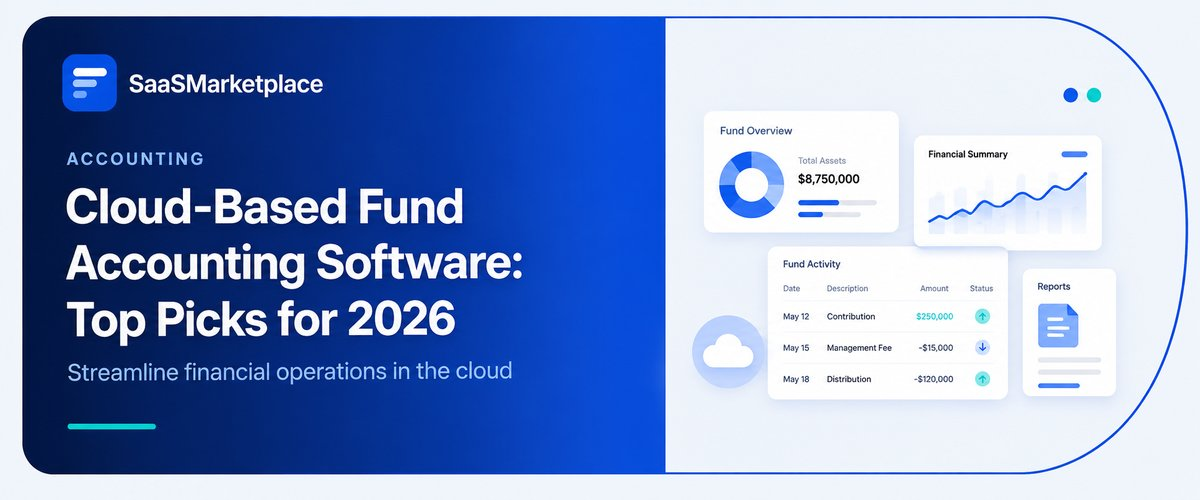
Cloud-Based Fund Accounting Software: Top Picks for 2026
-min.jpg)
Successfully navigating the complicated financial environment of the United States requires not only agility but also institutional security, along with real-time supervision of private equity, venture capital, and hedge funds. Since 2026, the transition to the use of cloud-based approaches and tools for fund Accounting software has progressed from being a competitive advantage to a must-have necessity, due to stringent SEC compliance rules, LP demand for transparent information, and the introduction of AI-driven processes in portfolio Accounting. Modern fund managers in the USA use cloud-based platforms that make it possible to automate capital calling, improve investor relations, and organize all back-office processes in a single cloud-based platform.
What Is Cloud-Based Fund Accounting Software?
Successfully navigating the complicated financial environment of the United States requires not only agility but also institutional security along with real-time supervision of private equity, venture capital, and hedge funds. Since 2026, the transition to the use of cloud-based approaches and tools for fund accounting software has progressed from being a competitive advantage to a must-have necessity, due to stringent SEC compliance rules, improved investor relations, and the need to organize all back-office processes in a single cloud-based platform.
With LP portals that are fully integrated, fund managers can simplify the process of communicating with investors and raising funds. GPs can also send important documents, call notices, and quarterly reports to LPs easily through encrypted cloud access. Automating the process enables the Accounting team to reduce the workload for back-office operations, decrease the turnaround time for collections, and ensure that the institutional investors are aware of all operational metrics of the portfolio.
Why Is Cloud-Based Fund Accounting Software Important for the US Market in 2026?
1. Meeting Rising SEC Reporting Obligations
Regulatory pressures in 2026 create a situation of faster and more detailed reporting for American asset managers. Regular reports such as Form PF revisions, Form 13F along with documents showing proxy votes, and monthly reports under Form N-PORT necessitate constant data aggregation. Manual record checking processes are replaced by automated processes in the cloud, which allow compliance departments to avoid delays and failures in reporting.
2. Accommodating Complex and Multi-Asset Investment Strategies
US private capital industry evolves toward mixed approaches, making use of venture capital and private equity investments as well as real estate and private credit. Outdated Accounting software is no longer able to work with multi-tiered waterfalls, intra-company capital flows, and ever-changing co-investment agreements. Thanks to the new cloud solutions used, companies have the technology that permits them to manage flexible ledgers.
3. Providing Investor Transparency On-Demand
In 2026, institutional limited partners believe they will have a system to operate independently and check their portfolios, document management, and capital at any time and without the need for other parties’ involvement. Thanks to cloud technology, it has become possible to set up secure portals for online access by investors to their bank statements, internal rate of return (IRR) figures, and other data, removing the necessity of sending official requests by email and improving communication with the firms they cooperate with.
4. Expanding Business Operations through AI and Automation
Companies have to grow their assets under management (AUM) without increasing their personnel in the back office. The cloud computing system uses artificial intelligence to perform the operations that require a lot of manual work, such as reading the contract terms, reconciling bank records, providing data for K-1 forms, and capital calls.
What Features Should You Look for in Fund Accounting Software?
1. Multi-Tier Fund Accounting and Automated Waterfall Calculations
An ideal platform provides advanced general ledger capabilities for complex fund structures like master-feeder funds, parallel vehicles, and co-investment dealings. Look for one that has automated waterfall modeling for real-time calculations of key parameters like hurdle rates, clawbacks, Accounting fees, and carried interest splits. As a result, manual calculation is eliminated, leading to a reduction of potential human errors and ensuring faster, more reliable distribution Accounting.
2. Encrypted LP Portals and Streamlined Investor Communications
An ideal system will consist of a branded self-service LP portal that helps in raising capital and managing relations with investors. The LPs must be able to sign digital subscription agreements, receive capital call notifications, view payment statements, and download Schedule K-1 in a secure manner. Encryption in combination with activity logging and access control methods protects sensitive data from third parties and therefore minimizes repetitive requests for back-office assistance.
3. Real-time Portfolio Examination and Look-through Analysis
Fund managers require a continuous view on their portfolio status, risk factors, and asset estimations. Advanced software will include a look-through exposure analysis enabling GPs to assess each asset detail by geography, sector, or asset class, even in nested structures and FoFs. Real-time dashboards collecting NAV, IRR, and MOIC will facilitate decision-making and high-quality reporting during LP updates.
4. Automated SEC Compliance and Reporting systems
With regulations being on the rise, the software has to have all required workflows for mandatory filings in the US. The perfect software would manage this by aggregating data from the fund ledger to standard reporting templates directly.
Which Cloud-Based Fund Accounting Software Options Are the Top Picks for 2026?
1. Zoho Books
- An online Accounting software created to optimize complete financial processes and income Accounting.
- Offers automated recurring invoice billing, payable handling, and multi-currency Accounting options.
- Includes live bank account reconciliations and customizable financial statement dashboards.
- Has seamless integration with enterprise applications, CRMs, and payment systems.
- Has simplified compliance Accounting, providing automatic tax rules and calculations according to the jurisdiction.
- Offers cooperation portals for clients and a mobile application for operating anywhere.
2. Sage Accounting
- A well-known cloud Accounting software designed for small and medium-sized companies and property owners.
- Offers core functions of general ledger Accounting, multi-organization Accounting, and cash flow forecasting.
- Automates bank transaction processing and invoice tracking, as well as approvals for vendor expenses.
- Has enterprise-level security systems, an audit trail, and permissions for everyone involved.
- Has improved the process of tax reporting and Accounting with the help of templates.
3. Ficsus.nl
- An innovative online solution for managing finances aimed particularly at independent workers along with small businesses.
- It helps make everyday expense Accounting easier as well as capture of electronic receipts plus automated invoicing.
- Partners involved are interconnected across functional areas of hour tracking, mileage recording, and even elementary CRM techniques as well as tools.
- The company instantly computes VAT amounts as well as electronically files taxes in compliance with all safety standards.
4. SnelStart
- A cloud solution for bookkeeping intended particularly for growing businesses, SMEs, as well as companies working in finance.
- This tool speeds up all primary operations related to finance, including data processing, quotation creation, and invoicing.
- The platform allows accessing financial institutions online, making it available for companies to see their cash flows and reconcile payments effectively.
How Does Cloud-Based Fund Accounting Software Improve Efficiency for US Businesses?
The efficiency of fund Accounting in US investment firms has greatly improved as a result of using cloud-based software. It replaces the tedious and time-consuming process of doing everything manually. Previously, entering information in spreadsheets took several days. Now, tasks that used to require days can be done in a matter of minutes. As a result of eliminating human errors and automating the updates of accounts, firms can save on staffing as well as complete difficult operations flawlessly.
With the centralization of data within one cloud system, all operational information becomes accessible in real-time for every member of the team, regardless of their location. General partners, compliance officers, and CFOs can examine it from any area within the United States. Access to relevant data in real time enables companies to solve challenges more quickly.
With the advent of cloud technology, investor communication and regulatory reporting have become frictionless and simplified the capital cycle Accounting. With the applications that encrypt investor portals, the general partners may effortlessly sign their subscription agreements, check performance reports, and download tax forms. Moreover, with the help of the already programmed compliance engines, the reporting information is retrieved from the central ledger to report to regulatory authorities without any violations of the usual workflow.
What Are the Costs of Implementing Fund Accounting Software in 2026?
Implementing cloud-based fund Accounting software in 2026 involves both predictable recurring costs and upfront integration expenses. Total Cost of Ownership (TCO) varies widely depending on Assets Under Accounting (AUM), fund structure complexity, and the depth of custom workflow automation required.
Below is the cost breakdown across the key layers of software deployment in the US market:
1. Software Subscription Fees (Annual Recurring Cost)
Pricing models: most platforms charge according to their total AUM, number of active funds, or number of end-users of the software (general partners, CFO, operations director).
Emerging Funds ($10M-$100M AUM): Approximately $10,000-$35,000 yearly for fundamentals of fund Accounting, cap table maintenance, and simple LP portals.
Mid-Market Funds ($100M-$1B AUM): Estimates range from $35,000-$120,000 or more annually, covering the needs of tiered waterfall calculations, built-in compliance tools та advanced look-through analytics. Institutional/Multi-Fund Companies ($1B+ AUM): Individual pricing for organizations, which is often more than $150,000-$300,000 per year.
2. Initial Purchase Fees (One-Off) Implementation & Configuration
Vendors or some outside assembly companies charge single service fees to create historical accounts, organize ledgers, formulate waterfall patterns, and set access levels. Cost Range: Generally from 25% to 100% of first-year software license expenses (from $5,000 for simple nascent funds to $50,000 or more for sophisticated PE or multi-entity systems).
3. Data Migration and Historical Cleanup (One-time)
Data Scraping and Mapping: Moving from old historical financials, including cap tables, capital calls, and LP profiles, from old spreadsheets and disconnected desktop systems to new systems requires extracting and reconciling the data. Cost Range: $3,000 to $20,000 depending on how much historical data is required to be cleaned before migrating.
How Do You Choose the Right Fund Accounting Software for Your Business?
1. Match Platform Features to Your Asset Class
Make sure that the software fits your specific funds, such as capital goods, private equity, or real estate. If a platform addresses your asset class, it means that it includes features such as built-in waterfall models and debt measurement tools.
2. Check Pre-Packaged Compliance Cover
Look for programs that help collect the necessary information for SEC filings. Choose a provider with solid experience in updating the software when there is a change in SEC tasks or IRS tax reporting.
3. Examine General Ledger Functionality and Waterfall Automation
Find a complex general ledger that helps to automate complicated processes concerning carried interest, clawback calculation, hurdle rates, and profit sharing.
4. Focus on the Safety Standards of the Security Architecture and the Ease of Use of the LP Portal
Make use of the software that is going to be compliant with SOC 1/SOC 2 Type II and implement zero-trust and end-to-end encryption for communication with investors. The portal must be able to provide LPs with a user-friendly interface through which users will be able to execute all documents needed to invest, get information on performance, and access K-1 forms.
5. Check the API Integration Compatibility with Your Current Technology Stack
Make sure that the product you are considering features an open API so that it can easily connect with your current customer relationship, accounting tools, banking backend, and transaction-planning solutions.
Conclusion
Moving to cloud-based fund Accounting software in the year 2026 is no longer an option for progressive US investment companies. It has now become the basis for achieving operational efficiency, LP transparency, and overall readiness for the regulations. The appropriate selection of the right platform helps convert difficult portfolio Accounting, SEC filings, and the movement of capital into straightforward and automated processes. For the purpose of comparing and selecting the top technology suitable for your company’s unique approach to the market, you need to turn to SaaSmarketplace, the best place for obtaining the necessary data for comparing, buying, and locating excellent business software solutions for your fund.
FAQ's
It is an internet-hosted platform that centralizes portfolio Accounting, investor communications, and regulatory reporting into a single secure digital environment.
Leading platforms protect sensitive financial data using SOC 2 Type II certifications, zero-trust access controls, role-based permissions, and end-to-end encryption.
Implementation usually ranges from 4 to 12 weeks, depending on the complexity of historical fund data, multi-entity structures, and custom API integrations.
Yes, modern solutions feature dedicated general ledgers that automatically compute hurdle rates, Accounting fee splits, and carried interest distributions.
Yes, top systems provide automated compliance modules that aggregate live ledger data directly into required filings like Form PF, Form 13F, and Form N-PORT.