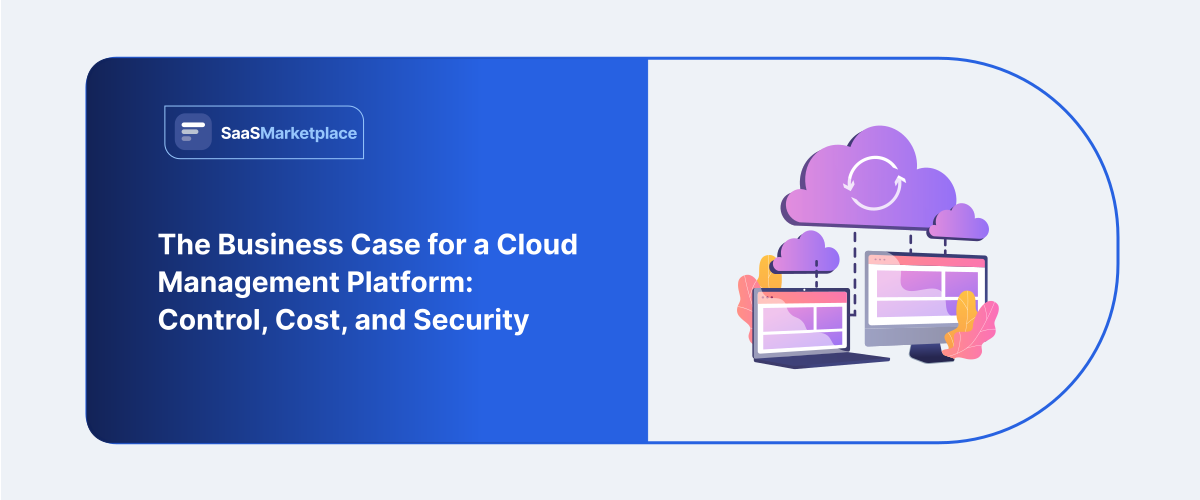
The Business Case for a Cloud Management Platform: Control, Cost, and Security
-min.jpg)
Modern companies do not run on a single server room anymore. Instead, engineering teams push applications across Amazon Web Services, spin up databases in Microsoft Azure, and host specialized analytics models inside Google Cloud Platform. On top of that, legacy on-premises hardware often stays plugged in to support compliance rules or custom databases. This setup gives developers incredible speed.
They spin up server instances with a credit card in seconds. But for finance directors, security officers, and system architects, this setup creates massive operational headaches. Monthly cloud bills arrive with thousands of line items that nobody understands. Idle virtual machines burn money overnight. Security settings vary wildly across accounts. This chaotic growth forces business leaders to ask a tough question: at what point does your organization actually need a cloud management platform?
Signs Your Business Needs a Cloud Management Platform
Not every company running cloud infrastructure needs a dedicated cloud management platform right away. A small team running a handful of servers on a single provider can often manage things through the provider's own dashboard without much trouble. The real need for a cloud management platform tends to show up under specific conditions:
- You are running workloads across more than one cloud provider and losing track of what is where.
- Your monthly cloud bill has grown large enough that nobody can fully explain every line item.
- Different teams are provisioning resources without a shared process, leading to duplicate or forgotten services.
- You need consistent security and compliance rules applied across multiple environments.
- Manual tracking of cloud resource management has begun causing real mistakes, such as unexpected charges or unpatched systems.
Through a single unified cloud dashboard, executives and lead engineers get immediate answers to critical operational questions. You can see exactly how much money your payment processing team spent this morning, which storage units lack encryption, and which virtual machines are running idle.
Do You Know?
Recent sector surveys indicate enterprise companies lose between 28% and 32% of their total cloud expenditures as compute instances sit dormant, more than they need or are abandoned. By spotting unused resources and improving server sizing, a focused cloud management platform enables finance departments to often cut monthly provider costs by as much as a third in the first 90 days.
Comparing Unmanaged Infrastructure vs. CMP Governance
To understand the business impact, look at how daily technical tasks operate with and without centralized platform controls:
|
Operational Focus |
Unmanaged Multi-Cloud Setup |
Governed Cloud Management Platform |
|
Cost Tracking |
Fragmented spreadsheets; quarterly surprise bills. |
Real-time cloud cost optimization with automated spend alerts. |
|
Access Control |
Separate passwords and permissions per vendor console. |
Unified policy enforcement across every connected account. |
|
Resource Provisioning |
Manual setup per environment; high human error risk. |
Standardized resource provisioning via automated templates. |
|
System Visibility |
Blind spots between public cloud and local servers. |
Total infrastructure visibility across all connected workloads. |
|
Security Auditing |
Manual compliance checks that take weeks to complete. |
Continuous tracking of your cloud security posture. |
Four Core Capabilities Driving Enterprise Adoption
If engineering directors evaluate the purchase of a cloud management platform, they usually encounter four specific operational difficulties.
1. Unified Multi-Cloud Governance
As companies acquire other businesses or expand product lines, they receive diverse technology stacks. For some engineering teams, the preference is AWS, while others rely on Azure and a newly acquired startup runs on Google Cloud. To manage compliance rules across three distinct ecosystems with native tools is difficult to a degree that is extreme.
A cloud management platform establishes standardized multi-cloud governance across every account. You define cloud security requirements, tag structures, and budget caps once. The platform automatically enforces those guardrails across every vendor environment, preventing rogue setups before they launch.
2. Intelligent Cost Tracking and Optimization
Cloud bills are famously confusing. And vendors charge by the second for compute power, network egress, storage tiering & API calls. To find the reason why a bill increased by $15 000 in the previous month, an employee must search through tens of thousands of raw ledger entries. Modern platforms bring sanity to financial tracking through continuous cloud cost optimization.
With this software, the system scans your global footprint so that it can find virtual machines that are larger than necessary, detached storage volumes, and unattached IP addresses. The software gives your team direct recommendations. As an example, you can downgrade an instance that is not used frequently, buy a reserved instance for a workload that is steady or shut down development environments on the weekend.
3. Automated Workload Management and Scaling
Manual IT operations are no match for modern software speed. Your customer web application experiences a traffic surge at 2:00 AM. If your engineer has to wake up to add more servers, your system will be down.
Using automated workforce management, your infrastructure automatically scales your resources up and down based on live application traffic. The software deploys additional capacity instantly when traffic spikes. When traffic drops down again on Sunday morning, unnecessary servers power off so you stop paying for them.
4. Comprehensive Infrastructure Visibility
It is not possible to secure or optimize things that are invisible or that we do not see. Shadow IT flourishes in disjointed environments. A developer establishes a public storage bucket in order to share test data with a contractor but forgets to secure it. Months go by, and that open bucket lies exposed on the Internet.
Security teams get total visibility of the infrastructure by using a centralised cloud management platform. The platform offers a real-time view of the digital inventory of every database, server, container and virtual network security across your global estate. In case the storage bucket gets unencrypted, or a firewall port opens, the platform alerts your security team immediately.
Navigating the Hybrid Cloud Reality
While many organizations aspire to take all operations to the public cloud, reality is far from that. Financial institutions, healthcare providers, and even manufacturing firms often have to keep core databases on physical hardware in private data centres.
Managing a hybrid cloud environment gives rise to a unique challenge. In addition to advanced cloud-native services, your sysadmins must use conventional on-premises virtualization tools.
A modern cloud management platform helps bridge the gap between on-premises servers and public cloud regions to solve the split-brain problem. By abstracting the underlying hardware, your team can now manage local servers and cloud instances through the same workflow. That uniformity decreases the training burden and simplifies contingency planning.
Standardizing Resource Provisioning and Developer Velocity
The speed largely determines engineering productivity. When developers are forced to request an IT ticket and then wait four days for a database to test, the software release cycle grinds to a halt. On the contrary, granting developers unrestricted admin credentials leads directly back to chaotic cloud sprawl and runaway spending.
A cloud management platform provides the perfect middle ground through self-service portals. IT leaders build pre-approved infrastructure templates that follow all corporate security and budgeting rules. From a menu, developers choose a pre-configured configuration to deploy.
This automated supply of resources delivers on-demand and on-time the desired sandbox environment to developers, at scale in minutes, while ensuring all new deployments meet corporate governance standards.

Pro-tip
Before deploying a cloud management platform, execute a thorough tagging cleanup across all current cloud accounts. Ensure every active workload carries tags for owner, department, and environment (such as production, staging, or testing). Clean resource tags allow your new software to generate accurate cost-allocation reports from day one.
Strengthening Security Posture and Compliance
Data breaches are ruinously expensive. Regulators impose massive financial fines for data leakage, and customer trust is difficult, if not impossible to restore. Security Settings Vary Dramatically between Cloud Vendors in Multi-Cloud. A security policy that works cleanly in AWS requires completely different syntax and configuration in Azure or Google Cloud.
A cloud management platform continuously monitors your global cloud security posture across all connected environments. It translates complex vendor settings into unified security compliance metrics.
The program frequently compares your setup against industry norms including PCI-DSS, ISO 27001, SOC 2, and HIPAA. Should a system setup stray from a compliance standard, the platform can either automatically reset the setup or start an automated repair procedure to stop exploitation.
Smarter Capacity Planning for Future Growth
Predicting future infrastructure needs used to involve guesswork. System administrators looked at last year's hardware usage, added 20% for safety, and bought expensive physical servers that sat half-empty for months.
Cloud infrastructure changed the purchasing model, but predicting usage remains tricky. If your customer user base grows by 50% next quarter, do you know exactly how many extra database nodes and network gateways you will need?
Using historical usage data to run predictive analytics, an enterprise cloud management platform eliminates any uncertainty involved in forecasting. The software simplifies capacity planning with long-term memory, storage, and CPU consumption tracking. It will give you a precise idea of when your existing server reservations will expire and how anticipated software launches will alter monthly vendor bills.
Managing the Central Dashboard Experience
Organizations run the risk of overburdening their busy IT teams. If a management tool sends thousands of alerts with no formatting to engineers, your teams soon suffer from alert fatigue and miss critical system alerts.
A custom cloud dashboard that changes data display according on the many levels of the company.
- For Chief Technology Officers: Top-level data for Chief Technology Officers includes total monthly cloud expenditure across the company, percentage of security-compliant transactions, and world uptime percentage.
- For DevOps Leads: Live telemetry tracking API error rates, container health, deployment success rates, and active auto-scaling events.
- For Financial Operations Managers: Detailed cost breakdowns by team, tag, project, and vendor, complete with variance forecasts for the current fiscal quarter.
Every stakeholder may make much faster and more precise decisions when they see relevant information fitted to their own needs.
Conclusion
Your infrastructure size will determine whether you choose a cloud management solution. Working across several cloud providers or running complicated local settings without central control will surely cause escalating expenses, security blind spots, and developer friction. Setting up a focused platform gives complete infrastructure insight, automatically allocates resources, and enforces tight multi-cloud control. Bringing your architecture under one functioning layer transforms scattered cloud accounts into a strong, safe technology engine created for sustained long-term development.
FAQ's
One interface of a cloud management solution combines monitoring, security, automated scaling, and cost tracking across hybrid and multi-cloud settings.
It finds unassigned virtual machines, notifies managers when resource consumption deviates from normal budgets, and helps to enforce worldwide spending caps.
Yes, modern platforms support a hybrid cloud environment, tracking local virtualization setups alongside public cloud regions.
It provides self-service templates that enable engineers in minutes to start pre-approved settings without infringing company security guidelines.
Unorganized teams create cloud accounts and virtual machines without unified tagging, rules, or offboarding procedures; that is cloud sprawl.