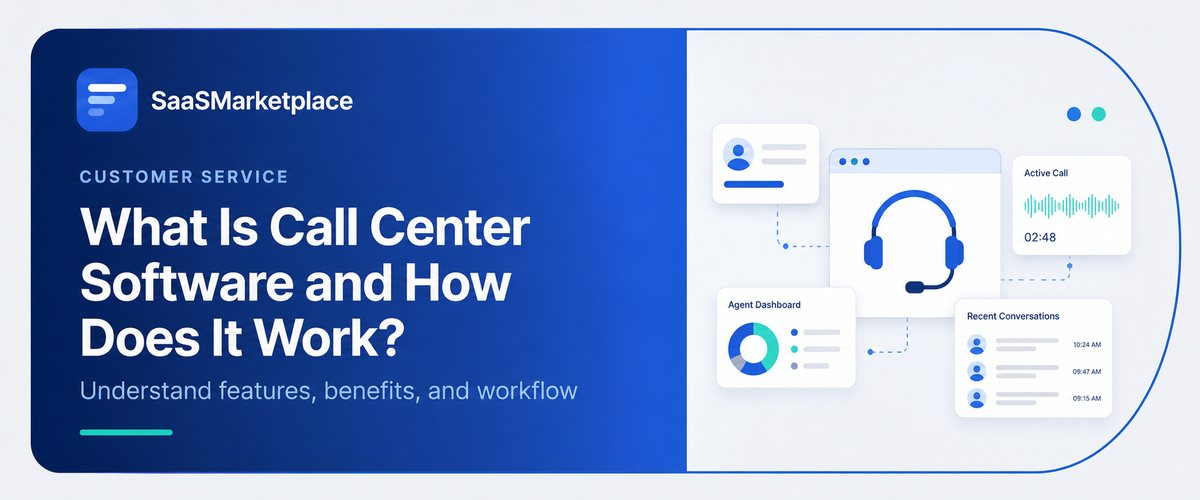
What Is Call Center Software and How Does It Work?
-min.jpg)
A customer calls in twice about the same issue, and two different agents give two different answers. That's usually not a training problem it's a systems problem, and it's exactly what call center software is built to solve. At its core, this software routes calls, tracks customer history, and connects agents to the tools they already use, like CRM Software and Help Desk Software. For U.S. companies fielding steady call volume, it's become less about sounding professional on the phone and more about giving every agent the same accurate picture of who they're talking to.
 Looking for Call Center Software? Check out SaaS Marketplace’s List of the Best Call Center Software in the USA for your business.
Why This Category Exists in the First Place
Phone support used to run on little more than a switchboard and a notepad. That worked fine when call volume was low and agents mostly handled repeat customers they already knew by name. It stopped working once businesses scaled past a handful of agents and callers started expecting someone to already know why they were calling.
Call center software grew out of that gap. It wasn't invented to make phone support look impressive it was built because businesses kept losing information between calls, between shifts, and between departments. Sales teams tracking leads in Sales CRM Software had no visibility into support tickets. Support agents using Service Desk Software had no idea a customer had just been pitched a renewal. Managers, meanwhile, were stuck guessing at call volume trends from whatever spreadsheet someone remembered to update that week. The software exists to close that gap.
What Call Center Software Actually Does
Strip it down and call center software just manages incoming and outgoing calls, routes them to whoever should take it, and logs what happened. That's the bare version. Most platforms sold today do a lot more automatic call distribution, IVR menus, call recording, live analytics, and a tie-in with CRM Software or AI CRM Software so an agent's screen already has the customer's history loaded before they even say hello.
That last part is really where the value sits. Give an agent a caller's order history, open tickets, and recent emails without making the customer repeat any of it, and calls get resolved faster with fewer people calling back a second time. Small thing on its own, sure but run that across a few thousand calls a month and it turns into a real difference in both cost and how satisfied customers actually are.
The Trade-Offs Vendors Don't Lead With
Sales demos tend to focus on the dashboard and the AI features. What they skip over is the setup work. Routing rules need to be configured properly, or calls end up bouncing between departments in ways that frustrate customers more than a busy signal would. Integration with existing systems Help Desk Software, Online CRM Software, Marketing Automation Software isn't automatic in most cases; it usually takes IT time to map data fields correctly.
Smaller companies often underestimate the ongoing cost too. Per-seat pricing looks reasonable at ten agents, but a support team that scales to forty can see licensing costs climb faster than call volume itself. It's worth running that math before signing a multi-year contract, since vendors rarely volunteer it upfront.
There's also the question of what happens when a call spikes unexpectedly a product recall, a billing error that hits half the customer base, a seasonal rush nobody quite planned for. Some platforms handle a sudden surge in concurrent calls gracefully; others start dropping calls or queuing them so long that customers hang up before ever reaching anyone. That's not something a standard demo ever really tests, so it's worth asking the vendor directly how their system behaves under real load, not just how it looks on a quiet Tuesday afternoon.
When It's Worth Adopting, and When It Isn't
Where this pays off fastest is businesses fielding genuinely high call volume subscription services, healthcare scheduling, financial support lines, anywhere callers expect the person on the other end to already be informed. Below a certain volume, routing and integration features just don't have enough calls to work on.
A dozen calls a day? A simpler phone system tied to a CRM will probably do everything you need, without the extra complexity. Businesses often reach for a full call center platform simply because it looks modern, not because their call volume actually calls for it and that mismatch is the mistake worth avoiding. Match the tool to your actual problem, not to whatever the competition happens to be running.
Core Features Worth Evaluating
Feature lists across vendors tend to look nearly identical on paper, which makes it hard to judge real differences during a demo. A few things tend to matter more once the software is actually in daily use:
- Automatic call distribution that routes based on skill, not just availability
- CRM integration, ideally with the specific CRM Software or Sales CRM Software already in place
- Real-time and historical analytics, since call volume patterns shift seasonally
- Call recording and quality monitoring for training and compliance
- Omnichannel support, connecting phone with chat and email in one view
- Scalability, so adding agents doesn't require a platform migration later
Which of these actually earns its keep usually becomes obvious after the first busy season, not on day one. The analytics dashboard that impressed everyone during the pitch? Half the time it goes untouched a month later. Meanwhile something as unglamorous as accurate skill-based routing quietly ends up being the one feature that actually brings handle time down.
How It Connects With the Rest of the Business Stack
This software rarely lives in isolation, and vendors know it. People sometimes treat it like a standalone phone tool, but really, most of what it's worth comes from what it plugs into. Support teams wire it to Help Desk Software and Service Desk Software so ticket history shows up the second a call starts. Sales teams tie it into CRM Software or AI CRM Software so nobody has to switch screens to check where a deal stands.
Marketing sometimes feeds call outcomes into Marketing Automation Software, since a call that ended badly shouldn't trigger the same follow-up sequence as one that closed a sale that would be a strange thing to get wrong, but it happens without this link. And on the leadership side, Business Intelligence Software will often pull in call data alongside resolution time and satisfaction scores, so nobody's staring at phone metrics in a vacuum.
Common Mistakes During Rollout
Give it a few months and a pretty consistent pattern shows up across companies rolling this out. The big one: going live with whatever routing rules came out of the box instead of actually mapping them to how the business runs. Generic logic almost never matches real call patterns, so wait times stretch right when call volume spikes exactly the moment you can least afford it.
Then there's training, or the lack of it. Agents who can technically answer the phone but were never walked through the connected CRM Software or Help Desk Software tend to just work around the system rather than use it properly, which quietly cancels out most of the efficiency the software was bought to deliver.
And the third one nobody looks at the analytics after go-live. Teams build these reporting dashboards during setup, feel good about it, and then never open them again. That data actually matters for staffing and routing decisions, but only if somebody's checking it regularly instead of treating dashboard setup as a box to tick once and forget.
Security and Compliance Considerations
Call center software handles sensitive customer data by default names, account numbers, sometimes payment details during a call. Encryption for stored recordings and call metadata isn't optional for most regulated industries, and PCI compliance matters specifically for any business processing payments over the phone.
Retention policy is another thing worth a closer look. Some platforms just keep every call recording forever unless someone actively changes that setting, and that can turn into real liability if the business hasn't spelled out a clear retention and deletion policy. Easy to skip past this during initial setup much less easy to skip past it once legal or compliance actually starts asking questions.
Choosing the Right Platform
There's no universal best option, regardless of what most vendor comparison pages suggest. The right platform depends on existing infrastructure. A business already running Online CRM Software and Marketing Automation Software from a particular vendor ecosystem may get more value from a call center platform built to integrate natively with that stack, rather than the one with the flashiest AI features.
Budget planning should account for more than the subscription fee. Setup time, agent training, and any custom integration work needed to connect with existing CRM Software or Business Intelligence Software all add real cost. A platform that looks cheaper upfront but requires expensive custom development to integrate properly can end up costing more over a two-year period than a pricier option with open APIs from day one.
Running a pilot with a small group of agents before full rollout tends to surface issues that never come up during a vendor demo things like call quality on certain networks, or how well routing logic actually handles edge cases. These details are minor on their own but meaningfully affect day-to-day usability once the whole team depends on the system.
It's also worth talking to a reference customer who's been on the platform for at least a year, not just the six-month case study the vendor points to. Problems with scaling, support responsiveness, or hidden fees usually surface well after the honeymoon period, and someone who's lived through a renewal cycle will tell you things a sales rep won't.
Conclusion
Call center software won't fix a broken customer service operation just by existing. What it does is strip friction out of something every phone-based business already deals with getting the right information in front of an agent at the right second.The companies that get the most value out of it don't bolt it on as some separate upgrade; they wire it deliberately into CRM Software, Help Desk Software, and whatever else already runs the business day to day.
Before picking a platform, figure out your actual call volume, what systems agents already depend on, and which integrations you genuinely can't skip. That's the groundwork that decides whether this becomes a real improvement or just one more tool agents quietly learn to route around.
FAQ's
It's used to manage inbound and outbound calls, route them to the right agent, and log customer interactions, typically alongside CRM and support tool integrations.
A basic phone system just connects calls. Call center software adds routing logic, analytics, CRM integration, and recording, giving businesses visibility into call patterns and customer history.
Businesses handling high call volume subscription services, healthcare, financial support lines see the fastest returns, since routing and integration features matter most at scale.
Most established platforms integrate with CRM Software, AI CRM Software, and similar systems, letting agents see customer history and account details without switching applications mid-call.
Look at integration compatibility with existing tools, data security and retention policies, actual per-agent scaling costs, and how routing logic handles real call patterns, not just demo scenarios.