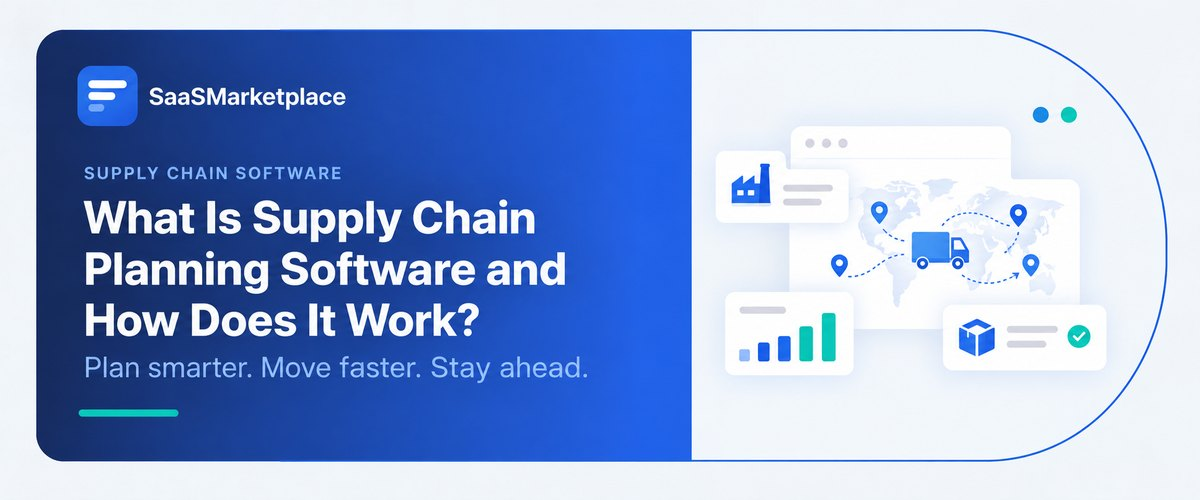
What Is Supply Chain Planning Software and How Does It Work?
-min.jpg)
Supply chain planning software sits above the transactional systems that run day-to-day operations your ERP, your warehouse management system, your transportation management system and answers forward-looking questions those systems aren't built to answer: How much of this product will we need next quarter? Do we have enough capacity to meet that demand? Where should inventory be positioned to avoid both stockouts and excess?
 Looking for Supply Chain Planning Software? Check out SaaS Marketplace’s List of the Best Supply Chain Planning Software in the USA for your business.
It's a distinct layer from the systems of record. An ERP software tracks what happened and what exists right now orders, inventory counts, transactions. Planning software takes that data and projects it forward, testing scenarios, flagging risk, and recommending (or increasingly, taking) action before a problem shows up on the warehouse floor. It doesn't replace warehouse execution, carrier dispatch, or accounts payable those stay in their own systems. What it does is give the planning layer above them a coherent, shared view instead of a set of disconnected department-level spreadsheets.
How Does Supply Chain Planning Software Work?
At the core, planning software pulls in historical sales data, current inventory positions, supplier lead times, production capacity, and often external signals like market trends or weather, then runs that data through statistical and machine learning models to produce a forecast and a plan. The specifics vary by platform and by which planning discipline you're looking at, but most systems handle a few connected functions:
- Demand planning:Historical sales, promotional calendars, and market signals feed into a statistical or ML-driven forecast of what customers will actually want, by SKU, by location, by time period rather than a flat extrapolation of last year's numbers.
- Supply and inventory planning: The forecast gets checked against supplier lead times, production capacity, and current stock levels to figure out what to order, when, and how much safety stock to hold at each location without over-investing in inventory that just sits there.
- Sales and Operations Planning (S&OP) / Integrated Business Planning (IBP): Demand and supply plans get reconciled with financial targets in a recurring cross-functional review, so sales, operations, and finance are working from the same numbers instead of three separate versions of "the plan."
- Scenario planning and simulation: What happens if a key supplier goes down for six weeks? What if demand for one SKU spikes 40%? Planning software lets teams model these situations before they happen rather than reacting after the fact.
- Advanced planning and scheduling (APS): For manufacturers specifically, this layer optimizes production schedules against real constraints machine capacity, labor, changeover times something a generic spreadsheet or even a basic planning tool usually can't do well.
Categories of Supply Chain Planning Software
"Supply chain planning software" is often used as a catch-all, but it actually breaks down into a few distinct categories that solve different parts of the problem and buyers frequently end up with more than one, connected together.
|
Category |
Primary Job |
Best For |
Main Limitation |
|
Demand Planning |
Forecasting future demand by SKU, location, and time period. |
Any business trying to move past manual, spreadsheet-based forecasting. |
Only as accurate as the historical and external data feeding it. |
|
Supply & Inventory Planning |
Balancing stock levels against forecasted demand and lead times. |
Distributors and manufacturers managing large SKU counts across locations. |
Doesn't address the demand-forecasting side on its own. |
|
S&OP / IBP |
Reconciling demand, supply, and financial plans across departments. |
Mid-size to large organizations with cross-functional planning cycles. |
Needs organizational buy-in, not just software, to actually work. |
|
Advanced Planning & Scheduling (APS) |
Optimizing production schedules against real capacity constraints. |
Manufacturers with complex production environments. |
Overkill for businesses that don't manufacture in-house. |
|
ERP-Embedded Planning Modules |
Basic forecasting and MRP tied directly into the ERP. |
Smaller businesses wanting one system rather than several. |
Typically less sophisticated than dedicated planning platforms. |
Supply Chain Planning Software vs. ERP
|
Factor |
ERP |
Supply Chain Planning Software |
|
Primary Function |
Records transactions orders, inventory, financials. |
Forecasts and optimizes future decisions. |
|
Time Orientation |
Present and historical. |
Forward-looking. |
|
Core Question Answered |
What happened, and what do we have right now? |
What should we do next, and what happens if conditions change? |
|
Typical Strength |
System of record, financial accuracy, transaction processing. |
Forecasting accuracy, scenario modeling, cross-functional alignment. |
|
Common Gap |
Limited or basic forecasting capability. |
Doesn't process transactions or manage financial records itself. |
Key Features Worth Understanding
Statistical and ML-based forecasting engines are the foundation of most modern platforms they don't just extrapolate last year's numbers but factor in seasonality, promotions, and increasingly, external data like weather or macroeconomic indicators. Scenario modeling lets planners simulate a supplier disruption, a demand spike, or a capacity shortfall before committing resources, instead of finding out the plan doesn't hold once conditions change.
Real-time or near-real-time data integration matters more than it used to, since planning built on data that's a week stale defeats a lot of the purpose. Exception-based alerting flags only the SKUs, locations, or orders that actually need a planner's attention, rather than requiring someone to manually scan every line of a report. And collaboration tools shared dashboards, and structured review workflows for S&OP meetings are what actually get sales, operations, and finance looking at the same numbers instead of three separate spreadsheets that don't reconcile.
AI and Supply Chain Planning Software in 2026
Gartner's 2026 supply chain technology trends research names agentic AI and physical AI among the top developments shaping the space this year a shift from AI that surfaces insights toward AI systems capable of planning, acting, and adapting within defined constraints. Gartner has also forecast that spending on supply chain software with agentic AI capabilities will grow sharply, from under $2 billion in 2025 to a projected $53 billion, reflecting how quickly vendors are building autonomous decision-making into planning tools.
Adoption data backs up that this isn't just marketing. Research from The Hackett Group found that a large majority of organizations had already deployed or were piloting AI specifically in supply chain analytics by 2026, with meaningfully high adoption in S&OP/IBP and advanced planning and scheduling specifically. That said, the same research found lower adoption for scaled AI transformation across a full operating model meaning AI has become common in analytics-heavy planning functions, but a genuinely autonomous, end-to-end AI-run supply chain remains the exception rather than the norm.
McKinsey's analysis of AI-driven supply chain solutions points to double-digit percentage reductions in logistics costs and meaningful inventory reductions where demand forecasting and real-time management improve though as with any industry-wide figure, actual results vary a lot by how mature the underlying data and processes already are before AI gets layered on top. Industry coverage this year is fairly consistent on one point worth flagging for buyers: AI capabilities with demonstrated production ROI demand forecasting, route optimization, anomaly detection have clear implementation paths and established vendors behind them, while more autonomous capabilities like fully generative planning or autonomous procurement are still better suited to a managed pilot than a full-scale rollout.
Benefits
Centralizing demand and supply data into one connected model cuts down the disconnect that shows up when sales, operations, and finance are each working from their own spreadsheet version of "the plan." Scenario planning catches the impact of a disruption a supplier delay, a demand spike before it turns into a stockout or an inventory write-off, instead of after the fact. Better forecast accuracy, even a modest improvement, tends to compound across a large SKU base into real reductions in both excess inventory and lost sales from stockouts.
None of this happens automatically, though. The software improves the quality and speed of the forecast and the plan it doesn't replace the judgment involved in deciding how to respond to a genuinely novel disruption, or how much risk a Business Intelligence is willing to carry in exchange for leaner inventory. Organizations that expect the software alone to fix a planning process that was broken for organizational reasons siloed teams, no shared metrics, no executive buy-in on the S&OP cycle tend to end up disappointed regardless of which platform they chose.
Challenges and Limitations to Consider
Data quality is the recurring theme across nearly every piece of research on this topic. A planning model built on inconsistent master data, incomplete sales history, or disconnected systems won't produce reliable forecasts no matter how sophisticated the underlying algorithm is. Cleaning up item masters, bills of materials, and historical data before implementation is unglamorous work, but skipping it is one of the most common reasons planning software underdelivers.
Change management is another recurring failure point. Industry guidance on supply chain planning implementations consistently flags that many of these projects get treated as IT initiatives rather than business transformation efforts scoped around modules and technical architecture rather than around the specific business outcomes the organization actually needs. Skipping structured training in favor of vendor-provided materials, or failing to define clear KPIs before go-live, shows up repeatedly as a driver of low adoption even when the software itself is a good fit.
Cost and implementation timelines also deserve real scrutiny upfront. Enterprise-grade platforms can take months to implement properly, and organizations that rush the data and process work in favor of a faster go-live tend to end up with a system nobody trusts enough to use for real decisions reverting to the old spreadsheet "just in case" it turns out to be more reliable.
When Specialized Planning Software May Not Be Necessary
A small business with a limited SKU count, simple demand patterns, and a single location might genuinely be well served by the basic forecasting and MRP functionality built into most ERP systems the complexity dedicated planning software is built to manage just isn't there yet at that scale. A company that doesn't manufacture in-house has little use for advanced planning and scheduling specifically, even if demand or inventory planning would still help.
And an organization still stabilizing its core processes inconsistent data across systems, no established S&OP cadence, and unclear ownership of the planning function, is sometimes better off fixing those foundational issues first, rather than layering sophisticated planning software onto a process that isn't ready to use it well.
Small Business vs. Enterprise Considerations
Smaller and mid-market businesses tend to prioritize a shorter implementation timeline, transparent pricing, and forecasting and inventory planning capability without the complexity of a full enterprise IBP suite. A platform built primarily for large, multi-entity global manufacturers is often more system than a growing distributor with a few dozen SKUs across two warehouses actually needs.
Larger enterprises, particularly manufacturers with complex, multi-tier supply networks, generally need considerably more: concurrent planning across demand, supply, and finance; advanced scheduling that accounts for real production constraints; and integration across a wider set of systems spanning multiple ERPs, regions, and business units. The complexity that justifies an enterprise IBP deployment for a global manufacturer would be substantial overkill for a single-location distributor just trying to get past spreadsheet-based forecasting.
How to Evaluate Supply Chain Planning Software
A handful of practical questions cut through most vendor pitches:
- How clean does your underlying data item masters, sales history, bills of materials actually need to be before the forecasting models produce trustworthy output?
- Does the platform handle your specific planning need (demand, supply, S&OP, or manufacturing scheduling), or are you buying capability you won't use?
- How does it integrate with your existing ERP, WMS, and TMS natively, or through custom integration work?
- What's a realistic implementation timeline for a business your size, based on the vendor's actual track record rather than the sales pitch?
- Which AI capabilities have demonstrated ROI in production for businesses like yours, versus features that sound impressive in a demo?
- How is pricing structured, and how does it scale as SKU count, location count, or user count grows?
- What does the vendor's change management and training support actually look like post-go-live, not just during implementation?
- Can you test the platform against your own real-world planning scenarios before committing, rather than relying solely on an RFP process?
Common Mistakes
Treating a planning software implementation as primarily an IT project scoped around modules and technical architecture rather than the specific business outcomes it needs to deliver is one of the most frequently cited reasons these projects go over budget or underdeliver. Selecting a platform based on a polished interface or an impressive demo without digging into how well it actually handles your specific planning complexity is a close second.
Skipping structured, company-specific training in favor of generic vendor materials tends to produce low adoption even after a technically successful go-live planners in more than a few documented cases have reverted to running their own spreadsheets alongside the new system rather than trusting it. And launching without clear KPIs defined in advance forecast accuracy improvement, inventory turns, on-time delivery rate makes it nearly impossible to demonstrate the ROI that justified the investment in the first place.
Conclusion
Agentic AI is the clearest directional shift industry analysts are pointing to for the next several years moving from systems that recommend a decision to systems that can plan, execute, and adjust within defined boundaries, with human oversight focused on higher-stakes exceptions rather than routine decisions. Alongside that, "physical AI" combining AI models with IoT sensors and robotics for real-time sensing and execution in warehouses and production environments, is expected to extend planning software's reach beyond pure forecasting and into more direct operational execution. None of this replaces the fundamentals, though. Every piece of current research on this topic converges on the same point: the organizations getting real value from AI-enabled planning tools are the ones that already had reasonably clean data and a functioning planning process before adding AI on top, not the ones expecting the technology to compensate for either.
Related reads:
FAQ's
It's a category of tools that forecast demand, balance supply against that demand, optimize inventory, and coordinate planning decisions across sales, operations, and finance sitting above transactional systems like an ERP rather than replacing them.
No. An ERP records transactions and current state orders, inventory, financials. Planning software is forward-looking, using that data to forecast demand and model scenarios. Most organizations run both, integrated together.
Not necessarily. A small operation with limited SKUs, simple demand patterns, and a single location may be well served by the basic forecasting built into most ERPs. Dedicated planning software tends to pay off once demand variability, SKU count, or location count grows past what a spreadsheet or basic ERP module can handle well.
Sales and Operations Planning (S&OP) reconciles demand and supply plans across departments on a recurring cycle. Integrated Business Planning (IBP) extends that same idea to include financial plans directly in the process, so operational decisions and financial targets are evaluated together rather than separately.
For specific, well-established capabilities demand forecasting, route optimization, anomaly detection yes, with demonstrated ROI and mature vendor support. For more autonomous capabilities like generative planning or fully autonomous procurement, most organizations are still in a managed pilot phase rather than full production use.