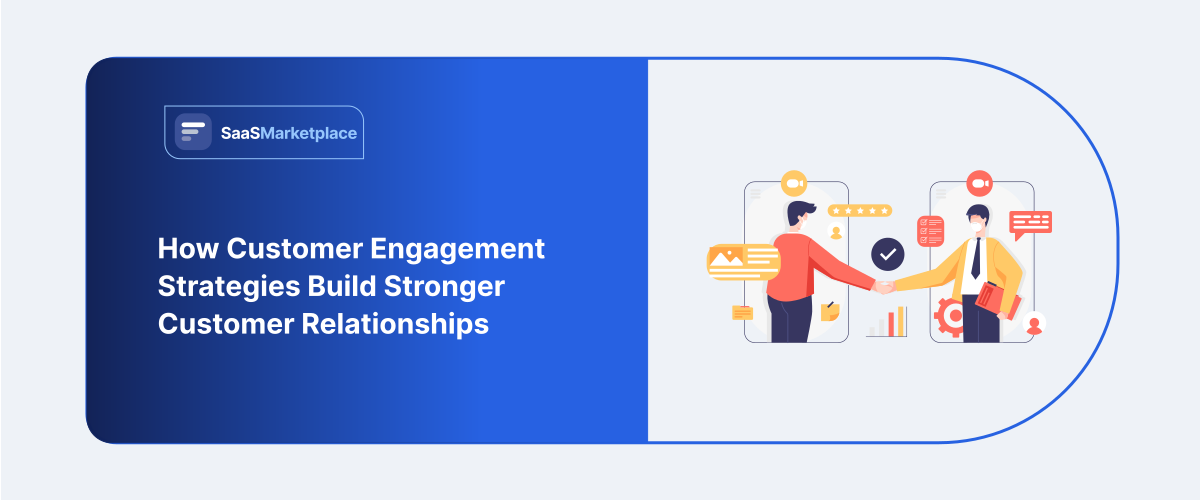
How Customer Engagement Strategies Build Stronger Customer Relationships
-min.jpg)
The modern corporate marketplace has transformed into a radically transparent arena. Companies can no longer survive or protect their margins by relying on price cuts or baseline product specifications alone. Instead, modern competition lives and dies on the caliber of the end-to-end customer experience. In a crowded global market, engineering an intuitive, memorable, and friction-free customer experience is the primary engine of sustainable brand growth. This intricate relationship begins the exact microsecond a consumer discovers your brand or clicks an ad, making Marketing Automation Software valuable for creating timely and relevant customer interactions. When an organization shifts its primary focus to improving how individuals feel about its business at every touchpoint, it lays a durable foundation for long-term operational success.
 Looking for CRM Software? Check out SaaS Marketplace List of the Best CRM Software in USA for Your Business
 What Is Customer Engagement?
This operational concept defines the emotional, cognitive, and behavioral attachment a consumer builds with a business throughout their lifecycle. You can witness this dynamic directly in how frequently, how deeply, and how enthusiastically they interact with your digital platforms, educational resources, physical products, and internal support organizations. It does not function as an isolated milestone that your team checks off a spreadsheet after a sale. Rather, it is the sum of each interaction over the life of their relationship with your company. If you execute this step right, you’ll be able to find the group of customers who are most desired to engage with your business, as they make your lives easier or more productive.
1. Customer engagement vs. customer experience
While corporate teams often use these phrases interchangeably, they govern entirely different dimensions of the modern buyer’s journey. The holistic customer experience functions as the total perception, mental image, and emotional response a buyer forms about your corporate identity. It equals the total of every single impression, system interface, and feeling they encounter while interacting with your brand. On the other hand, active consumer involvement falls under the scope of the strategies, targeted actions, and particular initiators that will attract people to engage in the process. One can imagine the whole customer experience as the interior of the room, whereas the involvement tactics are particular conversations that keep the visitors at a satisfactory level.
2. Customer engagement vs. customer retention
It is equally critical to separate the process of driving active participation from the final financial outcome of brand stability. Long-term loyalty stability, or customer retention, represents a clean historical metric that tracks whether your existing buyers keep spending their budgets with your company over a specified quarter or fiscal year. Active consumer involvement serves as the primary leading indicator that directly feeds that lagging historical number. An organization is not going to be able to sustain an extremely high level of customer retention if its active audience base feels uninvested in or underappreciated. By focusing on the high-value, uniquely engaging aspects of one’s presence in the market landscape, one is going to be able to raise the general level of customer satisfaction, which ultimately makes the organization’s survival statistically inevitable.
3. Examples of customer engagement throughout the customer journey
- A prospective B2B buyer spends twenty minutes interacting with an educational, web-based tool on your main resource page.
- A newly registered mobile app subscriber opens their first onboarding module and finishes configuring their personal feature dashboard.
- A veteran user navigates to an online customer community forum to share customized troubleshooting workflows with rookie users.
- A satisfied e-commerce shopper drafts an explicit, long-form public review illustrating how your product saved them hours of labor.
- A casual social media follower submits a detailed answer inside an interactive poll concerning which upcoming software features matter most.
8 Customer Engagement Strategies That Strengthen Relationships
1. Personalize Customer Interactions
Use customer preferences and purchase history
The use of blanket digital messaging is an ineffective approach to engaging with users. To ensure a seamless experience, you can use AI CRM Software to drive one-to-one interactions and better tailor communication to individual needs. Your account teams can use what a particular client chose, downloaded, or utilized in previous stages to customize copy and address actual problems that this specific user is facing.
Personalized recommendations
E-commerce ecosystems and software platforms can analyze recent search paths to show users products they actually require. If a commercial buyer frequently orders organic laboratory supplies, displaying complementary eco-friendly items on their home dashboard streamlines their internal procurement loop and increases cross-sell metrics.
Personalized email and messaging
Email Marketing Software enables businesses to use dynamic subject lines and adjust informational content based on an individual's physical location or recent platform milestones, making outbound notes feel truly authentic. Addressing long-time users by their preferred name and celebrating their specific performance milestones is a sure way to make them feel that they are not a number but rather an important partner to you.
2. Create Consistent Omnichannel Experiences
Website
The place where each visitor lands on your turf needs intuitive trees, rapid technical parameters, and self-service data that complements the rest of the communication.
The incoming contact center needs to feature a sense of continuity because it is the aftermath of a discovered product and a completed transaction, which is why the new customer receives order confirmation, relevant articles, and configuration guides right after the purchase.
Social media
Social Media Management Software can help make the platforms where you and your clients interact a place of engagement, not just one-way announcements, while providing fast responses and fostering a live community around your product.
SMS
Text messaging workflows require incredible discretion and an absolute respect for personal space. Confine text alerts exclusively to urgent, time-sensitive events like immediate package delivery updates or critical account security flags.
Customer support
Whenever a buyer interfaces with a help desk agent, Help Desk Software can provide that professional with instantaneous visibility into the user's complete historical journey across every channel, ensuring the consumer never suffers the frustration of repeating their story.
Keeping the experience consistent across channels
A fragmented, confusing omni-channel journey completely shatters a consumer's faith in a brand's operational capability. Whether an individual checks your corporate Instagram feed, reads a transaction receipt, or makes a hard phone call to an executive, your voice and style must match. A unified posture guarantees that moving between different networks feels effortless, which directly upgrades the modern customer experience.
3. Use Customer Data Responsibly
First-party data
With ongoing global changes surrounding cookies and digital tracking legislation, collecting clean first-party data has become the ultimate priority. This is highly accurate data that users supply of their own free will through setup forms, preference centers, and explicit profile creation.
Behavioral signals
Monitoring how individuals utilize your tools, such as which industry whitepapers they spend time analyzing, gives your strategy teams time context regarding their immediate operational priorities, paving the way for ultra-relevant email outreach.
Segmentation
Slicing your master email lists into precise cohorts based on industry vertical or feature usage protects your brand from sending irritating, generalized blast spam. Instead, you can share hyper-targeted campaigns that speak directly to the exact issues that specific cohort tackles every morning.
Privacy and customer trust
Gathering digital tracking information demands radical transparency. Detail exactly how your security infrastructure safeguards sensitive personal records and maintain highly visible buttons to opt out at any time. Fiercely protecting privacy builds immense public trust and secures maximum customer satisfaction.
4. Engage Customers at the Right Time
Welcome campaigns
Initial impressions dictate the long-term trajectory of an entire corporate alliance. A smart welcome email sequence should instantly thank the individual for their choice, map out clear product expectations, and walk them through their very first technical configurations to prevent early drop-off.
Post-purchase communication
The brand relationship must never pause just because a transaction clears your banking portal. Deploying instant shipping summaries, detailed video setup instructions, and preventative maintenance concepts tells buyers you care about their actual results, which immediately elevates customer satisfaction.
Re-engagement campaigns
When a historically great buyer goes dark for a multi-month stretch, automated win-back workflows can gracefully restore that lost connection. Providing an exclusive, tailored trial offer or sharing a massive technological update reminds them of the clear operational leverage you bring to the table.
Abandoned-cart communication
Consumers abandon items in their cart for myriad reasons, from an abrupt need to return to work to second-guessing a domestic shipping charge. Shopping Cart Software can help businesses send a simple, nonintrusive note within a short time window to recover the sale by addressing the customer's specific pain point.
5. Make Customer Support Part of Engagement
Fast responses
In a digital economy defined by speed, slow support turnarounds actively drive buyers straight into the waiting arms of your direct competitors. Making rapid resolution times standard across live text chat, corporate channels, and phone support is a fundamental prerequisite for a premium customer experience.
Proactive support
The most impressive help occurs long before a user encounters a system error. By actively tracking underlying platform bugs or logistics delays, your team can reach out to impacted users early, explain the fix, and offer an account credit to offset the trouble.
Multiple support channels
Different buyers require entirely different paths to a solution. Offering a balanced mix of support channels, including fully searchable technical wikis, public peer-to-peer community hubs, email support ticketing, and traditional telephone connections, guarantees everyone finds relief comfortably.
Turning complaints into relationship-building opportunities
An incredibly frustrated buyer represents the ultimate opportunity to prove exactly what your organization stands for. When a service representative meets an angry escalation with raw human empathy, takes unconditional ownership of the failure, and implements an instant fix, they transform a bad moment into a foundational memory that cements lifetime customer loyalty.
6. Build Loyalty Programs and Rewards
Points and rewards
Using a clean, unambiguous points framework turns standard procurement cycles into an engaging experience. Enabling buyers to accumulate points for writing detailed reviews, referring colleagues, or hitting purchase milestones ensures they feel continually appreciated by your brand.
Exclusive offers
Rewarding your top-performing spend accounts with early product access, private sales events, or limited premium options creates a deep sense of insider status and dramatically lifts their overall relationship with your company.
Membership programs
Premium subscription clubs, such as introducing free express logistics options or providing complimentary expert consultations every month, deliver high-value perks that incentivize commercial buyers to centralize their entire annual budget with your company.
Referral incentives
Your happiest daily power users function as the most effective sales pipeline your company owns. Providing mutual rewards, where both the loyal advocate and their newly introduced peer secure major account credits, drastically drops your acquisition costs while organically scaling your community.
7. Encourage Feedback and Two-Way Communication
Surveys
Deploying short, hyper-focused questionnaires like Net Promoter Score (NPS) parameters yields clean, numbers-based data points highlighting exactly how your audience views your current operational performance.
Reviews
Actively soliciting public reviews on independent corporate directories creates vital social proof for prospective accounts. Replying thoughtfully and professionally to both glowing write-ups and sharp critiques demonstrates that your leadership team respects public input.
Social interaction
Like user content, answer direct messages with human phrases, and join the conversation inside your social comment sections. Treating public profiles as a two-way conversation humanizes your corporate entity and drives a vibrant brand culture.
Acting on customer feedback
Gathering data means nothing if it stays locked away inside an unread analytics portal. Pass user feedback directly to product design and system engineering teams to stamp out recurring bugs, proving to your community that their insights drive corporate change.
8. Use Automation Without Losing the Human Touch
Automated journeys
Modern customer relationship management platforms allow scaling brands to construct automated communication paths that react instantly to user events, guaranteeing no account feels abandoned during critical onboarding milestones.
Behavioral triggers
When an individual crosses a major platform milestone, like utilizing a premium tool ten times, an automated note can celebrate that win and pass along advanced tips to help them squeeze more efficiency out of the asset.
AI-assisted personalization
Advanced algorithmic engines can sort through massive historical transaction matrices in milliseconds. This helps growing enterprises forecast upcoming market buying trends and scale their individual personalization efforts without relying on slow manual data entry.
Where human interaction still matters
While automation provides incredible speed, it can never substitute for human empathy. Intricate technical challenges, highly charged account escalations, and major contract extensions will always require a compassionate specialist who can listen, comprehend, and connect.
How to Measure Customer Engagement
To verify if your retention ideas are working, you must track numbers through a modern customer relationship management infrastructure.
- Engagement rate: Evaluates likes, shares, comments, and direct click counts across your corporate social profiles and newsletters.
- Conversion rate: Tracks the percentage of site visitors who complete a target workflow, like downloading an instructional handbook or upgrading a service tier.
- Repeat purchase rate: Tracks the proportion of your total user base that buys from your inventory more than once over a quarterly timeframe.
- Customer retention rate: Calculates the precise percentage of buyers who remain active with your company across a set financial period.
- Customer lifetime value: Tracks the cumulative gross revenue a single corporate account delivers to your company throughout your entire alliance.
- Customer satisfaction: Collected via short, post-interaction surveys to check how happy users are with recent product performance or live support staff.
- Customer churn: Monitors the exact percentage of accounts that cancel their service agreements or cease purchasing from your brand entirely.
Conclusion
Building a highly profitable modern enterprise means moving far past cold, transactional sales scripts. Corporate success comes from creating steady, helpful conversations that treat your buyers as true commercial partners. When an entire organization focuses intensely on improving the overarching customer experience, every internal team naturally starts working to create long-term value.
FAQ's
These are structured action frameworks brands use to maintain meaningful, ongoing conversations with their audience.
It is critical because it shifts your entire organization away from risky, transactional sales toward steady, relationship-driven revenue.
Consistent, helpful interactions prove to your audience that your brand truly cares about their personal operational success.
There is no single magic bullet. The most successful framework combines deep data personalization with total omnichannel consistency.