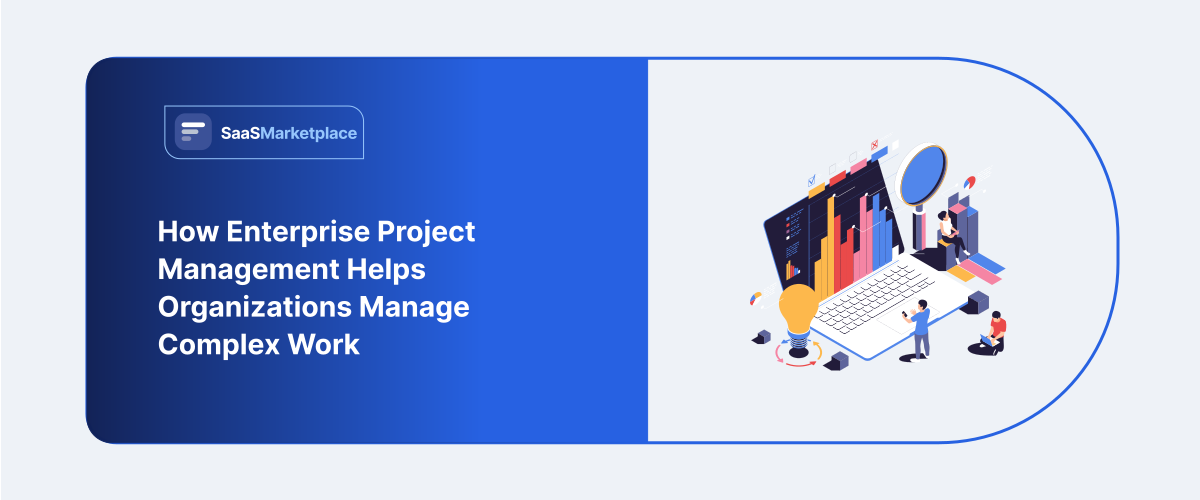
How Enterprise Project Management Helps Organizations Manage Complex Work
-min.jpg)
Scaling modern business organizations requires a sophisticated structural approach to navigate high-volume operational workflows automation efficiently. When several departments carry out parallel projects, local planning and control can fail, leading to serious internal relations complications and fragmented business processes. To avert this danger and to ensure the harmonious use of resources, it is essential to implement a universal corporate project management system that would set the key performance indicators for all sides of the business. In such a manner, the C-level directors would be able to enforce the standardized system of monitoring internal operations free from superfluous details and effectively oversee the wide range of organizational processes. The coherent approach to executive oversight would guarantee that the company’s capital spending would bring the projected benefits and yield sustainable value.
 Looking for Project Portfolio Management Software? Check out SaaS Marketplace List of the Best Project Portfolio Management Software in USA for Your Business
 What Is Enterprise Project Management?
Definition of EPM
At its organizational core, enterprise project management represents the systematic practice of governing all corporate initiatives across an entire business entity. It is a comprehensive framework that scales traditional tracking methodologies to handle multi-layered, interconnected business activities simultaneously. This discipline transforms abstract strategic visions into visible operational realities by establishing universal execution metrics.
How it differs from traditional project management
Understanding the precise distinction between localized execution and broad corporate governance remains vital for operational efficiency. Traditional project management focuses heavily on the successful delivery of a single, isolated initiative within narrow budget and timeline boundaries. Conversely, EPM looks at the entire collection of organizational undertakings to ensure broad operational harmony.
Connecting projects with broader business objectives
Individual initiatives must never operate in a vacuum, detached from the primary economic goals of the parent corporation. Implementing a structured corporate framework bridges the historic gap separating high-level strategic planning from daily floor activities.
Managing multiple teams and initiatives simultaneously
Simultaneous execution across global organizational networks requires a highly structured approach to prevent internal departments from clashing. EPM establishes centralized tracking protocols that oversee concurrent corporate workflows, allowing managers to identify cross-project dependencies instantly.
Why Enterprise Project Management Matters
Better alignment between strategy and execution
Vague executive declarations or disconnected corporate mission statements fail to inspire precise execution unless mapped to active workflows. Implementing a centralized framework guarantees that corporate capital flows exclusively into initiatives that possess direct strategic justification.
Improved resource allocation
Human capital and financial assets represent finite corporate commodities that require careful, analytical optimization. EPM gives operations managers complete visibility into enterprise capacity metrics, enabling data-driven personnel assignments across all active initiatives.
Greater visibility into organizational work
When tracking data remains trapped on localized hard drives or in personal email threads, leadership cannot evaluate enterprise health accurately. Establishing a universal corporate framework removes these internal visibility blockages by streaming data into centralized executive repositories.
Consistent processes across departments
The risk of allowing individual departments to create varied methods of tracking is administrative chaos, which slows down corporate progress. Establishing standard operating procedures for executing marketing, engineering, and financial activities will help ensure that workers use the same terms and formats when reporting.
Better decision-making
Modern commercial dominance depends on making critical structural shifts based on validated historical metrics rather than traditional executive intuition. A comprehensive framework supplies corporate boards with real-time data feeds regarding portfolio cost, timeline adherence, and variance metrics.
The Core Components of Enterprise Project Management
1. Portfolio Management
Managing multiple projects together
Elite corporate governance treats individual initiatives as interconnected components of a larger, unified ecosystem. Utilizing project portfolio management methodologies allows executives to analyze aggregate costs, risk profiles, and scheduling timelines simultaneously.
Prioritizing high-value initiatives
Organizations frequently face a surplus of internal proposals competing for limited corporate funding and personnel. Portfolio management creates objective criteria for evaluating incoming requests based on which their potential value can be identified. As a result, projects with high ROI are prioritized, while those with low potential are simply discarded.
2. Resource Management
People, budget, and technology
In order to ensure comprehensive corporate auditing, one has to carry out an exhaustive survey of all material and immaterial assets in the firm’s possession. In this regard, the manager should assess the technical expertise of available personnel, infrastructure, and budget in order to develop a realistic understanding of the company’s capacities.
Avoiding the over-allocation of resources
The assignment of too many tasks to a limited pool of specialized workers may lead to extreme delays, a decrease in the quality of performed work, and high turnover rates. Effective resource management allows one to avoid such situations by analyzing the current commitments of all company personnel in all departments in order to identify overlaps.
3. Governance
Standard processes
Establishing a formalized administrative framework ensures that all enterprise actions adhere to pre-approved quality metrics. Governance defines the universal lifecycle methodologies, documentation standards, and quality gates that every initiative must pass sequentially. Standard processes eliminate operational variance and ensure that corporate deliverables meet strict institutional benchmarks.
Roles and accountability
Ambiguity regarding operational ownership represents a primary driver of project delay within complex corporate networks. Governance controls the vulnerabilities by providing the role description and reporting structure of each member in an organization. Using a formal responsibility assignment matrix ensures that everyone knows what they are supposed to do. It also provides the lines of communication to follow in case of any technical problems with deliverables since no one is allowed to pass the buck.
Decision-making frameworks
Organizations usually have a defined process for approvals and decision-making for any form of corporate governance issues. This is the kind of policy that addresses the escalation procedures, change control, and spending approvals within a firm. Predefined frameworks prevent administrative gridlock by outlining exactly which leaders possess final fiscal or operational authority.
4. Reporting and Visibility
Project dashboards
Today, businesses are dependent on the creation of systems or dashboards that can collate, consolidate, and monitor the flow of information and data in a more simplified manner. This helps the users understand the status of their field operations at a glance. Preparing these visual data feeds requires automated aggregation to save valuable analytical hours for management personnel.
Progress reporting
Establishing a predictable, automated cadence for status documentation keeps diverse team groups fully aligned on shifting corporate priorities. Progress reporting details actual work completed against the master timeline, highlighting emerging technical bottlenecks early. Utilizing a centralized platform prevents critical insights from becoming lost in fragmented internal email networks.
Performance indicators
Evaluating institutional health requires tracking clearly defined key performance indicators across the corporate ecosystem. Management must monitor metrics such as schedule variance, cost performance indices, and resource utilization rates systematically. Analyzing these data streams allows corporate boards to evaluate delivery efficiency with high mathematical precision.
How Enterprise Project Management Aligns Projects With Business Strategy
Translating strategic goals into projects
Executive boards must avoid leaving broad corporate growth visions as abstract text inside annual reports. EPM functions as the practical mechanism that translates long-term corporate goals into specific, actionable initiatives. For example, a strategic target to reduce national supply chain costs by fifteen percent undergoes conversion into multiple targeted logistics projects.
Prioritizing projects by business value
Not all operational initiatives deliver identical strategic benefits to a scaling business corporation. High-performing organizations utilize mathematical matrix scoring to evaluate how effectively individual projects support core business milestones. Initiatives that secure premium scores receive immediate funding and top-tier talent allocation.
Measuring outcomes instead of only task completion
Traditional execution loops frequently celebrate the completion of basic checklists without verifying whether those actions generated actual value. Elite corporate governance shifts focus toward measuring broad business outcomes, such as expanded market share or improved system uptime metrics. Evaluating true business impacts forces departments to remain accountable for the actual quality of their output.
Removing projects that no longer support business priorities
Macroeconomic landscapes adjust rapidly, causing specific corporate strategies to become obsolete mid-year. Enterprise frameworks require a continuous project review protocol to identify active initiatives that have lost their strategic alignment. When an ongoing project no longer supports the modern path of the corporation, leadership must terminate it immediately.
Managing Resources Across Multiple Projects
Identifying resource conflicts
In multi-layered enterprise environments, separate departments frequently attempt to claim the identical specialized personnel or material assets for concurrent initiatives. Centralized tracking frameworks resolve these internal disputes by providing cross-portfolio resource visibility. Operations leaders can pinpoint overlapping demands during the early phases of strategic planning to adjust schedules dynamically. Early visibility prevents resource gridlock from stalling critical enterprise paths.
Balancing workloads
Improper asset distribution results in specific corporate teams remaining completely idle while other departments experience severe operational exhaustion. Management must analyze active workloads continuously to distribute assignments evenly across the global corporate network. Shifting secondary tasks away from heavily burdened teams optimizes institutional efficiency and maintains steady workflow momentum. Workload balancing ensures sustainable enterprise productivity.
Planning capacity
Long-term corporate expansion requires a deep, predictive understanding of future human capital and technical infrastructure requirements. Organizations must execute comprehensive capacity forecasting by comparing upcoming pipeline demands against current employee counts. Incorporating specialized Document Management Software ensures that all historical capacity reports, resource guidelines, and hiring plans remain organized and universally accessible. Predictive capacity planning safeguards long-term delivery capabilities.
Managing specialized talent
Premium technical assets, such as senior system architects or specialized legal analysts, require careful management across an enterprise portfolio. An organization must avoid trapping elite specialists inside a single department on low-value tasks. Corporate tracking frameworks allow leadership to deploy specialized talent dynamically to high-dollar initiatives exactly when needed. Maximizing the impact of specialized personnel elevates overall execution quality.
Making resource decisions based on priorities
When unexpected organizational challenges force sudden resource shortages, management must avoid making arbitrary allocation choices. Enterprise leaders must utilize established portfolio rankings to route available personnel to highest-priority initiatives immediately. Lower-ranked projects must pause or adjust timelines to accommodate the needs of critical corporate paths. Prioritization-driven choices guarantee that vital business deadlines remain fully protected.
How Technology Supports Enterprise Project Management
Centralized project information
Scattering operational guidelines, financial budgets, and project roadmaps across disparate personal desktops damages corporate efficiency. Organizations must centralize all initiative assets, tracking data, and historical logs inside a single, secure corporate repository. Incorporating specialized Accounting Software allows financially sensitive industries to secure cost tracking, manage organizational ledgers, and automate expense auditing seamlessly within this repository. Centralization guarantees that all personnel access identical data instantly.
Cross-team collaboration
Achieving seamless execution across global corporate networks requires advanced digital solutions designed to foster continuous project coordination. Shared digital workspaces allow cross-functional groups to co-author documentation, share technical assets, and discuss issues contextually. Integrating communication directly into corporate tracking tools prevents vital contextual data from becoming lost. Robust communication systems break down departmental silos permanently.
Workflow automation
Human capital represents the most valuable asset within any commercial enterprise, making the minimization of manual administration essential. Deployed corporate platforms must automate low-value logistical tasks, including sending deadline reminders, generating status reports, and updating pipeline metrics. Removing manual coordination steps minimizes human error and accelerates overall throughput. Automation empowers teams to focus intellectual energy exclusively on complex problem-solving.
Reporting and dashboards
Executive decision-making relies on real-time visibility into key performance indicators across all active enterprise initiatives. Modern tracking technologies synthesize granular field data into high-level dashboards, showcasing budget consumption and schedule variance instantly. Automated reporting eliminates the need for manual preparation, saving valuable analytical hours for management personnel. Data-driven dashboards ensure corporate pivots rely on hard evidence.
Integrations
Disjointed data ecosystems create major operational blind spots that severely hinder institutional revenue growth. Enterprise tracking platforms must maintain seamless, bidirectional integration with central ERP software, financial ledgers, and internal communication channels. Connecting these separate technologies guarantees that information flows smoothly between departments without requiring manual data re-entry. Unified software environments protect data integrity across the firm.
AI-assisted work management
The integration of algorithmic work management tools allows organizations to optimize scheduling, predict potential resource constraints, and automate risk identification. Utilizing advanced predictive models enables operations leaders to analyze historical execution data to optimize future project estimating accuracy. Deployed correctly, algorithmic assistance tools enhance corporate decision-making without replacing human oversight. Technology maximizes tracking precision across extensive portfolios.
Conclusion
Achieving sustainable corporate expansion across complex modern enterprises requires a structured commitment to universal portfolio governance, strict resource optimization, and data-driven strategic alignment. Enforcing centralized accountability frameworks, standardizing administrative workflows across separate departments, and utilizing real-time visibility dashboards allows human capital to remain focused exclusively on highest-priority corporate deliverables. By systematically analyzing key performance metrics, eliminating unmitigated scope expansions, and leveraging advanced tracking technology, an enterprise can confidently overcome execution hazards, optimize operational throughput, and secure lasting industry leadership.
FAQ's
The discipline represents the systematic application of knowledge, skills, tools, and technical frameworks to govern all initiatives across an entire business entity.
Traditional project tracking focuses heavily on delivering a single, isolated initiative within narrow budget, timeline, and scope boundaries.
Implementing a formalized corporate framework empowers executive boards to optimize resource visibility, mitigate strategic market risks, and maintain absolute baseline transparency.
The primary pillars of the framework encompass strategic portfolio management, optimized resource management, strict administrative governance, and real-time reporting visibility.