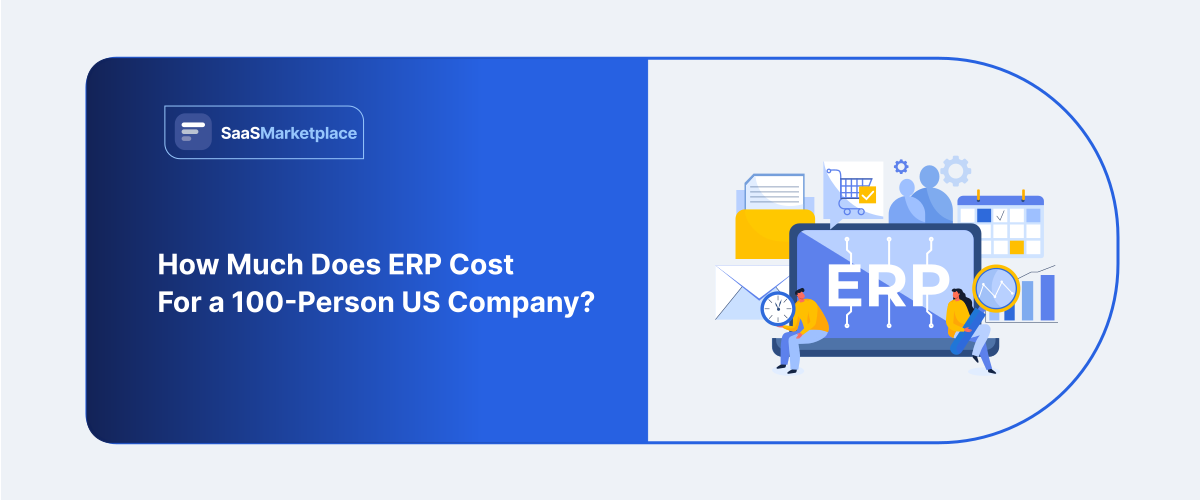
How Much Does ERP Cost for a 100-Person US Company?
-min.jpg)
The total year-one price lands between $80,000 and $300,000 or better depending on the supplier and implementation complexity. You asked a seller for a fee. They asked you for a discovery call. That exchange is why this article exists.
Almost nobody publishes real ERP software numbers, so buyers walk into negotiations without a reference point. The query of the way a great deal does ERP cost then receives a response by means of whoever is selling, which is not a really perfect association for the individual writing the check. Below is what a hundred-individual US employer virtually pays for an ERP software program in 2026, line by line. That consists of the prices that show up on invoice 3 in place of inside the Notion deck.

Looking for ERP software? Check out the SaaS Marketplace List of the Best ERP Software in USA for your business.
One note before the numbers. Every figure here reflects ERP software pricing for mid-market deployments in the United States, quoted in USD, based on published vendor rates and benchmark data from implementation research.
The ERP fee for a 100-employee US organization in 2026 normally ranges as follows:
- Cloud ERP subscription: $1,500 to $4,000 consistent with month general
- Per-consumer pricing: $50 to $150 according to user in line with month
- One-time implementation: $25,000 to $150,000
- Data migration: $5,000 to $30,000
- Training and change control: $10,000 to $50,000
Why ERP Pricing Is Rarely Straightforward
Why Vendors Do Not Publish Prices
Two reasons, and only considered one of them is defensible.
The defensible one: ERP software in reality varies by means of module blend, person kind, and integration intensity. A hundred-person distributor and 100-person accounting company need very distinct builds, and a single published range could misinform both.
The less defensible one: opaque ERP pricing gives the sales team room to anchor high and discount later. Buyers who arrive with a benchmark negotiate better, which is exactly why the benchmark stays hidden.
What Drives ERP Cost Variation
Four levers move ERP software, costing more than anything else.
User count is the obvious one, though not every employee needs a full license. Module scope comes next, since inventory and manufacturing cost far more than core financials. Then there is customization depth, which is where budgets usually break. Finally, the partner you hire to implement it.
Two companies of identical size can pay double or half of each other based purely on those four.
ERP Cost Breakdown for a 100-Person US Company
Here is how the money actually splits across a first-year ERP software budget.
|
Cost Component |
Typical Range (100 users) |
Notes |
|
Cloud subscription (annual) |
$60,000 to $180,000 |
Depends on tier and module mix |
|
Implementation and setup |
$25,000 to $150,000 |
Often 1x to 3x first-year license |
|
Data migration |
$5,000 to $30,000 |
Scales with data quality, not volume |
|
Training |
$10,000 to $50,000 |
Frequently underbudgeted |
|
Annual support |
18% to 22% of license |
Standard for on-premise contracts |
License Fees: Per User vs Flat Rate
Most cloud providers charge in step with named users per month. In 2026, mid-marketplace ERP software program pricing sits between $40 and $200, consistent with users and consistent with month. The bulk of actual offers land inside the $70 to $120 band.
Not all seats cost the same, which are where customers store money. Full users get the pinnacle fee. Employees who only approve timesheets or view reviews typically qualify for a limited license at a fraction of the fee.
For 100 personnel, a sensible cut-up is probably 35 complete users, 40 restricted, and 25 self-service users. That structure alone can cut your subscription line by a third.
A few vendors price resources consumed rather than headcount. Acumatica built its model around that approach, which suits companies with lots of occasional users.
One-Time Implementation and Setup Costs
Implementation is the unmarried biggest variable in any ERP software program budget and the one most customarily underestimated. Industry benchmarks positioned ERP implementation fees at kind of 1 to 3 times the primary-year license rate.
For a 100-person company, that interprets to $25,000 at the easy quit and $150,000 or extra when you upload a multi-entity accounting tool, warehouse workflows, or industry-precise compliance.
Panorama Consulting Group's benchmark information places the common implementation for a mid-sized agency near $450,000, even though that parent consists of larger and extra complicated deployments than a straightforward 100-user rollout.
Data Migration Costs
Budget $5,000 to $30,000 here, and understand what drives it. Migration is the part of an ERP software project that looks small on paper and rarely behaves that way.
The cost is not about how much data you have. It is about how bad it is. Duplicate customer records, inconsistent SKU naming, and three different formats for the same address field all cost billable hours to reconcile.
Clean your data before the vendor touches it. That single decision saves more money than any negotiation tactic.
Training and Change Management
Ten thousand dollars gets you a few sessions and some documentation. Fifty thousand gets you role-based training, super-user development, and post-launch support.
Companies cut this line first when budgets tighten. It is also the line most strongly correlated with whether the project succeeds, which makes the cut expensive in ways that never appear on a spreadsheet.
Ongoing Support and Maintenance
Cloud ERP software subscriptions usually bundle basic support. Premium tiers with faster response times add 10% to 20% on top.
On-premise deployments work differently. Annual maintenance runs 15% to 22% of the original license value every year, forever, whether or not you use it.
Annual Subscription Renewal Costs
Read the uplift clause before you sign anything. Most contracts allow annual increases of 3% to 7%.
Over a five-year term, a 5% annual uplift adds roughly 22% to your total subscription spend. Negotiating a cap at signature costs nothing and saves real money later.
Cloud ERP vs On-Premise: Cost Difference
Cloud ERP Pricing for 100 Users
Cloud ERP pricing USA consumers encounter in 2026 typically starts around $999 per month for a base platform and then adds in keeping in-person prices on top. Oracle NetSuite publishes an approximate place to begin near $99 per person in keeping with the month with a base platform price of $999 monthly.
Run that for 100 mixed-license users, and you land inside the $3,000 to $8,000 monthly variety earlier than implementation.
Microsoft Dynamics 365 Business Central sits at a decrease of more or less $70 to $110, consistent with complete consumer keeping per month. SAP Business One cloud pricing starts near seventy-five, in keeping with the consumer in step with the month.
On-Premise ERP Cost for 100 Users
Perpetual licensing means a large upfront hit. Expect $50,000 to $500,000 for the license itself, plus server hardware, database licenses, and the IT staff to run them.
SAP Business One on-premise starts around $25,000 for smaller deployments. Add maintenance at 15% to 22% annually, and the "one-time" cost stops being one-time fairly quickly.
Which Costs Less Over Five Years?
Closer than most vendors admit, and the honest answer depends on your IT setup rather than on the ERP software itself.
Cloud wins clearly on year one because there is no capital outlay. By year five, the subscription total often catches up to what the perpetual license plus maintenance would have cost.
What tips it is staffing. Cloud removes the need for dedicated infrastructure headcount, and one server administrator salary outweighs most of the licensing difference. For a 100-person company without an existing IT team, cloud is almost always the cheaper path.
Hidden ERP Costs Nobody Tells You About
These are the ERP hidden costs US companies most often miss in 2026:
- Customization fees: $10,000 to $100,000 or more
- Third-party integration costs: $5,000 to $40,000
- Consultant and partner fees: 15% to 25% of license cost
- Employee downtime during rollout: two to four weeks on average
- Annual maintenance: 18% to 22% of license cost yearly
Customization and Module Add-Ons
Every "can it do X?" that gets answered with "yes, with some configuration" is a line item. This is where ERP software quotes quietly grow between the demo and the signature.
The trap is that customization compounds. Custom code has to be retested at every upgrade, so a $30,000 modification becomes a recurring maintenance obligation rather than a purchase.
Integration With Existing Software
Your ERP system will need to talk to your CRM, your e-commerce platform, your payroll provider, and probably your shipping carrier.
Standard connectors are cheap. Anything requiring middleware or custom API work runs $5,000 to $40,000 per integration, and integration work is notorious for expanding once it starts.
Consultant and Partner Fees
Most ERP software vendors sell through partners who handle the actual work. Partner day rates in the US run $150 to $300 per hour depending on seniority and specialization.
Ask who will be on your project by name. Junior staff learning your industry on your budget is a real and common problem.
Employee Downtime During Rollout
Nobody puts this in the proposal because it does not appear on an invoice. It is still real money.
Assume two to four weeks of reduced productivity around go-live, plus the ongoing time your internal project team spends away from their regular jobs. For a 100-person company, that internal cost frequently exceeds the training budget.
ERP Pricing by Vendor: 100-Person US Company
SAP Business One Pricing
Cloud pricing starts near $75 per person consistently per month. On-premise perpetual licensing starts off evolving around $25,000 for smaller footprints. Built for smaller and mid-sized operations in preference to company complexity.
Oracle NetSuite Pricing
Roughly $99 in line with consumers consistent with the month plus a base platform charge of $999 month-to-month. Strong for multi-entity and multi-foreign money groups. Renewal negotiations are where NetSuite clients file the maximum friction, so plan for that communication early.
Microsoft Dynamics 365 Business Central Pricing
Essentials sits close to $70 per person per month and Premium around $100. The apparent pickout of your corporation already lives within Microsoft 365, due to the fact that the combination work largely disappears.
Acumatica Pricing
Priced on resources and transaction volume rather than user count. Unlimited users is really beneficial for groups with seasonal or occasional customers. Quotes commonly start around $20,000 yearly.
Sage Intacct Pricing
Financial-first rather than full operations. Annual charges normally land between $15,000 and $60,000 depending on modules and entities. Popular with offering groups that don't need stock.
Total Cost of Ownership (TCO): 3-Year Estimate
The erp total cost of ownership picture matters more than any single quote. Judging ERP software on year one alone is how companies end up surprised in year three.
|
Year |
Realistic Range |
|
Year 1 |
$80,000 to $300,000 |
|
Year 2 |
$65,000 to $190,000 |
|
Year 3 |
$68,000 to $200,000 |
|
3-year total |
$213,000 to $690,000 |
Year one carries implementation. Years two and three are subscription plus support plus whatever enhancements you queue up.
Published research on 100 user mid-market deployments puts the five-year ERP total cost of ownership anywhere from $500,000 to $3 million, with the upper end reflecting enterprise-tier platforms rather than mid-market ones.
How to Reduce ERP Costs Without Cutting Corners
Start with license tiering. Most ERP software contracts contain more full seats than the business actually needs. Audit who genuinely needs a full seat before you sign, not after.
Phase your modules. Core financials and inventory in phase one, everything else once the team has absorbed the change. Companies that deploy everything at once pay more and adopt less.
Negotiate the renewal uplift cap at signature, when you still have leverage. After go-live, you have almost none.
Clean your data internally. Every hour your team spends deduplicating records is an hour you are not paying a consultant $250 for.
Ask for a fixed-fee implementation where the scope allows it. Time and materials contracts put all the schedule risk on you, and schedule risk is the expensive kind. Partners will generally comply with a hard and fast rate as soon as discovery is entire, that is, any other argument for procuring a right discovery phase in place of skipping it.
Consider a 2D quote even if you already recognize which platform you want. Competing partner bids on the equal software program mechanically range with the aid of thirty percent for an identical scope, and carriers are privy to that when they rate.
And get implementation scope written into the contract in detail. Vague statements of work are how ERP implementation costs double without anyone technically breaking a promise.
Conclusion
For a 100-person US company in 2026, plan on $80,000 to $300,000 in 12 months and $65,000 to $200,000 annually after that. The huge unfold in ERP software expenses isn't always vagueness. It displays true differences in module scope, customization urge for food, and how disciplined you are approximately in controlling the implementation. Companies that land at the low stop percentage have one habit. They determined what they surely wanted earlier than they commenced talking to carriers, and they held that line when the demo confirmed something true to them.
FAQ's
Year one typically runs $80,000 to $300,000, covering subscription, implementation, migration, and training, with $65,000 to $200,000 annually after that.
Mid-market cloud ERP averages $70 to $120 per user per month in 2026, though multi-year discounts often bring the real number lower.
Implementation generally runs one to three times your first-year license fee, or $25,000 to $150,000 for a 100-person company.
The main ones are customization, third-party integrations, partner consulting fees, employee downtime during rollout, and annual maintenance on perpetual licenses.
Three-year TCO for a 100-user deployment typically falls between $213,000 and $690,000.