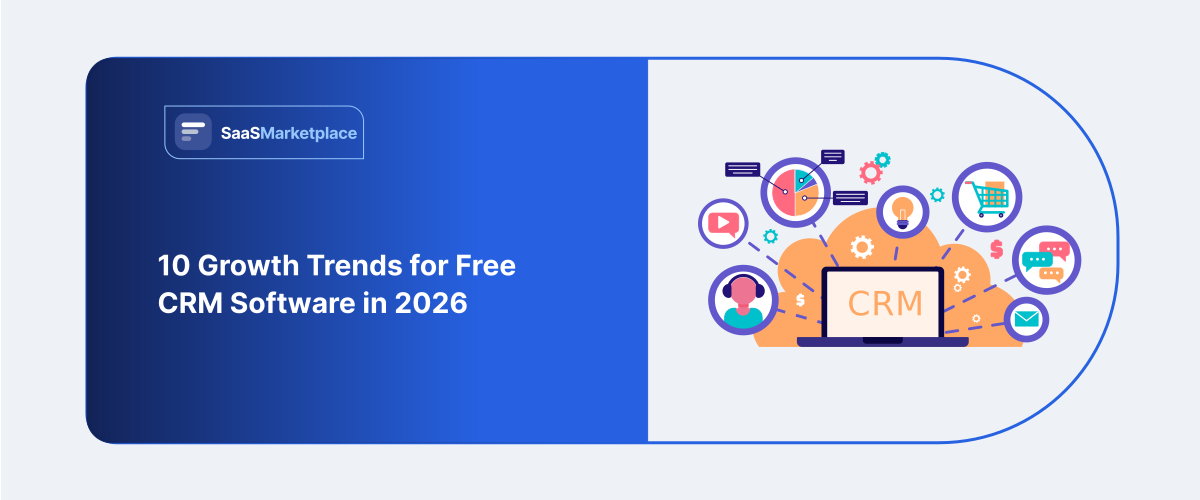
10 Growth Trends for Free CRM Software in 2026
-min.jpg)
In the process of combating fierce competition, small U.S. companies as well as fast-growing startups have progressed from perceiving free CRM software as merely one of the available options to treating it as an operational necessity. The estimated growth of the global CRM industry to over $126 billion shows that U.S. companies are using free and freemium solutions as a foundation for creating and optimizing sales, marketing, and customer service processes. Due to the ongoing changes in cloud computing, zero-cost options have advanced beyond mere spreadsheets, helping streamline business processes. These companies now serve as dynamic and interconnected platforms enabling companies to automate their routine tasks and enjoy the benefits of predictive analytics while providing consumers with the services that meet their personal needs.
What Is CRM Software, and Why Is the US Market Booming?
CRM software serves as the digital headquarters of the client-related activity of a business, bringing together communications, keeping an eye on sales pipelines, and turning data into a single dashboard. Instead of making sales reps, the marketing and customer service teams comb through unrelated spreadsheets or different emails; modern CRM provides a total view of a customer's journey. This means every event from the first click on the website and opening marketing emails to direct sales calls and technical support messages is registered in the right order. Actually, this kind of data turns into timelines, allowing companies to predict income, follow up with clients automatically, and get rid of tedious paperwork.
US markets are now flourishing in the midst of a perfect storm of rising customer expectations, fierce digital-first competitors, and rapid development of artificial intelligence across American business. With North America having over 40% share of the global CRM software market, US companies are moving to utilize cloud-based systems instead of traditional legacy systems that cannot offer scalable automation solutions. It is the transition to so-called agentic AI, where CRMs are no longer simple data storage but utilize autonomous AI agents to qualify leads and provide immediate solutions for customers, that boosts the rapid growth of the marketplace. The current reality, where retention is the new king and consumers require fast and personalized services, has turned CRM into a basic necessity for companies operating in any field.
How Is AI Changing the Way CRM Software Works?
The greatest change in CRM technology can be regarded as the evolution from data storage that is conversant to execution that is self-reliant. In the past, a CRM system used to depend on people completely in terms of making notes during calls, changing the conditions of a deal, and the like. Nowadays, classical databases have turned into a system with an action-oriented approach with the help of artificial intelligence. The best providers use specific artificial intelligence techniques to execute processes autonomously instead of providing recommendations to their users for taking action.
Artificial intelligence technologies enable the creation of marketing and sales strategies on a completely new level. Instead of relying on human intuition and quarterly reports, modern CRM systems take into account hundreds of factors at the same time, for example, different information on emails or messages from customers. By means of modern technology, it is possible to detect risks with regard to losses early enough and to offer the best ideas on how to manipulate the situation.
As a result, hyper-automation fundamentally increases human efficiency while decreasing operational difficulty. By eliminating administrative work, sellers benefit from a substantial boost in the amount of time they spend on face-to-face activities, leading to reduced sales cycles and higher win rates. Moreover, omnichannel support agents resolve routine issues 24/7 through conversations resembling human interactions, which means that a vast majority of incoming support tickets are processed immediately. In the case of American companies, this implies that customer processes can finally reach a stage of limitless scalability with no proportional increase in terms of workforce numbers.
Are Free CRM Software Plans Getting More Powerful?
Yes, indeed. The freemium software arena has completely changed. It is no longer the case that small businesses and startups have to choose between a simple and digital or a time & expense management software enterprise plan. Top providers of software are aggressively fighting for their share of the industry and locking customers in for long periods of time. In addition, these providers offer software for free with lots of high-value features that had previously been hidden behind quite a steep paywall. For example, there used to be such features in paid software as advanced cross-channel marketing automation tools, custom pipelines, and built-in landing pages.
The crucial factor that made it possible for software providers to provide customers with software for free is the homogenization and democratization of AI technologies. This led to a great reduction in the price of implementing technological solutions connected with artificial intelligence and machine learning used for CRM activities. Nowadays, with a free account, people can do much more than just collect information about clients.
This added level of control does require a calculated trade-off that businesspeople in the US need to carefully consider: now the cornerstones of the system cannot be unilaterally switched off. In the past, the only way to get users to stop using an application was to switch off the critical components. Today, companies do not need to deactivate the basic functions of their offerings, as they can allow the user free access to the entire function of the platform while limiting their access to certain functions, such as the maximum volume of stored data, the allowed number of users, monthly emails sent from the account, etc. Companies found a way to implement the new grow-as-you-go strategy, which allows small companies to automate their revenue operations without paying for complicated data storage until the business expands to a certain level that requires upgrading the system.
Is Mobile CRM Software Becoming the Standard for Sales Teams?
- Real-Time Data Injection: Rather than waiting on sales agents to manually record notes at the conclusion of the day or the week, mobile applications make it possible for the immediate entry of information, utilizing data that is relevant at the moment. Account executives can dictate results of meetings and the status of business deals while driving or waiting in an airport.
- Location-Based Intelligence and Territory Management: In the case of sales teams who are traveling across the territories within the country, mobile CRM software solutions utilize the built-in GPS capabilities of the device to generate the most efficient travel instructions. Software is capable of revealing nearby customers, highlighting hot leads that the rep can visit immediately, and estimating the driving distance of a sales representative, allowing for the maximum number of presentations to be made in a day.
- Instant Responsiveness to the Hot Leads: One of the company's most important measures is the time of contacting the lead, as modern customers want to get instant replies. Mobile CRM technologies send notifications to the end-users the moment the lead wants to book a demo or interacts with marketing content, thus sales representatives can contact the person they need.
- Seamless Offline Capability: Sales representatives who travel to remote regions or work in secure company facilities frequently encounter issues with cellular connectivity. Leading mobile CRMs successfully address this problem by providing offline capabilities that maintain data locally on the mobile device and synchronize updates, notes, and data back to the main company cloud when the internet connection is established again.
- Mobile Desktop Experience: Modern mobile apps are no longer the basic versions of their web cousins, and mobile CRM design is very effective in processing complex operations. Mobile CRMs allow sales representatives to search quickly and effortlessly their catalog of products, dynamic pricing, create contracts, and check full information about customers with a single tap.
- Biometric Security and Enterprise Compliance: American companies always worry about corporate data and confidential details about customers when using mobile devices. Mobile CRMs combine both advanced smartphone hardware technology, such as Face ID and fingerprint scanners, along with mobile device management rules to secure sensitive information and comply with regulations without adding any burden for sales representatives.
Can CRM Software Really Deliver Hyper-Personalization?
- Messaging Based on User Behavior: Incorporating the features of a customer relationship management (CRM) system, companies can utilize a unique opportunity to send a message according to the particular actions of their clients. For example, when a potential buyer in the state of Texas spends ten minutes on the customer's pricing page and downloads the white paper for midsize businesses, the CRM system sends them a communication message that includes personalized content for companies within the sector.
- Predicting Preferences of Customers: The CRM systems recognize what a client may need next through their previous purchases, shopping patterns, and data of clients with similar preferences. To illustrate this point, if a customer purchases a piece of machinery, the CRM will have information about its life cycle and will automatically send a personalized recommendation about its replacement or necessary supplementary component exactly at the time needed.
- Customizing Customer Service: Real personalization happens not only in marketing departments, but also in customer service departments. In case an individual calls or chats with operators, the CRM system provides the agents with the customer's complete information on their purchases, problems, and rate of engagement.
- Modification of Dynamic Websites and Landing Pages: The engine of advanced CRM technology is full integration with CMS systems that enable the customization of information displayed to users based on their CRM profiles. For example, loyal customers returning to the brand can see a welcome banner with offers that correspond with their loyalty status, while potential customers see an introductory video, ensuring that all visitors see information based on their customer status.
- Customized Timing and Channels Equipment: The process of hyper-personalization encompasses not only the message itself but also the place and timing of its delivery. Modern CRM technologies gather historical engagement statistics to determine the fact that a certain lead is 80% more likely to receive a text message on Tuesday afternoon than an email message sent on Monday morning.
How Is Social Media Integration Reshaping CRM Software in the US?
- Social Commerce and Seamless Selling: The social commerce space is expected to reach millions in revenue, which has driven platforms such as TikTok Shop or Instagram Checkout to prompt their users to displace traditional websites. Modern systems for CRM have enabled sales employees to access transactions, control shipment tracking, and manage customer files through social media feeds.
- AI in Social Listening: Modern systems for CRM do not simply wait for messages; they proactively use social media for monitoring brands, key terms, and any industry conversations without tags. What is more, built-in instruments enable companies in the U.S. to capture the emotions of the posts automatically.
- The Emergence of Conversational CRM Workflows: Young consumers today (i.e., Millennials and Gen Z) prefer chatting with brands instead of emailing or calling them. With the help of communication tools like WhatsApp Business API, Instagram, FB Messenger, and others, it became possible for companies to keep track of the conversations with their clients without losing the distributional information.
- AI Robots in Customer Support: Thus, U.S. businesses could utilize automated bots via social media messaging platforms to reduce the costs of building their support teams
- Customized Influencer Management in America: As micro-influencer marketing gained importance for the US market, CRMs adapted systems that enable tracking of relationships with influencers.
What Role Do Data, Analytics, and Trends Play in Free CRM Software?
1) Integrated Predictive Analytics
There is a trend of providing free CRM software services that start using basic predictive models to provide forecasts for small companies. Users have a unique opportunity not to guess possible successful deals anymore, as the system provides automated win probability statistics based on previous leads.
2) Emergence of Active and Generative AI
Technologies of AI have gone from being sold as additional options to being used as an integral part of the service offered by free versions of CRM software. The users of free CRM software can utilize AI agents to write personalized customer emails and to summarize previous interactions.
3) Available Mobile Accessibility
Companies providing free CRM products make major investments in creating decent mobile applications to allow constant control over data entering into the system while being in the field. With the help of mobile solutions, sales representatives can change the information about the leads that they work with directly while being in the field.
4) No-Code Application Integration
Advanced free CRMs emphasize open APIs for integration with popular tools such as Slack or Gmail. Thanks to the connection of existing systems, these platforms do not require repetitive data entry and save on tool fatigue.
5) Automation of Data Purification and Enrichment
Free services provide basic automated cleaning tools to fight low-quality databases. The CRM immediately identifies duplicates and fills in the company info from public online sources.
6) Hyper-Personalization Input
Analytics systems included in free CRMs help to analyze user behavior to send communication at the right time. In particular, the system detects when a potential customer opens an email or goes to the pricing page to alert the sales manager right away.
7) Native Omnichannel Data Integration
Free versions of software are now able to gather data from social media, WhatsApp, emails, and phone calls in one location. Due to this, the customer is provided with a full 360-degree perspective, thus avoiding disjointed dialogues across numerous platforms.
8) Privacy-Centric Consent and Compliance
Even the free versions of CRMs are supposed to comply with the high standards of global privacy laws such as CCPA and GDPR. There are automated means of tracking consent and providing users with the chance to request deletion of their data in free contact forms.
9) Democratization of User Experience
Free CRMs abandon the complicated and confusing corporate designs in favor of simple and user-friendly interfaces. This eliminates technical difficulties, making it easier for such small businesses to use the software without IT assistance.
10) Direct Paths to Bigger Upgrades
Free versions of CRMs are made in a way that they provide a smooth "proof of concept" that develops along with the company. The bigger the company’s information base becomes, the more free CRMs propose to expand the toolkit with paid solutions depending on the results of their analysis of its usage.
How Is Cloud Technology Expanding What Free CRM Software Can Do?
Cloud computing has entirely equalized the conditions for small businesses by moving the difficult part of data processing and storage from on-site and costly equipment to the provider’s remote servers. It also means that free tiers of customer relationship management systems can provide high-end services such as automatic data improvement, mobile syncing, or real-time collaboration features previously available only to large companies. Thanks to the vendor taking care of the supporting infrastructure, security updates, and maintenance, users can get fast access to a dependable database that easily grows along with their business.
Additionally, cloud computing is the main enabler of advanced AI and seamless integrations within free tiers of CRM systems. Today, free customer relationship management systems use cloud-based AI technologies for predictive lead scoring, automating email workflows, and processing communication histories. Unlike a static and isolated virtual rolodex, a free customer relationship management system operates as an interconnected center that allows synchronizing with tools like Gmail, Slack, or social networks.
Conlusion
The process of acquiring a beneficial CRM shouldn’t be stressful. The constant change of free CRM software allows us to get access to it without any difficulty through the SaaS Marketplace. Serving as a platform provides an opportunity to look for any type of Business Software that fits your needs. No matter if you want to have a free plan with AI capabilities or a sophisticated solution for enterprises, having the option to hit one market hub gives you confidence that you have made the right choice.
FAQ's
True free CRMs offer a permanent, non-expiring tier with baseline features, using a freemium model where you only pay if you outgrow user or contact limits.
Free tiers typically restrict deep workflow automation, advanced analytics reporting, and the total number of user seats allowed.
Yes, modern free CRMs build native data privacy and consent management tools directly into their systems to comply with international regulations like GDPR.
Most leading free CRMs provide out-of-the-box native integrations and open APIs to connect with standard tools like Gmail, Slack, and calendars.
Upgrading within the same platform requires zero data migration, as it instantly unlocks gated premium features on top of your existing database.