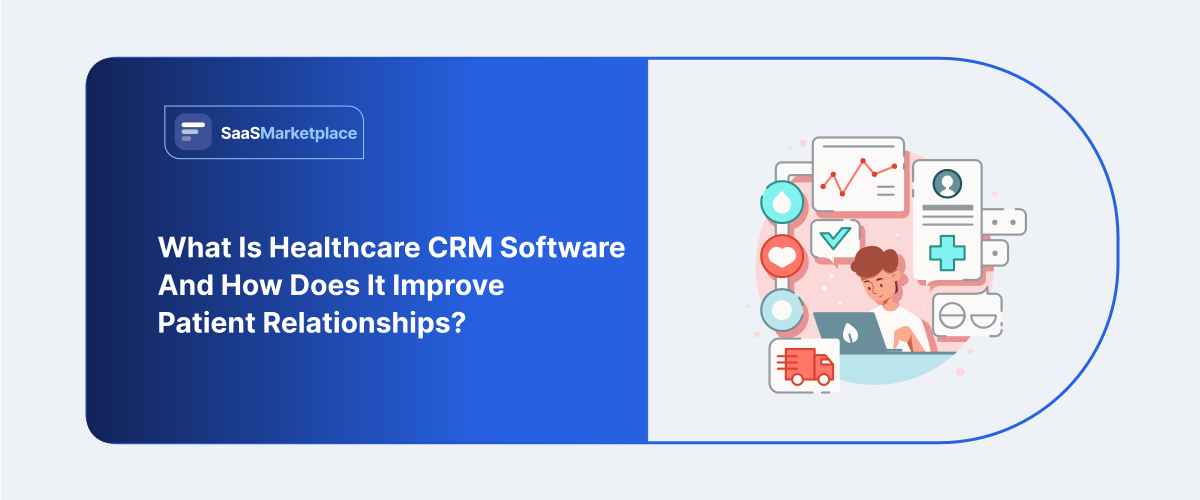
What Is Healthcare CRM Software and How Does It Improve Patient Relationships?
-min.jpg)
A patient calls to reschedule an appointment, and the front desk logs it. Two weeks pass, and a different staff member sends a reminder about a procedure that's already been canceled; nobody caught that the two calls were connected. Small mistake, but the kind that costs trust fast. Patients notice, almost immediately, when an office doesn't seem to remember its own history with them. That's the gap healthcare CRM software is built to close. Patient communication, appointment history, and follow-up activity all land in one shared record, so whoever's on the phone, at the front desk, care coordinator, or billing and invoicing is looking at the same picture the last person saw.
 Looking for Healthcare CRM Software? Check out SaaS Marketplace’s List of the Best Healthcare CRM Software in USA for your business.
The risks involved here surpass those found in many other sectors as well: failing to contact a patient again or sending duplicate messages creates more than mere annoyance; it may determine if that individual receives necessary medical attention. The section below explains precisely what this program accomplishes, distinguishes its functions from typical customer relationship management systems or electronic health records, outlines probable expenses, and identifies scenarios where a clinic truly requires such a tool.
What Healthcare CRM Software Actually Does
Strip it down and a healthcare CRM is tracking every non-clinical touchpoint a patient has with a practice scheduling, reminder calls, satisfaction surveys, outreach campaigns, billing questions, referrals. Rather than that information scattering across spreadsheets, sticky notes, and whatever any given staff member happens to remember, it lands in one record tied to the patient.
The record earns its keep the moment more than one person needs to deal with the same patient. A referral coordinator sees the reminder call already went out. A billing rep sees the patient already asked about payment plans and doesn't have to make them repeat themselves. None of it is clinical information in the diagnostic sense; it's relationship and logistics software data, but it's precisely the kind of detail that, when it's missing, makes a practice feel disorganized to whoever's on the other end of the phone.
Bigger health systems lean on the same tools for population-level outreach flagging a segment of patients who are due for an annual screening, say, or checking in after a hospital discharge to cut down on readmissions. Smaller practices generally use a scaled-down version of the same thing: mostly appointment reminders and basic follow-up tracking.
How It's Different From an EHR
This is where most of the confusion comes from, so it's worth spelling out directly. An EHR electronic health record holds the clinical side: diagnoses, medications, lab results, treatment history. A CRM holds relationship data instead: who got contacted, when, about what, and what's supposed to happen next.
They're meant to work together, not compete. A CRM might pull a patient's next appointment date straight from the EHR to trigger a reminder, or flag that a recommended follow-up visit never got scheduled. What it generally won't do is touch treatment records directly that's not its job. It's built around communication and engagement, not diagnosis or documentation.
Some practices try to stretch their EHR into doing CRM-style outreach, since a lot of EHRs ship with basic patient messaging built in. Fine for very simple needs. But EHRs weren't designed for marketing-style segmentation, multi-step automated campaigns, or tracking relationship data that isn't clinical and that's usually where the cracks start showing.
How It Improves Patient Relationships
The improvement isn't abstract it shows up in specific, measurable behavior. Appointment reminders sent automatically, timed and personalized based on appointment type, tend to reduce no-show rates meaningfully compared to manual reminder calls that depend on staff bandwidth.
Follow-up consistency is another area where it matters. A patient who was supposed to schedule a follow-up visit but didn't can be automatically flagged for outreach instead of falling through the cracks until someone happens to notice during a records review.
There's also a trust dimension that's harder to quantify but still real. When a patient calls in and the person answering already has context recent visits, open questions, prior communications the interaction feels coordinated rather than like starting from scratch each time. Practices that have gone through this transition often notice the shift shows up first in patient satisfaction scores, before it shows up anywhere else.
None of this works, though, if staff don't actually log interactions consistently. A CRM populated inconsistently ends up giving a false sense of coordination worse, in some ways, than no system at all, since staff start trusting information that isn't complete.
Core Features to Expect
Most healthcare CRM platforms share a similar core:
- Patient contact and interaction history a centralized log of communications and touchpoints
- Appointment reminders and scheduling integration automated, often multi-channel (text, email, call)
- Segmented outreach campaigns targeted communication based on patient type, condition category, or care gap
- Referral tracking visibility into where a referral stands and whether it converted to a scheduled visit
- Patient satisfaction surveys: automated post-visit feedback collection
- HIPAA-compliant messaging: secure channels for anything containing protected health information
- Reporting dashboards: no-show rates, outreach response rates, referral conversion
Larger systems often add population health management tools on top of this identifying patients overdue for preventive care across an entire patient panel, for example. Smaller practices usually don't need that layer and can get real value from the basics alone.
Compliance and Security Requirements
Here's where healthcare CRM software really parts ways with general-purpose platforms. Once a system touches patient contact info, and often data that qualifies as protected health information under HIPAA, the vendor has to sign a Business Associate Agreement and actually demonstrate compliance infrastructure not just say the right words on a pricing page.
In practice, that means encryption both at rest and in transit, role-based access so staff only see what their job requires, and audit logs detailed enough to show who touched what and when. Worth double-checking that a vendor's BAA actually names CRM data specifically, rather than just their EHR product some vendors that sell both write their compliance paperwork narrowly around one line of the business.
Technology only gets a practice halfway there, though. Staff can undermine a fully HIPAA-compliant system just by falling back on habit texting a patient from a personal phone instead of routing the message through the platform's secure channel.
What It Costs
Expect to pay more than a general business CRM would run that compliance overhead has to get funded somewhere. Small practices generally start around $50–$100 per user per month at the entry level, which covers basic contact management, appointment reminders, and secure messaging.
Multi-provider practices or small health systems tend to land in the $100–$200 range, once campaign automation, referral tracking, and heavier reporting get added in. Push into full enterprise health-system territory, and per-user costs can climb past $300 a month, especially once population health tools and integrations with several EHR systems enter the picture.
Set aside a separate budget line for implementation. Plugging a CRM into an existing EHR is rarely plug-and-play vendor-side configuration work is usually involved, and practices routinely underestimate how long that takes before things actually run smoothly.
Common Implementation Mistakes
Treating the CRM as a replacement for staff judgment rather than a support tool is one recurring issue. Automated reminders and outreach work well for routine communication, but sensitive conversations a concerning test result, a difficult diagnosis discussion still need a human, and practices that over-automate patient communication risk coming across as impersonal at exactly the wrong moment.
Skipping EHR integration planning is another common misstep. A CRM software that operates as a disconnected silo from clinical records ends up duplicating data entry work for staff, which is usually the fastest way to kill adoption.
Underestimating training time is a frequent one as well. Front-desk and clinical support staff are often already stretched thin, and a CRM rollout that doesn't include real hands-on training tends to result in inconsistent use some staff logging everything, others barely touch it, which undermines the whole point of having a centralized record.
Rolling out too many features at once tends to backfire too. Practices that try to launch appointment reminders, satisfaction surveys, referral tracking, and campaign automation simultaneously often overwhelm staff. Starting with the highest-impact piece usually appointment reminders and expanding from there tends to go more smoothly.
When a Practice Doesn't Need One Yet
A tiny practice one person running it with just a few regular patients might manage fine without a specific CRM tool, particularly when the electronic health record system handles simple messages and alerts adequately on its own.
Once a clinic brings on extra doctors, when employee changes make casual wisdom shaky, or if the number of patients rises beyond what a single worker can remember who needs checking back, conditions alter. When absent rates or skipped visits become a definite, quantifiable issue instead of just a rare bother, that is typically the most obvious sign it is time to act.
Below that threshold, the cost and complexity of a full healthcare CRM can outweigh the benefit, especially for a practice that's still refining its basic patient communication workflows.
Conclusion
A shared record communication history, appointment status, open follow-ups is what a healthcare CRM actually gives every staff member who touches a patient, instead of leaving it to memory or scattered notes.Software alone fails to forge superior patient connections; rather, personnel employing the tool with regularity accomplish that specific task. Select a solution integrating smoothly with current electronic health record systems, verify that regulatory documentation truly encompasses customer relationship management information beyond mere clinical files, and allocate genuine instruction periods for the group prior to determining if the investment proved valuable.
FAQ's
No. An EHR stores clinical records like diagnoses and treatment history, while a CRM manages communication and relationship data such as outreach, reminders, and follow-up tracking. The two usually work together rather than replacing each other.
Yes, if it handles any protected health information. That means a signed Business Associate Agreement with the vendor, encryption, access controls, and audit logging at minimum.
Typically $50–$300 per user per month, depending on practice size and feature depth, with the higher end reflecting the compliance infrastructure and integration complexity involved.
Not safely, if any protected health information is involved. General CRMs usually aren't built with HIPAA compliance in mind, which creates real regulatory risk even if the software otherwise seems to fit.
4No it supports and organizes communication rather than replacing the human parts of it. Sensitive conversations still need a person; the CRM mainly handles routine reminders, tracking, and follow-up so nothing gets missed.