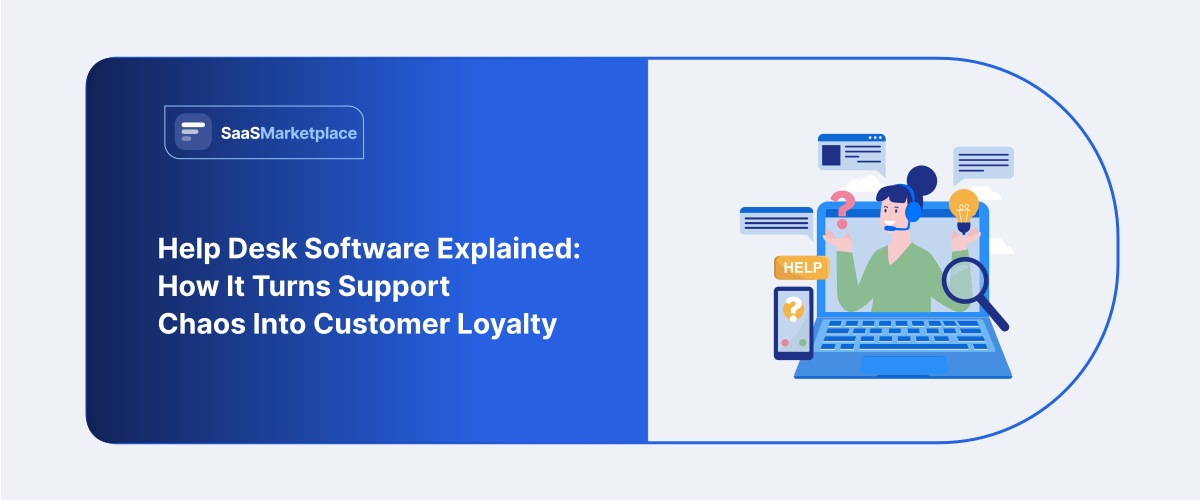
Help Desk Software Explained: How It Turns Support Chaos Into Customer Loyalty
-min.jpg)
A customer emails about a broken feature. Someone else opens a live chat at the same time. A third person calls in, annoyed. Meanwhile, a colleague down the hall needs their laptop reimaged and fires off a Slack message nobody sees for two hours. Sound familiar? If you're running support without a real system behind it, this is just Tuesday. This is the exact mess help desk software exists to clean up. Help desk software isn't just a fancier inbox. Done right, it gives your team one place to catch every request, whether that's a customer complaint, an IT ticket, or a “hey, is this normal?” message, and actually keep track of who's handling what.
 Looking for Help Desk Software? Check out SaaSmarketplace’s List of the Best Help Desk Software in USA for Your Business.
In many current scenarios, service platforms operate as cloud-based systems. Because of this structure, staff members are able to access the interface from portable computers in various locations. By using those tools, an employee is able to continue the specific tasks that a colleague previously managed. It is useful to examine the functional mechanics of help desk software and the methods for determining when a group requires more than a communal email account.
What Is Help Desk Software?
As you remove promotional phrasing, the core function of help desk software is straightforward. It transforms every incoming request for support into a digital ticket. The system next guides that ticket to the particular individual in charge of the assignment. This saves staff members from having to sift through outdated email conversations to find the last sender.
It essentially does three things. It gathers requests from anywhere, sorts them into searchable and filterable tickets, and assigns every one to the correct department or agent. Some tools are built purely for customer-facing support and work a lot like dedicated customer support software. Others double as an internal service desk, handling the stuff employees ask for constantly, like password resets, a new laptop, or access to a shared drive.
If you have researched "help desk" tools in the past, you have likely encountered the terms service desk & IT service management. To be precise, the distinctions between the categories are often unclear. In general, help desk software is for managing daily support requests, but a complete IT service management platform is more extensive because it includes features for tracking physical equipment, managing organizational changes, and formally logging service interruptions.
Signs Your Business Actually Needs One
Not every team needs this on day one. But a few warning signs usually mean you've already outgrown a shared inbox:
- Customer messages sit unanswered because nobody's sure whose job it was.
- Two agents reply to the same email while a third gets missed completely.
- Nobody can tell you how long a ticket's actually been sitting open.
- Employees keep asking the same questions because there's no knowledge base software pointing them anywhere
- Your team has grown past two or three people, and the email thread has basically become unreadable
If two or more of those hit close to home, that's not a coincidence. It usually means what you need next isn't a better inbox rule; it's an actual help desk system.
Do you know?
Closely tracking response times, support teams often see the same trend: consumers seldom notice when a request sits idle for hours without recognition at all, but they do notice. Help desk solutions mostly address this by making sure nothing stays hidden from first sight.
How Help Desk Software Actually Works
Help desk software converts a request that arrives via email, live chat, phone call, or web form, into a ticket with its own ID once it drops. From there, a few behind-the-scenes actions start to show themselves.
Based on rules you have created around subject, importance, or customer type, the ticket gets automatically forwarded to the appropriate owner. A strong ticketing system is worthwhile here as forwarding every single email to the correct recipient is precisely the kind of work no one wants to do at scale, and typically the first thing any good ticketing system gets right.
Most help desk software also lets you set SLAs, or service level agreements, so a ticket gets flagged if it's taking longer than promised to answer or resolve. It sounds small, but it's the difference between catching a frustrated customer early and finding out three days later that nobody replied.
Then there's automation. Confirmation replies, ticket tagging, escalating something nobody's touched in 24 hours- these can all run on their own. Help desk automation is often the single biggest reason a chaotic ticket queue turns into something a small team can manage without burning out, and teams that lean into help desk automation early tend to grow support volume without doubling headcount every time traffic spikes.
There's also the self-service side. A lot of customers would rather find the answer themselves than wait on a reply, which is where knowledge base software comes in, letting you publish help articles so the easy questions never even become tickets.
And last, reporting. Dashboards showing response time, resolution time, ticket volume, and agent performance are what let a manager actually see how the support ticket system is doing instead of guessing.
Types of Help Desk Software
Not all help desk software is built for the same job.
- Customer Support Help Desk: This is customer support software in its most recognizable form, built for handling questions from paying customers. It usually plugs into live chat and email, and sometimes call center software for phone support too.
- IT Help Desk or Service Desk: This one's aimed at internal employee requests, things like access issues, onboarding new hires, or a broken monitor. It's essentially IT support software with a ticketing layer on top, overlapping a lot with service desk software and broader IT service management platforms. Bigger IT departments sometimes keep a separate IT support software setup entirely rather than mixing it with customer tickets.
- Hybrid Help Desk Software: Handles both customer support and internal IT requests from one dashboard. This is common with mid-sized, growing companies that would rather not pay for two separate systems doing similar work.
Core Features Worth Looking For
A few elements, when you are evaluating help desk software, usually count more than others:
- Omnichannel ticketing combining five channels, email, chat, social, and phone, into one queue rather than five
- Automated regulations for ticket routing, tagging, and escalation without manual busywork
- A built-in knowledge base so customers and employees can self-serve the easy stuff
- SLA management with alerts before a deadline actually gets missed
- Reporting dashboards showing the team's actual performance as well as that of every agent
- Connections to your project management software, chat tools, or CRM
- Customer satisfaction surveys that attach right to a closed ticket
Though you might not need all seven right now, the more your ticket volume rises, the more each one shows its value.
How Help Desk Software Improves the Customer Experience
Good customer service software isn't just about closing tickets faster, though that's part of it, and that's really the whole point of paying for decent customer service software in the first place. It's about how customers actually feel about your company the moment something goes wrong. When requests are organized and nothing falls through, people get consistent answers instead of repeating the same story to three different agents in a row, which gets old fast.
A lot of modern help desk platforms also connect with chatbot software to knock out simple, repetitive questions instantly, and with CRM software so an agent can see a customer's order history without switching tabs mid-conversation.
Pair it with customer success software too, and you can often catch an unhappy account before a small complaint turns into a cancelled subscription. None of this is really about speed alone. On the client end, it's about structured support, that is more important for retention than most teams realize it to be.
Common Mistakes Businesses Make When Adopting Help Desk Software
Even solid help desk software can flop if it's rolled out carelessly. A few mistakes keep showing up:
- Switching to new help desk software without first mapping out ticket categories or routing rules
- Turning on every automation at once, which just confuses agents and customers alike
- Skipping agent training, so half the team quietly keeps working out of their personal inbox
- Ignoring the reporting data, so slow response times go unnoticed for months at a time
- Picking a support ticket system based on price alone instead of how it fits actual team workflows

Pro-tip
Don't flip the switch for your whole team on day one. Run new help desk software with a small pilot group for two or three weeks first. It's a lot easier to fix a messy routing rule when three people are affected instead of thirty
How to Choose the Right Help Desk Software for Your Team
Begin with the essentials: your real help channels, present ticket volume, and team size. A five-person company would find a platform made for a 200-agent company to be bloated and costly. Should your staff be spread out or work from home, choose a cloud-based help desk over anything on-premises.
From there, shortlist a few help desk software choices, hold them against your must-have features, check how easily each one interfaces with programs you currently use, and test the free trial using actual tickets instead of sample data.
Of course, price counts. However, if it cannot handle your ticket volume or offers little automation six months in, the least priced help desk program is actually not inexpensive. Most of the time, the correct help desk program simply fits into your team's current operations rather than appearing as one more item to handle.
Conclusion
One of the best operational decisions a developing company can do is to move to specialist help desk software. Adopting an ordered ticketing system helps your staff have total visibility over every client interaction by going beyond chaotic mailbox folders. The correct system prepares you for long-term success whether you want a quick-response IT help desk for your internal staff or a full customer service platform for world consumers. You can provide outstanding service as your company grows, save your support representatives from burnout, and maintain quick resolution times by combining self-service possibilities with clever help desk automation.
FAQ's
It gathers, arranges, and keeps tabs on employee or client support inquiries all in one system rather than spread across emails.
Not at all. Every time they are managing recurring requests, customer service, human resources, and IT groups all utilize it.
Typically, a service desk handles broader IT service management chores; a help desk handles daily support requests.
Yes, plenty of help desk software options offer simple, affordable plans built specifically for small teams.
Most modern platforms support omnichannel ticketing, folding email, chat, social, and phone into a single queue.