What Is Multi-Channel Ecommerce Software and Why Online Sellers Need It?
-min.jpg)
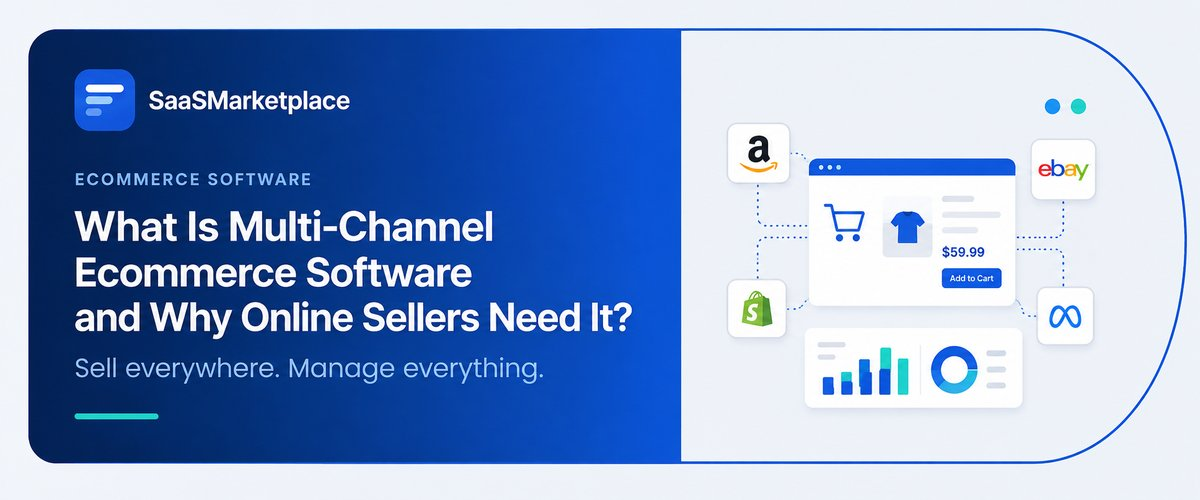
Multi-channel ecommerce software serves as a single point of control that merges and automates tasks spanning both digital and physical sales outlets. Contemporary retail encompasses website shops, third-party marketplaces, social selling sites, and traditional brick-and-mortar locations. Handling each outlet separately builds operational barriers, leading to wrong stock counts, duplicate sales orders, mismatched prices, and broken customer records.
 Looking for Multi-Channel Ecommerce Software? Check out SaaS Marketplace’s List of the Best Multi-Channel Ecommerce Software in the USA for your business.
This tool functions as a main center linking stock tracking, order handling, item descriptions, and client information with live updates. If a product moves from one site, available quantities refresh immediately across all systems to stop over-selling goods. As internet vendors grow, this solution cuts down human mistakes, speeds up delivery steps, allows easy growth into fresh markets, and keeps buying smooth at every contact stage.
What Multi-Channel Ecommerce Software Actually Does
At its core, multi-channel ecommerce software pulls every place you sell your website, Amazon, eBay, Walmart Marketplace, Instagram Shop, and your physical store into one connected system. Instead of logging into five different dashboards to check what sold where, you get one view of orders, one view of stock, and one view of customers.
On paper, that sounds straightforward enough. In practice, it's usually what separates a business that grows without much drama from one that burns half its week untangling spreadsheet mistakes. Inventory counts drift the moment you add a second sales channel. A order placed on Amazon doesn't automatically subtract from what's available on your website unless something is actively syncing the two. Multiply that across four or five channels, and manual tracking stops being realistic pretty quickly.
Why This Problem Gets Worse as You Grow
Here's something a lot of new sellers don't expect: adding channels doesn't just add sales, it adds coordination work. A single-channel store can get away with checking inventory once a day. Once you're running a website, two marketplaces, and a retail counter, stock levels can change every few minutes, and any lag between systems shows up as an overselling problem the kind that generates cancellation emails and one-star reviews.
Smaller companies tend not to notice this gap until it's already cost them a few rough weekends. It usually goes the same way: sales tick up, something takes off on social media, and suddenly three channels are pulling from stock that only exists in one warehouse. Nobody's tied those channels together yet, so somebody ends up refreshing a spreadsheet by hand a fix that never really holds up for long.
Core Features Worth Paying Attention To
Multi-channel platforms aren't built the same way underneath, and which features actually matter depends a lot on how a given business runs day to day.
Inventory Sync Across Channels
This is the feature that solves the hoodie problem above. Good software updates stock levels in near real time across every connected channel, so a sale in one place is immediately reflected everywhere else. Some platforms sync every few minutes, others advertise instant updates, and the gap between those two claims matters more than it sounds. A short delay is sometimes enough to cause trouble with fast-moving products, so it's worth pressing vendors on how their sync actually performs once real order volume hits it.
Order Management in One Place
Rather than switching tabs between marketplace seller portals, you get a single queue showing every order, regardless of where it came from. Packing slips, shipping labels, and tracking numbers can be generated from that one screen, which cuts down significantly on the manual re-entry that eats up a warehouse team's morning.
POS Software Integration
For businesses with a physical location, connecting online sales to POS software is one of the more overlooked pieces of the puzzle. Without that link, your online store and your cash register are effectively two separate businesses that happen to share a bank account. With it, a sale rung up in-store immediately updates online stock, and vice versa.
Mobile and iPad POS Software
Foot traffic doesn't always happen at a fixed counter. Pop-up shops, farmers markets, and food trucks have pushed a lot of small businesses toward iPad POS software, which turns a tablet into a full checkout station without the upfront cost of traditional hardware. For a multi-channel seller, the advantage is that this mobile setup still needs to report back into the same central inventory system otherwise you're back to manually reconciling numbers at the end of the day.
Billing and Payment Consistency
POS billing software covers receipts, tax calculations, and payment processing, and that side of things has to hold together no matter where the checkout happens website, counter, or handheld device. Tax rules shift by state, and sometimes by county too, so software that works out the correct rate automatically based on location saves everyone a real headache when filing season comes around.
Common Mistakes Businesses Make When Choosing a Platform
A lot of businesses assume that any software advertising "multi-channel support" behaves roughly the same underneath, but the differences between platforms run deeper than that label suggests. Some platforms sync inventory but leave order management scattered. Others handle marketplaces well but treat in-store POS integration as an afterthought, bolted on rather than built in.
Another common misstep is choosing software based purely on the number of channels it supports, without checking how well it integrates with the channels a business actually uses. Connecting to fifteen marketplaces means little if the two channels driving most of your revenue your Shopify store and the counter, say don't sync cleanly with each other.
This usually surfaces after a team has already signed on and started moving data over, which is a frustrating spot to land in and one that's avoidable. Testing the real integration against your own sales channels before committing to a longer contract beats trusting a features list on faith.
When Multi-Channel Software Might Not Be the Right Fit Yet
Not every business needs this immediately. A single-location store selling only through one website doesn't have a sync problem to solve, and adding complex software at that stage can be more overhead than it's worth. Things tend to shift once a second channel enters the picture a new marketplace listing, a physical location, a wholesale account and manual tracking starts showing cracks.mWaiting can make sense if order volume is still low enough for one person to check stock across channels by hand without much strain. That window closes faster than most people expect, though, especially once a seasonal rush or a marketing push sends orders climbing.
What to Look for Before Committing
A handful of practical questions usually separate a solid choice from an expensive mistake:
- Does it integrate directly with the specific marketplaces and POS hardware you already use, rather than requiring a workaround?
- How does it handle returns and refunds across channels does inventory update correctly either way?
- What happens during an internet or system outage? Can a store still process transactions and sync later?
- Does the vendor respond quickly when support is actually needed, and have they worked with businesses your size before?
There's no universal right answer here. A five-location retail chain and a single café aren't solving the same problem, and good software fits the business instead of forcing every business into the same mold.
Conclusion
Multi-channel ecommerce software has stopped being something only large retailers need; at this point, it's practical for any business selling in more than one place. The point isn't collecting every feature a vendor lists; it's landing on a system where inventory, orders, and point-of-sale data actually agree with each other in real time. The businesses that get the most value out of multi-channel software tend to be the ones that took the time upfront to map out exactly how orders, inventory, and payments should flow between systems, rather than assuming any platform would figure that out on its own. It's also worth revisiting the setup periodically rather than treating it as a one-time decision. Sales channels change, a marketplace updates its API, a new payment method becomes standard, a store adds a second register.
FAQ's
Yes, most modern platforms integrate with POS software so that in-store sales update online inventory automatically, and vice versa.
For many small to mid-sized retailers, yes iPad POS software can handle daily transaction volume comfortably, though very high-volume stores sometimes prefer dedicated hardware.
Some platforms support both, but restaurant POS software and retail POS software are built around different workflows, so it's worth confirming both use cases are genuinely supported, not just technically possible.
A grocery store POS system typically adds support for weighted items, frequent price changes, and high SKU counts, which standard retail setups aren't always built to handle well.
Most POS billing software applies tax rates based on location, but businesses selling across multiple states should confirm the software stays current with changing tax rules.