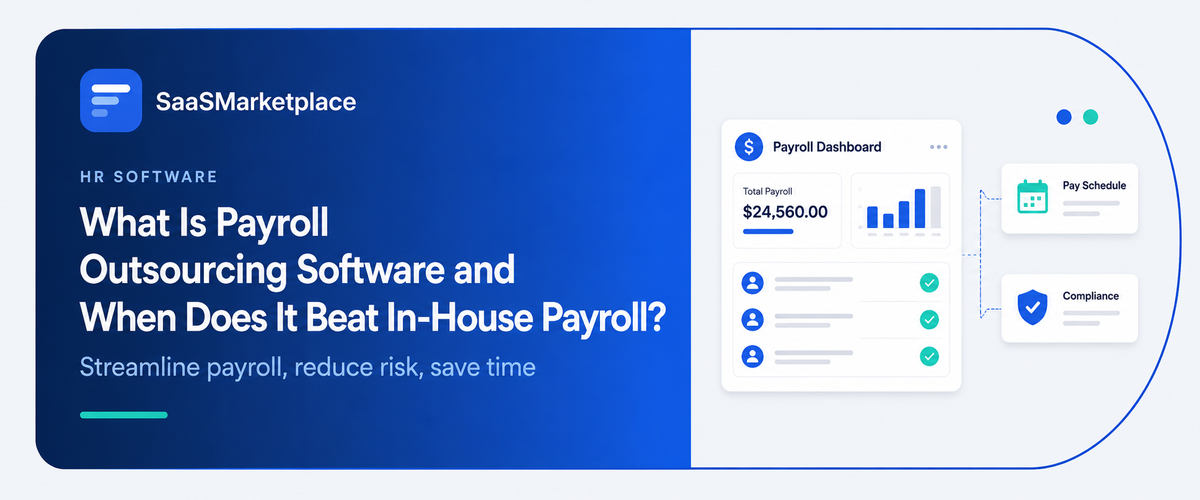
What Is Payroll Outsourcing Software and When Does It Beat In-House Payroll?
-min.jpg)
The administration of worker payments is a vital task that a company performs. In the initial phases of a business, the tracking of hours, the calculation of wages, and the delivery of funds seem easy to handle. Internal administrative workers often complete those tasks, using electronic spreadsheets or simple internal tools. But as the number of workers increases, the methods of payment become complex, and tax laws from multiple states apply.
 Looking for Payroll Outsourcing Software? Check out SaaSmarketplace’s List of the Best Payroll Outsourcing Software in USA for Your Business.
The internal management of salaries then becomes a slow process that hinders operations. If a worker calculates tax withholdings wrongly, misses dates for legal filings, or tracks benefit costs incorrectly, the business may face expensive fines - those errors also damage the confidence of the workers. To ensure that data is correct plus processing is fast, current organizations transition to payroll outsourcing software.
What Is Payroll Outsourcing Software?
It is a platform that combines technology and services to link internal business activities with external payroll specialists. The payroll software differs from traditional applications because legacy programs require internal workers to complete every calculation, verify every tax rule, and send every government form by hand. In contrast, an outsourced platform functions as a managed system.
Using this framework, internal teams upload monthly variable inputs, such as approved hours, bonuses, commissions, and new-hire data, via secure portals. The service provider manages the remaining steps - they run scripts for calculations, process direct deposits, create pay stubs, and file tax documents with state and federal agencies automatically.
By combining cloud accessibility with expert external oversight, payroll outsourcing software allows organizations to offload complex statutory responsibilities while retaining full visibility over salary disbursements.
Do You Know?
Industry compliance audits reveal that businesses that operate between small and medium sizes achieve an 80% reduction in statutory filing penalties through their payroll outsourcing software compared to organizations that handle tax submissions manually.
The Operational Dilemma: In-House Payroll vs. Outsourcing
The process of employee compensation management requires organizations to evaluate their available resources against their risk management targets. Organizations need to understand the fundamental distinctions between internal team operations and external technology partner collaborations to select their preferred approach.
In-House Processing Realities
Standard payroll software enables companies to operate internally while they keep complete authority over when payments are made and who can see their data. Payroll and accounting teams have the ability to make quick changes while they produce manual checks right away, and they can adjust payment systems through their immediate response capabilities.
The system needs users to stay vigilant about its operation at all times. The system requires internal administrators to track tax code variations while they handle withholding responsibilities across different regions, and they need to sustain their software system connections. The cost of hiring full-time payroll staff and keeping up with their in-house systems becomes more expensive than paying for outside services when a business expands.
The Managed Outsourcing Advantage
The deployment of payroll outsourcing software transfers all administrative work to outside experts who specialize in correct processing and official compliance requirements. Internal managers review and approve final pay runs instead of spending time on tax withholding calculations and ledger entry balancing.
Additionally, top-tier outsourced payroll services include compliance guarantee clauses in their service agreements. If a processing error or late tax filing occurs due to vendor oversight, the service provider absorbs the resulting regulatory fines, shielding the client business from financial penalties.
Core Capabilities of Modern Payroll Outsourcing Software
Evaluating modern managed platforms involves looking closely at the specific features that automate end-to-end processing:
1. Automated Tax Withholding and Statutory Filings
Tax regulations at local, state, and federal levels undergo frequent changes. The outsourcing engines contain modern payroll compliance software that performs dynamic tax table updates. The software performs exact calculations of local income taxes and unemployment contributions and social insurance deductions for each pay period while it generates quarterly and annual tax filings through automated processes.
2. Employee Self-Service Portals
Fielding routine questions about pay stubs, tax withholdings, and remaining paid time off consumes valuable HR time. Advanced payroll processing software includes secure employee self-service web portals and mobile applications. Staff members can securely log in to download year-end tax forms, update direct deposit bank details, and track historical earnings independently.
3. Integrated Benefit Deductions and Ledger Tracking
Compensation rarely involves base wages alone. Modern systems integrate directly with payroll & benefits software and benefits administration software to calculate pre-tax health insurance premiums, retirement match contributions, and wage garnishments automatically. Once a payroll run completes, the platform pushes journal entries directly into your existing payroll accounting software to keep financial records accurate and up to date.
Strategic Signs It Is Time to Switch to Payroll Outsourcing
Continuing to manage employee pay using basic internal tools during rapid business expansion creates operational risks. Organizations should evaluate payroll outsourcing software when they spot these operational indicators:
1. Expanding into Remote and Multi-State Markets
The process of hiring remote workers who operate from various states and municipalities creates an intricate system of overlapping tax regulations. The process of tracking state withholdings, local transit taxes, and regional unemployment rules becomes difficult for internal staff members to handle through their manual approach.
2. Internal HR Spending Days on Routine Data Entry
Imagine if each month, all senior HR managers had to dedicate their entire last week just to manually review timecards, compute overtime rates, and input information into separate spreadsheets. This would distract HR from important work like retention, recruiting, and engagement.
3. Repeated Tax Filing Errors and Penalty Notices
Receiving penalty notices from tax authorities for incorrect withholdings or missed filing deadlines indicates that internal administrative processes are overextended. Offloading these operations to specialized payroll outsourcing companies eliminates calculation errors, ensures tax returns arrive on schedule, and simplifies how wage data syncs with your payroll accounting software.
4. Rapid Headcount Growth and Scaling Pressure
Adding dozens of new employees quickly places heavy demands on internal administrative teams. Cloud payroll software platforms are highly flexible and scale effectively as employer's headcount increases without any need to employ any additional in-house payroll administrators.
Feature Comparison: Internal Platforms vs. Managed Outsourcing
Selecting between an internally operated platform and a fully managed outsourced solution involves consideration of several operational aspects:
|
Evaluation Criteria |
In-House Payroll Software |
Managed Payroll Outsourcing Software |
|
Primary Operational Burden |
Internal HR & Finance staff handle all entry & checks |
Vendor manages calculations, filings, & distributions |
|
Tax Compliance Responsibility |
Internal team holds full liability for errors |
Service provider manages updates & absorbs filing error risks |
|
Scalability for Multi-State Teams |
Complex; requires manual tracking of regional tax codes |
Seamless; software handles multi-jurisdiction rules automatically |
|
Implementation & Training Overhead |
High initial training required for internal staff |
Low internal training needed; vendor manages workflows |
|
Best Suited Business Model |
Companies with dedicated, in-house tax expertise |
Fast-growing teams, remote workforces, & lean HR teams |
Scaling Overseas: Multi-Country and Global Payroll Requirements
International expansion introduces increased payroll complexity. When doing business across international markets, there are complexities introduced by differences in labor laws, exchange rates, foreign banking fees, and fixed obligatory benefits.
Attempting to run international payroll using standalone domestic tools is impractical. Instead, growing enterprises utilize specialized global payroll software and multi-country payroll software integrated into their broader global payroll outsourcing strategy.
These sophisticated international internal tools take care of local tax withholding, facilitate disbursement in local currency, and ensure full regional employment compliance through a one-stop shop single managing console.
Integrating Payroll with Broader Workforce Ecosystems
Standalone payroll applications operating in isolation create data silos that lead to re-keying errors. In today's enterprise architectures, payroll outsourcing software is integrated with large, enterprise-wide human resource management systems:
Integration of the managed payroll engines with a central HR software or an enterprise-wide HCM software suite guarantees that the updates to the employee records like address, salary increases or even promotion titles will be synchronized and passed on to the various operational databases.
Similarly, linking payroll tools with specialized workforce management software automates timecard imports, shift differential calculations, and overtime tracking, eliminating manual data entry before pay runs.
For enterprise-scale operations with complex, multi-entity corporate structures, deploying comprehensive enterprise payroll software options ensures smooth integration across all regional departments and subsidiaries.

Pro-tip
When evaluating payroll software for small business outsourcing options, select a provider that offers integrated employee self-service mobile applications. Allowing employees to retrieve their own digital pay stubs and tax documents drastically reduces routine administrative support tickets.
Migrating to Outsourced Payroll
Transitioning to an outsourced payroll provider proceeds smoothly when planned in clear phases:
- Audit Existing Compensation Processes: Record Salary Structures, Incentive Schemes, Rules for Benefit Deductions, and State tax accounts.
- Standardize Employee Data Files: Improve current employee data files to have correct Social Security numbers, tax withholding elections, and bank routing information.
- Select compatible managed software: Select a service provider whose cloud system will easily work with your current time recording, accounting, and HR package.
- Use parallel payroll test runs: Run parallel test runs simultaneously with your internal operation during one or two pay cycles to ensure calculations are correct prior to full transition.
- Implement employee access portals: Give staff definitive onboarding instructions on how to access their self-service web and mobile accounts.
Conclusion
Moving into payroll outsourcing software for small, growing companies provides a quick, safe way to pay employees without competing risks or compliance burdens by outsourcing the tax calculation engine alongside the vendor, resulting in: decreased administrative costs, no Federal or State statutory penalties, and multi-state compliance. Moving away from manual processes in-house to a managed outsourcing path allows internal HR and finance teams to focus on other value-added internal activities.
FAQ's
In-house software scales with an internal team of staff to do calculating wages and tax returns. Outsourcing scales on a combination of cloud software and vendor support to do calculating, payouts and tax returns.
Commercial managed providers utilize enterprise-grade data encryption, multi-factor authentication, and hard SOC-compliance protocols to secure financial data.
Yes, outsourcing eliminates the need to hire dedicated internal payroll staff, saving time and preventing costly statutory filing errors for small teams.
The software automatically tracks employee work locations, applies local state withholding rules, and files required tax returns directly with state authorities.
Reputable managed outsourcing vendors include compliance guarantees that absorb financial penalties resulting from vendor processing errors.