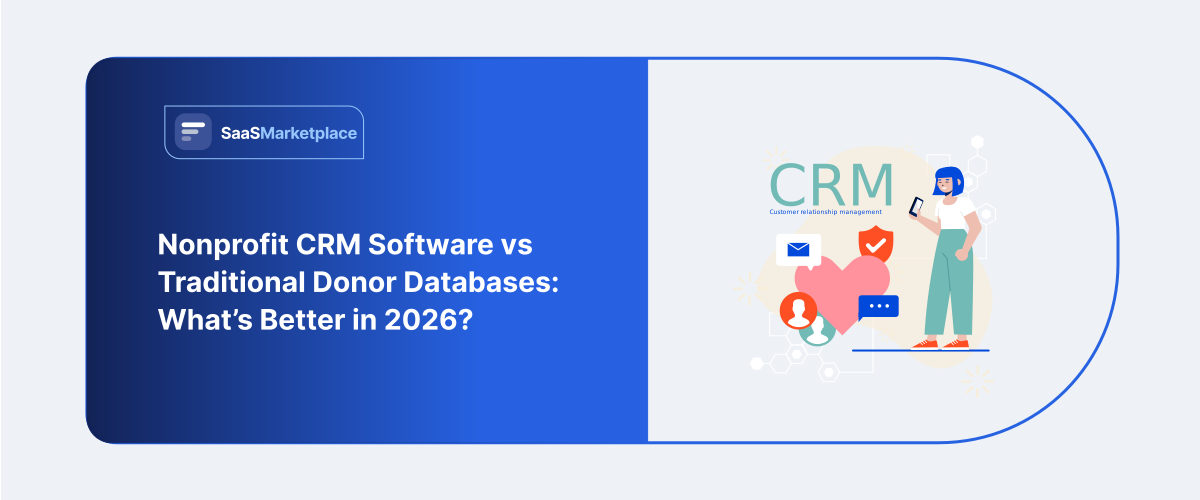
Nonprofit CRM Software vs Traditional Donor Databases: What’s Better in 2026?
-min.jpg)
The year 2026 marks a crucial evolution for nonprofit organizations in terms of how they connect with and manage their supporters. Unlike the traditional donor database that can simply be described as a storage of received donations and important information regarding contacts, nonprofit CRM software employs the latest technologies to integrate all donors' info with automatic business operations, multi-channel communications, volunteer management, and predictive analytics. A donor database today doesn’t really meet the needs of the growing nonprofit sector, because donors want more modern methods of reaching out like email, social media, and websites.
What is Nonprofit CRM Software, and how does it differ from a Traditional donor Database?
Nonprofit CRM software, meaning Customer Relationship Management, is a pretty versatile kind of tool that helps an organization, with a mission in mind, keep in touch with its sponsors and then nurture those relationships over time, kinda steady like. But unlike older systems that mostly just logged donation history and that was it, a modern CRM bundles donor information with real going-on events, the hours spent volunteering, digital outreach, and advocacy campaigns, all together in one place. This helps nonprofits view the whole picture of how their supporters engage, like when someone signs a petition, shows up for a gala, or sets up a recurring monthly donation. And because it does that, it makes it possible to send timely and more personalized nonprofit communication.
The primary distinction between traditional database solutions and modern customer management software is found in their purpose; while the functions of an old-fashioned donor database are limited to capturing information, modern customer relationship management software performs as an effective machine for attracting donations. An older database relies on manual data input to save historical transaction data and produce standard tax receipts, putting the workforce into monotonous administrative loops of work. By contrast, nonprofit CRM software automates daily processes that include sending out gift confirmations, monitoring deadlines for grant proposals, and starting email communications based on donor behavior.
Which Features make Nonprofit CRM Software stand out against old donor Databases?
1. Automated Workflow Engine & Multi-Channel Campaigns
Rather than having to do manual exports just to run email blast campaigns, a modern CRM houses complex donor communications in an automated environment. The platform uses static Excel sheets exported to external software to distribute information.
The package allows for trigger-driven campaigns such as sending an immediate tax receipt and following that up with a customized welcome sequence three days after the initial donation.
2. Unified 360-Degree Constituent Profiles
Modern CRMs help to put together all the required information of supporters in one view. The bug tracking will include financial donations made only.
It is a combination of giving history, participation in events, and voluntary activity hours, along with social networking data, into a single flexible profile.
3. Smart Segmentation and Predictive Analysis
CRM programs utilize current information and real-time data that allow development teams to concentrate on relevant degrees of opportunity.
Provides substantial historical data reporting (Who gave $100 last year?) Automatically highlights donors that are on the verge of leaving; measures retention ratios as well as applies predictive analysis to expose potential donors.
4. Direct App and Online Giving Integration
Recent innovations offer cloud technology and automatic connections that eliminate the need for data duplication.
The staff has to input data by hand when processing cheques and credit cards. Allows for immediate recording of transactions in payment processors, bookkeeping programs, custom web forms, etc.
Is Nonprofit CRM Software more Cost-Effective than a Traditional Donor Database in 2026?
1. Reduction in Paid Administrative Time
With the use of outdated systems, employees work full-time to do data entry tasks such as record checks, matching up various spreadsheets, and fixing duplicates. An automated gift system reduces work time for employees in data entry and enables them to work on other important activities such as donor care and campaign planning.
2. Increased Donor Retention Rates
Securing new donors entails significant expenses compared to retaining existing donors. The retention rate of first-time donors in the NPO sector is around 20%, while donor retention rates for repeat donors are usually around 75%. Modern CRMs use various automated methods to reach out to and nurture existing donors.
3. Consolidation of Technology Stack
Organizations using old-style databases are often compelled to buy standalone software programs for email marketing, ticketing for events, peer-to-peer fundraising, and volunteer management. Now, the technology field offers a modern, complete integrated CRM solution that unites all these functions within one system. This approach allows organizations to eliminate about 3 to 5 third-party solutions and, consequently, save significant money on software purchasing.
4. Machine Learning and Predictive Analytics in Major Gift Detection
Previously, to identify people who can make a major contribution to fundraising, organizations needed to turn to expensive wealth screening consultants. Modern CRMs, designed in 2026, have already been developed using a unique predictive analysis technology that takes into consideration giving behavior, engagement, and public indications to identify brains of potential major giftors hidden in an organization’s network.
5. Reduced Merchant Processing and Payment Fees
Outdated databases can trap non-profits in inflexible payment systems that impose high transaction fees. Newer CRM programs work with modern payment processors or include no-cost giving options (like tips) that allow groups to keep a greater share of their donation income.
6. Costs for IT Maintenance Are Removed
On-site databases often require special servers, complicated data backups, custom network configurations, and payment for technology support for many updates. Cloud CRMs provide automatic updates of technology, secure technology, and cloud-based backups at no additional cost.
How does Nonprofit CRM Software improve data management compared to legacy systems?
In the case of existing databases, heavy reliance on static spreadsheets and isolated desktop applications results in creating data silos, causing fragmentation of information about the benefactors across multiple files. However, cloud-based non-profit CRM systems resolve the problem by uniting all constituent processes and actions, including digital transactions, event registrations, hours of volunteering, and email clicks, into one up-to-date single unit of reference. Thus, the teams of fundraising and management get instant access to detailed information on donors without the necessity to combine outdated spreadsheets before starting the campaign or preparing financial statements.
Data hygiene and precision improve due to automated synchronization and built-in validation rules. While traditional systems suffer because of human errors occurring in manual data entry, such as duplication of entries, writing the wrong mailing addresses, and not recording pledges made offline, non-profit CRM systems carry out automatic capturing of data received online through payment portals, web forms, and related software. What is more, many modern CRMs offer donor self-service portals, thereby giving donors the ability to process their personal information and payment methods on their own.
Modern CRM systems are not just about keeping records; they take data to become useful information. Old CRM systems can only give you figures you already know. There are a lot of techniques used in modern CRMs, including analytics, predictive modeling, and dynamic segmentation. These techniques allow you to see trends in donations, identify potential high-value donors, and even find out supporters who are about to leave you. This helps American charities to make data-driven decisions to increase donor retention and improve fundraising.
Can Nonprofit CRM Software boost donor engagement better than traditional databases?
1. Automated Personal Reception Sequences
Rather than needing several weeks for a paper receipt to arrive, CRMs prompt personalized email journeys soon after the making of an online donation. This instant acknowledgment facilitates rapid acknowledgment of impact, which improves conversion rates from first to second donation.
2. Multi-Channel Engagement Oversight
Modern CRMs track all supporter actions text messages, opening emails, RSVP for events, and contribution of volunteer hours on a single timeline. Employees thus can understand how the donor wishes to commenting, leading to a personalized approach instead of just using mass mailings.
3. Dynamic Behavioral Classification
Unlike traditional mailing database systems, CRMs constantly update donor groups according to real-time donation frequency and website engagement. Charities can thus reach out instantly to certain groups of people, for example, to those who attended a gala at least once before, but have not enrolled in the monthly donation program since that event.
4. Alarms for Lapsed Donors
In order to address decreasing retention rates in the industry, innovative platforms alert supporters who have the chance of leaving. Development teams are notified about automatic tasks to follow up with these supporters by calling or emailing them before they leave for good.
5. Customized Requests Based on Giving History
Instead of sending everyone the same amount of money, the CRM recommends donation levels based on donation history for each individual. This leads to better conversion rates than in the case of sending random money to people.
6. Employer Matching Gifts
Many of the American CRMs offer built-in solutions that scan online donations for the possibility of corporate matching. Notifying donors that their employers might match their donations greatly increases donor satisfaction and overall income for the charity.
How well does Nonprofit CRM Software scale as your organization grows?
The nonprofit customer relationship management solutions grow together with the US organizations using them, being flexible and customizable with the use of the cloud-based nature of the service. The main functionality allows very small organizations to apply only basic options (tracking clients and sending thank-you letters), while more complex tools such as the major gift pipeline, grant management, and corporate gift matching are available to bigger entities.
Traditional databases will slow down when the number of records increases; on the contrary, cloud-based software can serve as a database no matter if the number of users ranges from thousands to hundreds of thousands.
In terms of operations, modern CRM solutions allow companies to increase their capacity due to legislative changes by increasing permissions, security features, and introducing automatic workflows. Companies with small teams can conduct daily tasks effectively, while bigger organizations can set different levels of operation for such teams as business development, marketing, event management, and executives.
What 2026 Trends are pushing US Nonprofits toward Nonprofit CRM Software?
In 2026, converging shifts in donor expectations, technology, and demographics are forcing US charities further away from their legacy systems toward the age of modern-day CRMs, including:
1. Self-contained Agentic AI and Automation
Nonprofits no longer use independent AI tools, but CRMs embedded with their own AI engines capable of writing customized thank-you letters, summarizing donor conversations, and identifying key prospects instantly.
2. First-Year Donor Retention at All-Time Low
With first-year donor retention at under 20%, charities turn to CRMs to deploy automated welcome series, automated behavioral tracking, and customized stewardship journeys to keep their revenue stream intact.
3. Explosion in Non-Cash Donor Giving
With cash donations on the decline, charities require CRMs that can handle complicated donation mechanisms, such as Donor-Advised Funds (DAFs), stock transfers, and corporate matching donations, all in one system.
4. Need for Security-Conscious Data Governance
Growing privacy regulations in the US and calls for more transparency are making it risky for organizations to rely on dated, spreadsheet-driven strategies, resulting in a shift towards CRMs with comprehensive or cloud-optimized compliance protocols
5. Encompassing Digital Demands of All Generations
Young people nowadays, particularly donors from the Gen Z and Millennial demographic, expect to be able to log in and manage their finances using a user-friendly portal on their phones; that is, they want to be able to carry out transactions without any human interaction.
Conclusion
By 2026, changing from relying on outdated databases to using modern nonprofit CRM systems will no longer be simply a desirable option; it will become a crucial step towards sustainability in the long run. Traditional databases work as mere storage systems; however, today’s CRMs represent an agent of growth capable of combining various data sources and organizing transactions systematically. Organizations willing to integrate advanced software solutions should visit online vendors such as SaaSMarketplace to search for, compare, and purchase software solutions that meet their requirements in the business sector.
FAQ's
A traditional donor database acts as a static ledger for tracking gifts and contacts, while a modern nonprofit CRM serves as a dynamic operational hub that automates multi-channel engagement, marketing, and cross-departmental workflows.
Yes, nonprofit CRMs are far superior in 2026 because they incorporate agentic AI, predictive analytics, and seamless tool integrations to increase donor retention and save staff operational time.
Traditional databases trap information in isolated silos, lack automated donor stewardship capabilities, and rely heavily on manual data entry rather than real-time cloud updates.
Yes, most modern cloud-based nonprofit CRMs offer tiered, affordable pricing models that allow small teams to access advanced automation without massive upfront infrastructure costs.
CRMs automatically track engagement history, send personalized thank-you communications, and use predictive scoring to alert fundraisers when a donor is at risk of lapsing.