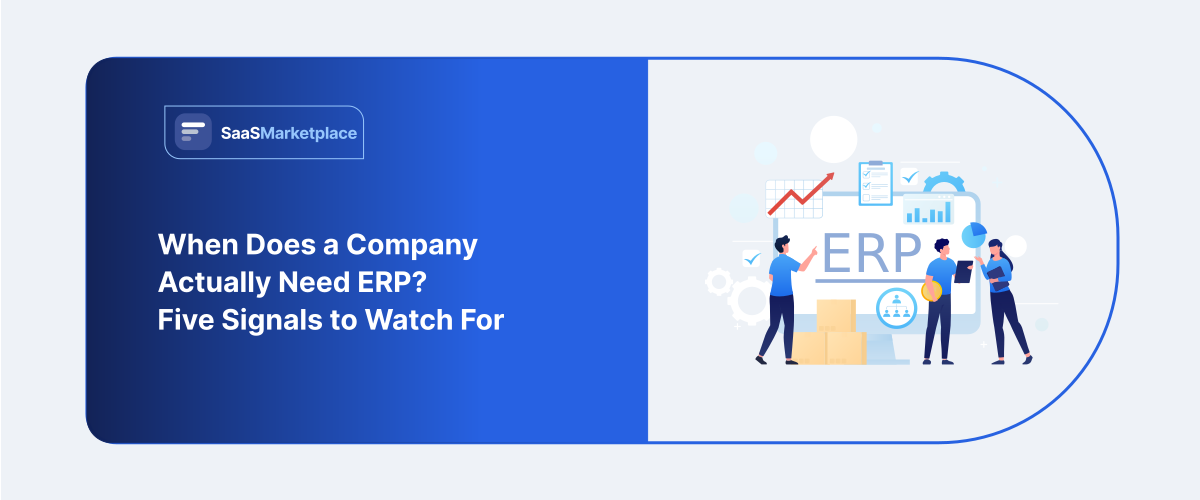
When Does a Company Actually Need ERP? Five Signals to Watch For
-min.jpg)
A company normally desires an ERP software program when disconnected structures, manual reporting, stock problems, rapid headcount booms, and patrons going through operational errors start slowing the enterprise down. In 2026, the 5 clearest alerts are information silos across departments, sluggish monetary near cycles, supply chain visibility gaps, HR process pressure, and growing client lawsuits tied to inner inefficiency.

Looking for ERP software? Check out the SaaS Marketplace List of the Best ERP Software in USA for your business.
Nobody wakes up one morning and decides to shop for an ERP system. It usually starts with a bad week. A shipment goes out to the wrong address. Finance asks Sales for numbers that Sales already sent twice. Someone finds a pricing error that has been live for eleven days. That is the point wherein management starts off evolved, asking the actual query. Do I want an ERP software program, or do we just need better conduct? Fair question. This guide walks through the 5 indicators that answer it and what each one without a doubt looks like in a growing US company in 2026.
What Is ERP Software?
ERP stands for organization resource making plans. The call is older than the maximum of the humans using it, and it sounds heavier than it is. Strip away the jargon, and it means one component. One database is shared via finance, operations, inventory, buying, HR, and sales, so each person is asking the equal numbers at the equal time. That is what ERP is in plain terms. Not a magic engine. A single source of truth.
What ERP Does That Other Software Cannot
Your accounting tool is very good at accounting. Your CRM is very good at deals. Neither one is aware of what the other is doing. Enterprise useful resource planning software programs connect those features so an income order mechanically touches inventory, then production, then invoicing, without every person retyping them. An ERP system is not a higher version of the tools you already use personally. It is the layer under them. That distinction matters. Companies that buy ERP software expecting a prettier QuickBooks are usually disappointed. Companies that buy it to kill duplicate data entry usually are not.
Why Timing Matters When Adopting ERP
Getting the timing right is half the decision. The question of when to implement ERP is less about revenue milestones and more about whether your processes have started fighting each other.
Too Early: The Risks of Premature ERP
A twelve-person startup does not need enterprise resource planning. It needs customers.
Buying too early burns cash you cannot spare and forces rigid workflows onto a business that is still figuring out what its workflows should be. Implementation takes months of leadership attention. At that stage, that attention is worth more than the software.
There is also the adoption problem. Small teams tend to ignore systems that feel oversized, and an unused ERP system is just an expensive line item.
Too Late: The Cost of Waiting Too Long
Waiting is the more common mistake and the more expensive one.
Every quarter you delay, more data gets buried in spreadsheets that will eventually need cleaning before migration. More custom workarounds get baked into daily habits. More staff learn a process that will have to be unlearned.
Migration cost scales with mess. That is the part nobody mentions in the sales deck.
Signal 1: Your Teams Are Working in Disconnected Systems
Here are the five signals your company needs ERP in 2026:
- Teams working in disconnected, siloed systems
- Month-end financial reporting takes days rather than hours
- Inventory and supply chain are constantly breaking
- Headcount growth is outpacing your current processes
- Customers are experiencing your operational problems
The first one shows up quietly. Nobody escalates it because everyone has adapted to it.
The Spreadsheet and Email Problem
Ask your operations lead how many spreadsheets the business depends on. Then ask how many of those live on someone's desktop instead of a shared drive.
The answer is usually uncomfortable. A distributor we could describe as typical for the US mid-market had fourteen active spreadsheets feeding one weekly report. Four of them were maintained by a single person who was about to retire.
This is one of the clearest signs you need ERP. When institutional knowledge lives inside a file rather than a system, you are one resignation away from a problem.
Data Silos Costing You Decisions
Silos do not just slow you down. They make you wrong.
Sales quotes a delivery date based on inventory numbers that were accurate last Tuesday. Procurement orders stock based on a forecast that never saw the cancelled purchase order. Both teams are doing their jobs correctly with incorrect inputs.
ERP software fixes this by removing the gap between when something happens and when everyone else knows about it.
Signal 2: Finance and Reporting Takes Days Not Hours
Finance is where the pain becomes measurable, which is why it is often the department that pushes hardest for change.
Manual Month-End Close
A healthy close takes three to five business days. If yours runs past ten, something structural is wrong.
Watch what your accounting team actually does during those days. If a meaningful share of the time goes to exporting from one system, reformatting, and importing into another, that is not accounting work. That is data plumbing.
An ERP system removes most of it because the data never left in the first place.
No Real-Time Financial Visibility
The bigger issue is speed of insight. By the time a close is finished, the numbers describe a month that already ended.
Leadership ends up steering with a rear-view mirror. Decisions about hiring, pricing, and inventory get made on gut feel because the actual figures are three weeks behind. Enterprise resource planning closes that gap by making the dashboard live rather than retrospective.
Signal 3: Inventory and Supply Chain Is Constantly Breaking
If you sell physical goods, this signal tends to arrive loudly.
Stockouts and Overstock Problems
Both problems come from the same root cause. You do not know what you have.
Stockouts cost you revenue you already earned. Overstock ties up cash in a warehouse and quietly ages into write-offs. Many mid-market companies carry twenty to thirty percent more inventory than they need, purely as insurance against their own bad data.
That buffer is expensive. ERP software for small business and mid-market operations pays for itself fastest here, because reducing safety stock frees real cash rather than theoretical efficiency.
Poor Supplier and Order Visibility
Then there is the question nobody in your building can answer quickly. Where is order 4471?
If finding out requires three phone calls and a check of someone's inbox, your customers already know. They are the ones waiting on the answer.
Signal 4: Headcount Is Growing Faster Than Your Processes
Growth exposes weak processes rather than creating them. The cracks were always there.
HR and Payroll Strain
At twenty employees, someone in the office handles onboarding paperwork on top of their real job. At eighty, that arrangement collapses.
Time-off requests get lost. Payroll corrections become routine. New hires spend their first week hunting for logins that nobody remembered to request. ERP for growing business teams typically bundles HR and payroll software into the same platform, which stops the handoffs from falling through.
Onboarding and Compliance Gaps
Multi-state hiring makes this worse. Different states, different rules, different filing requirements.
Manual tracking works until it does not, and the failure mode is usually a penalty notice. Companies looking at ERP for growing business operations across state lines often cite compliance as the trigger rather than efficiency.
Signal 5: Customers Are Feeling the Operational Pain
This is the signal that should move fastest from noticed to acted upon, because it costs revenue rather than time.
Late Orders and Wrong Invoices
Internal chaos stays internal until it does not.
An invoice goes out with last quarter's pricing. A shipment arrives short two units because the inventory said they were in stock. A customer calls three times and gets three different answers about their delivery date.
None of those are customer service failures. They are data failures wearing a customer service costume.
Customer Complaints Linked to Internal Errors
Track your complaints for one month and tag each one by root cause. If more than a third trace back to information problems rather than product problems, that tag list answers when a company needs ERP more honestly than any vendor checklist will.
Customers rarely tell you they are leaving over operational sloppiness. They just stop calling.
What Happens If You Ignore These Signals?
Real Cost of Delayed ERP Adoption
Delay has a price, and it compounds.
Staff costs rise first. Companies routinely add headcount to manage complexity that a system should be handling, and those salaries recur every year while software costs do not scale the same way.
Then there is the opportunity cost. Businesses that cannot see their own numbers cannot move quickly on pricing changes, new product lines, or a competitor stumbling. In 2026, that hesitation matters more than it used to.
Migration gets harder too. Three more years of messy data is three more years of cleanup billed at consultant rates.
What to Do When You Spot These Signals
Internal Readiness Assessment
Before you talk to a single vendor, do an honest internal review.
Map your current processes as they actually run, not as the org chart says they run. Identify every place data gets manually moved between systems. Count how many hours per week that consumes across all departments.
That number becomes your business case. It also tells you whether you are still asking do I need ERP software or whether you already know the answer.
How to Build the Business Case for ERP
Executives do not approve budgets for tidier data. They approve budgets for outcomes.
Frame it in dollars. Hours recovered from manual entry, inventory carrying cost reduced, headcount avoided, and revenue protected from order errors. Then set a realistic timeline, because rushing selection is how good decisions turn into bad implementations.
If your business is outgrowing QuickBooks specifically, be direct about it in the proposal. A business outgrowing QuickBooks usually shows the same tells: multiple company files, manual consolidation, and no real inventory module.
Conclusion
Deciding when a company needs ERP is not a revenue threshold or a headcount number. It is a pattern. One signal on this list is a process problem worth fixing internally. Two or three appearing together usually means the problem is structural, and structural problems do not respond to better spreadsheets. Watch for the pattern, quantify what it costs you, and move before the cleanup bill grows. ERP software is a significant investment, and the companies that get the most from it are the ones that bought it while they still had time to plan rather than while they were putting out fires.
FAQ's
Watch for two or three signals like data silos, slow closes, or inventory issues showing up together, since that pattern points to a structural problem.
No, readiness depends on whether your processes are breaking down, not on hitting a fixed revenue or headcount number.
Costs compound over time as more data gets buried in spreadsheets and migration becomes more expensive to clean up.
Yes, a small team still building its core processes can struggle with ERP's rigid workflows and end up with an unused system.
Accounting and CRM each handle one function well, while ERP connects finance, operations, inventory, and sales through one shared database.