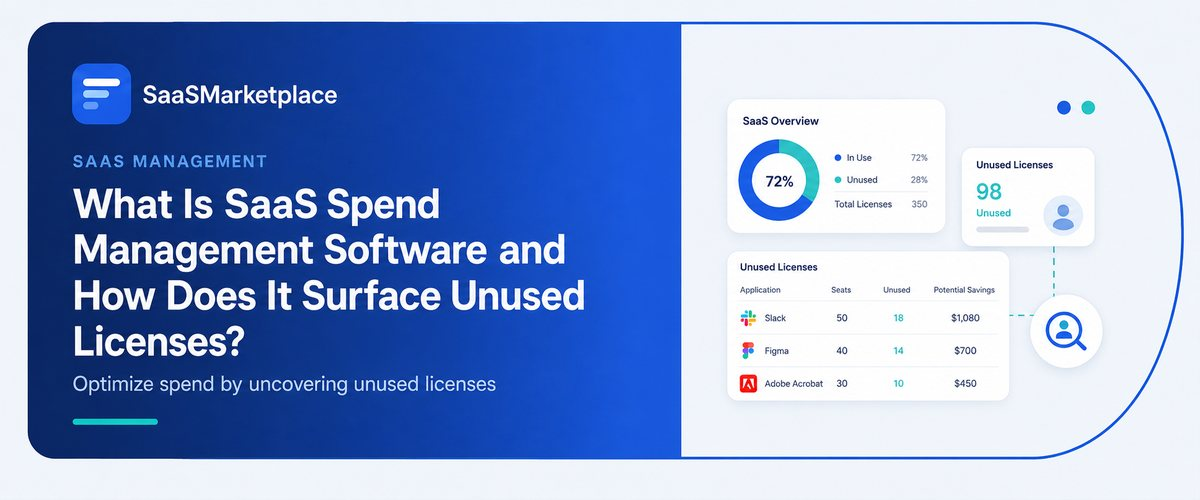
What Is SaaS Spend Management Software and How Does It Surface Unused Licenses?
-min.jpg)
Most organizations lack a clear understanding of their total software subscription costs. One marketing group might activate a service via a free test period but fail to terminate it afterward; another scenario involves an outgoing staff member whose allocated license continues to renew automatically until noticed; finally, accounting departments often uncover these expenses weeks after the fact, hidden within general credit card records.
 Looking for SaaS Spend Management Software? Check out SaaSmarketplace’s List of the Best SaaS Spend Management Software in USA for Your Business.
Software subscriptions auto-renew without usage audits, licenses remain assigned to former employees, and multiple departments pay for separate tools that perform identical functions.SaaS spend management software functions as a unified hub to reduce such monetary loss. By combining purchase logs, access controls, and usage tracking, these systems transform disjointed tech costs into clear operational metrics.
What Is SaaS Spend Management Software?
At its core, SaaS spend management software is a dedicated operational platform engineered to discover, track, evaluate, and optimize an organization's cloud subscription ecosystem. Unlike traditional financial tools that log payments after they occur, this technology actively correlates subscription billing data with actual user engagement.
This represents a narrower classification compared to broad spend control tools that usually handle total corporate outlays, such as tangible items, trips, and professional help. SaaS expense handling applications concentrate tightly on ongoing program licenses, since the main issue involves many tiny, frequently missed fees rather than one big acquisition involving multiple small, simple-to-ignore costs.

Quick Definition
SaaS spend management software is a system that discovers, tracks, and analyzes every software subscription a company pays for, combining cost data with real usage data to reveal which licenses deliver value and which ones are quietly going to waste.
How It Actually Finds Unused Software Licenses
Surfacing unused software licenses is not a matter of guessing. SaaS spend management software combines a few distinct data sources to build an accurate picture of who is using what.
Single sign-on and login activity
Most platforms connect to a company's single sign-on provider to see exactly when each employee last logged into a given application. A license nobody has touched in ninety days is an obvious candidate for reclamation, and this single data point catches a large share of wasted spend on its own.
Finance and expense data
Cross-referencing credit card statements, invoices, and accounting records reveals subscriptions that never went through a formal purchase process. This is where SaaS spend management software starts to overlap with expense management software, pulling recurring charges out of general spending data to identify software costs specifically.
Direct API integrations
To achieve greater insight, numerous systems link directly to the software via an interface, extracting real operational data such as logged-in users, specific function activity, and final sign-in times right from the origin instead of guessing these figures remotely.
Cross-referencing with IT records
Merging subscription records with IT asset management software that monitors hardware, software licenses, and user assignments aids in verifying if a specific seat remains valid for a current staff member or needs recovery immediately upon their departure from the organization.
Where Shadow IT Hides, and How It Gets Detected
Most of the money lost on software isn't due to unused licenses for tools that were officially greenlit; rather, it stems from subscriptions that neither the finance team nor IT authorized initially. This phenomenon is often termed shadow IT, and spotting such instances is among the most useful capabilities offered by SaaS spend management software.
By scanning expense records, SSO logs, and email domains for recurring software charges, the software surfaces applications that were never registered through official procurement. This matters beyond cost control, since unmonitored applications also widen the attack surface. Many organizations pair this discovery process with broader software supply chain security practices, since an unapproved tool with access to company data represents a real security gap, not just a budget line.
From Visibility to Action: Managing Renewals and Contracts
Identifying idle licenses yields benefit solely when action occurs prior to automatic contract renewal. Managing SaaS renewal is a primary workflow inherent within this software class, usually displaying approaching renewal timelines several weeks or months ahead, thereby providing groups sufficient time to determine if they should renegotiate terms, reduce scope, or terminate agreements.
Also, numerous systems link to contract management software, extracting details such as agreement provisions, notification timelines, and automatic extension rules so they appear within that single interface next to utilization metrics. Consequently, when a purchasing unit reviews a potential renewal, it observes precisely what number of licenses remain in use together with the specific legal language, instead of bargaining without clear visibility.
Do You Know?
Industry research has repeatedly found that roughly half of an organization's software licenses go unused for extended periods, often sitting untouched for a full year before anyone notices, which makes software spend visibility one of the fastest ways to recover real budget without cutting a single tool people actually rely on.
How This Fits Into Broader Asset and Cost Tracking
SaaS spend management software is a specialized branch of a much larger discipline. General asset management software tracks physical and digital assets across an entire organization, while SaaS spend management narrows that focus specifically to cloud subscriptions and recurring software costs.
Large organizations running hundreds of applications across multiple departments often need this to work alongside enterprise asset management software, since at that scale, software spend optimization becomes inseparable from how the company tracks every other asset it owns, not just its subscriptions.
Turning Subscription Data Into Decisions
Raw usage numbers are not particularly useful sitting inside a dashboard nobody checks. The strongest SaaS spend management software connects its data to business intelligence software, turning subscription spend management into reports that finance and department leads can actually act on during budget reviews, rather than a static list buried in an IT tool.
This reporting layer is also where cloud software spend tracking becomes genuinely proactive. Rather than finding waste annually during a budget check, groups receive continuous SaaS usage tracking that flags issues when they appear, closer to the instant they begin spending cash.
Getting Started With SaaS Spend Optimization
Once visibility is in place, the real work of SaaS spend optimization begins. A few practical steps separate teams that actually recover wasted spend from those that just admire a dashboard.
- Start with the biggest offenders. Sort flagged licenses by cost first, since reclaiming ten expensive seats matters more than reclaiming fifty cheap ones for the first pass at license utilization tracking.
- Integrate license recovery directly within the departure workflow. Since many dormant software keys originate from staff members who exited several months prior, linking key retrieval to the exit verification list seals this deficiency forever.
- Establish a regular review schedule rather than performing a single cleanup event. Visibility regarding software expenditure diminishes rapidly unless someone returns to examine the information, meaning that a repeating monthly or quarterly inspection prevents subscription cost control from reverting to its previous disordered state.
- Loop in department leads, not just finance. The people actually using a tool often know why usage looks low, whether that means the tool is genuinely unused or simply used in a way the data does not capture well.
Why Shadow IT Detection Matters Beyond the Budget
It is worth returning to shadow IT detection specifically, since it tends to get treated purely as a cost issue when it is really a risk issue too. Every unapproved subscription is a potential entry point nobody is monitoring, and SaaS usage monitoring that catches these tools early gives security teams a chance to review them before they become embedded in daily workflows.
By the time a shadow IT tool has months of adoption behind it, removing it becomes a change management problem, not just a budget line to cut. Together, these sources enable SaaS spend management software to automatically flag gaps in license utilization tracking, rather than relying on someone to manually check spreadsheets once a quarter.
Pro-tip
Before evaluating any SaaS spend management software, pull together a rough manual list of your known subscriptions first. Comparing that list against what the tool discovers is the fastest way to see how much shadow IT and forgotten spend your organization is actually carrying, and it makes the value of the software immediately obvious.
Building This Into How Your Company Buys Software
The strongest results come from treating SaaS spend management software as part of how purchasing decisions get made, not just a tool that reports on decisions after the fact. When a refresh comes near, retrieving usage figures prior to talking with a supplier is what renders SaaS renewals truly functional, instead of merely a calendar alert that slips away until the deal automatically extends.
This identical reasoning holds for fresh acquisitions. Mandating a rapid verification against current subscriptions prior to greenlighting a new instrument stops redundant spending which generates remediation tasks subsequently. With passage of time, this moves SaaS license refinement away from a responsive review toward a consistent element within the manner the entity assesses each unit of cloud software expenditure, monitoring either novel or pre-existing items.
Conclusion
Software tools designed to manage SaaS spending gain their value by swapping estimation for concrete metrics: identifying active users, pinpointing financial drains, and spotting looming contract renewals before they slip past attention. Optimizing licenses does not function as a single cleanup event; instead, it performs best when established as a recurring practice integrated into quarterly software stack evaluations. Firms viewing cost transparency as a steady routine, instead of a yearly rush preceding budget cycles, regularly reclaim greater amounts of lost expenditure and sidestep more unexpected renewal fees compared to entities that inspect only after costs feel prohibitive.
FAQ's
It is a specialized platform that discovers, monitors, and optimizes cloud software subscriptions by combining financial data with active user engagement analytics.
By cross-referencing identity provider activity, API event logs, and single sign-on records to flag accounts with zero activity over defined timeframes.
Yes, by scanning financial transaction streams, corporate card charges, and domain authentication logs to surface unapproved tools instantly.
Rightsizing downgrades underutilized premium seats to standard tiers and reallocates harvested licenses to new hires, eliminating the need to purchase additional software seats.
Yes, by scanning expense data and login records for subscriptions never registered through procurement.