What Is Talent Management Software and How Does It Support the Employee Lifecycle?
-min.jpg)
Most firms can state their hiring numbers from the previous three months. Very few know which recruits will manage later, or which older staff are secretly bored and seeking work today. This divide between counting heads and truly grasping your team is what talent tools fix, helping growth continue despite strict money limits elsewhere in HR spending plans. Numbers regarding size differ greatly based on the source: certain industry analyses place talent management software near $13-16 billion by 2026, while wider definitions result in figures close to $8-9 billion, showing yearly increases between about 9% and 15% according to each study. That spread mostly comes down to definitional differences whether a given firm counts standalone performance management tools separately, for instance but the direction is consistent everywhere: this is one of the faster-growing corners of HR software, and AI-driven analytics is the trend showing up in nearly every recent report as the reason why.
What Is Talent Management Software?
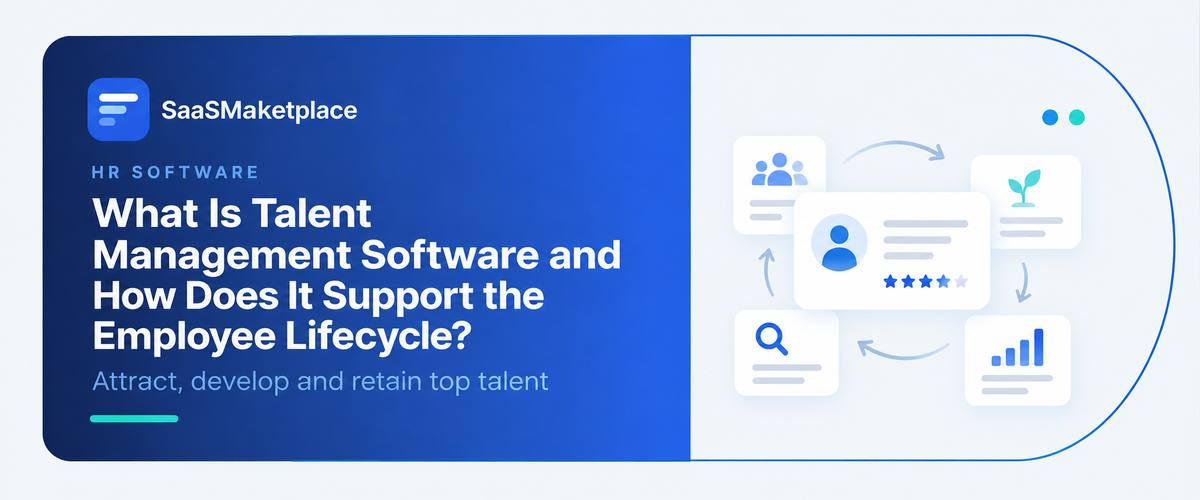
Talent management software is a platform, or connected set of tools, that helps organizations manage employees across the full arc of their time with the company from the moment someone's recruited through onboarding, performance reviews, learning and development, promotion or succession planning, and eventually offboarding. The unifying idea is treating the employee lifecycle as one continuous thing to manage strategically, rather than a pile of disconnected HR tasks that happen to involve the same person.
That's the textbook version. The more useful way to think about it: talent management software exists because a company's workforce is genuinely one of its biggest competitive assets, and most organizations manage that asset with far less rigor than they would apply to, say, inventory or cash flow. A retail chain fighting high turnover can use talent management platforms to spot which new hires show early signs of disengagement before they quit; that's a very different level of insight than a spreadsheet tracking start dates.
How Talent Management Software Maps to the Employee Lifecycle
Recruitment and talent acquisition
This covers job postings, applicant tracking, candidate screening, and increasingly, predictive scoring that tries to flag which candidates are likely to stay and perform well, not just which ones interview well. A multinational retailer dealing with chronic turnover, for example, might use these predictive tools specifically to improve retention at the hiring stage rather than trying to fix it after the fact.
Onboarding
Getting a new hire set up with paperwork, training schedules, introductions to the team, and access to systems is where a lot of first impressions get made or lost. Poorly handled onboarding is one of the more common, and more fixable, contributors to early turnover.
Performance management
Reviews, goal-setting, ongoing feedback, and increasingly continuous check-ins rather than a single dreaded annual review. This function generates a lot of the data that feeds into later lifecycle stages; you can't identify future leaders without some record of who's actually performing well.
Learning and development
Training programs, skills mapping, and personalized learning pathways based on identified gaps. The shift here in recent years has been toward specificity: mapping an individual's actual skill gaps rather than pushing generic training content at everyone regardless of need.
Succession planning
Identifying and preparing employees for future leadership roles, which depends heavily on having reliable performance and skills data from earlier stages. This is arguably the function that separates genuine talent management from basic HR administration; it's forward-looking in a way payroll and benefits tracking simply isn't.
Compensation management
Aligning pay, bonuses, and incentives with performance and market benchmarks, ideally tied back to the same performance data rather than existing as a separate, disconnected process handled once a year in a spreadsheet.
Where This Sits Next to Other HR Software
HRIS software and HRM software hold the core employee records: who's employed, their role, tenure, personal data. Talent management software builds on top of that foundation rather than replacing it; you can't run meaningful succession planning without accurate role and tenure data sitting underneath it.
HCM software is where the terminology gets genuinely confusing: many HCM suites now include talent management as one module among HRIS, payroll, and benefits administration. Whether a company buys talent management as part of a bigger HCM platform or as a standalone specialist tool often comes down to how deep they need the functionality to go. A standalone tool tends to go further on things like AI-driven skills mapping than a bundled module built to cover everything reasonably well.
HR analytics software is what turns raw talent data into something decision-useful: turnover trends, performance distributions, engagement scores. Talent management without analytics tends to produce a lot of process (reviews happened, training was assigned) without much insight into whether any of it is actually working.
HR chatbot software shows up increasingly at the employee-facing edge of talent management, answering routine questions during onboarding, nudging employees to complete a training module, or handling basic performance-review logistics without a human needing to manually chase people down.
HR employee mobile app functionality matters more than it used to, mostly because of how distributed workforces have become. A retail or field employee without regular desktop access still needs to complete onboarding steps, check a training assignment, or see feedback from a manager, and if that only works from a desktop HR portal, a meaningful chunk of the workforce effectively gets left out of the process.
Talent Management Software vs. Basic HR Software
|
Factor |
Basic HR / Online HR Software |
Dedicated Talent Management Software |
|
Primary focus |
Employee records, compliance, basic admin |
Strategic development across the employee lifecycle |
|
Performance tracking |
Often minimal or annual-only |
Continuous, data-driven |
|
Succession planning |
Rarely included |
Core feature |
|
Skills and learning |
Basic or absent |
Skills gap analysis, personalized learning paths |
|
Best for |
Small companies needing administrative basics |
Growing or established companies investing in workforce development |
|
Typical buyer |
Small business HR software users |
Enterprise HR software and mid-market buyers scaling talent strategy |
Enterprise vs. Small Business Considerations
Enterprise HR software buyers are the traditional core of this market, and for good reason: large organizations have enough people, enough turnover, and enough leadership pipeline complexity that manual tracking genuinely breaks down. These companies are also the most likely to run the full suite: recruitment through succession planning, all connected, all feeding a shared analytics layer.
Small business HR software buyers face a different calculus. A 25-person company doesn't need formal succession planning software; there usually isn't a deep enough bench to plan around yet. What smaller companies often benefit from instead is a lighter version focused specifically on onboarding and basic performance tracking, sometimes bundled into an online HR software platform rather than purchased as a separate, dedicated talent management tool. The inflection point tends to arrive with growth once a company has enough managers and enough career paths that "who's ready for the next role" stops being something one person can just know.
Common Mistakes Companies Make
- Buying the software before fixing the underlying process: Talent management software makes an existing performance and development process more efficient; it doesn't invent a good process from nothing. A company with no real performance management culture that buys a sophisticated platform often just ends up with expensive software nobody uses consistently.
- Treating performance reviews and succession planning as separate systems: The real value of talent management software comes from connecting these functions using actual performance data to inform who gets considered for advancement rather than running them as parallel, disconnected exercises that happen to live in the same login.
- Ignoring manager adoption: Even the best platform fails if managers see it as an administrative chore rather than a genuine tool for developing their team. Change management and manager training around the why, not just the how, tends to matter more than any specific feature.
- Underusing the analytics: A lot of organizations pay for a platform with real predictive and analytics capability and use it purely as a digital filing cabinet for reviews. The turnover-prediction and skills-gap features that justify a lot of the cost sit unused.
When a Company Might Not Need Dedicated Talent Management Software Yet
A very small company with a handful of employees, minimal turnover, and no real leadership pipeline to manage usually doesn't need dedicated talent management software; the functionality mostly solves problems that don't exist yet at that scale. Basic HR software with simple performance tracking tends to cover the need until the organization grows enough that manually tracking who's developing well, who's at risk of leaving, and who's ready for more responsibility becomes genuinely difficult to do from memory and a spreadsheet.
What to Evaluate Before Choosing a Platform
- Does it integrate with your existing HRIS or HCM software, or would it operate as a disconnected system requiring duplicate data entry?
- How strong is the analytics layer? Does it surface real insights, or just store completed reviews?
- Does it offer a usable HR employee mobile app for a distributed or frontline workforce, if that applies to your company?
- What's the actual change management support offered for manager adoption, beyond the software itself?
- Is the pricing and feature depth appropriate for your company's actual size, or are you paying for enterprise complexity you won't use?
Conclusion
Talent management software bridges the gap between basic workforce administration and strategic workforce development. While traditional HR systems track who is employed and handle basic compliance, dedicated talent management platforms optimize the entire employee lifecycle, unifying recruitment, onboarding, continuous performance feedback, targeted learning, and forward-looking succession planning into a single data-driven framework.
Ultimately, the ROI of a talent management platform hinges on organizational adoption and system connectivity. As remote work, skill shortages, and AI-driven analytics reshape the modern workplace, integrating talent data with existing HRIS environments allows organizations to proactively reduce turnover, close critical skills gaps, and build resilient leadership pipelines before critical talent needs arise.
FAQ's
No. An HRIS holds core employee records: personal data, role, tenure.
Usually not a dedicated platform right away. Smaller companies often get sufficient value from basic performance tracking bundled into their existing small business HR software.
Increasingly, for predictive analytics flagging which candidates or employees are likely to succeed or leave, mapping skills gaps automatically, and personalizing learning recommendations.
HCM software is the broader umbrella, often including HRIS, payroll, benefits, and sometimes talent management as one module among several.
Indirectly, yes, primarily through better onboarding, more meaningful performance feedback, and clearer development and advancement paths.
Most modern platforms support this, often through an HR employee mobile app and HR chatbot software for routine interactions, which matters more for organizations with field, retail, or fully remote employees who don't have regular desktop access.
Pricing varies significantly based on company size, feature depth, and whether it's purchased standalone or as part of a broader HCM suite.