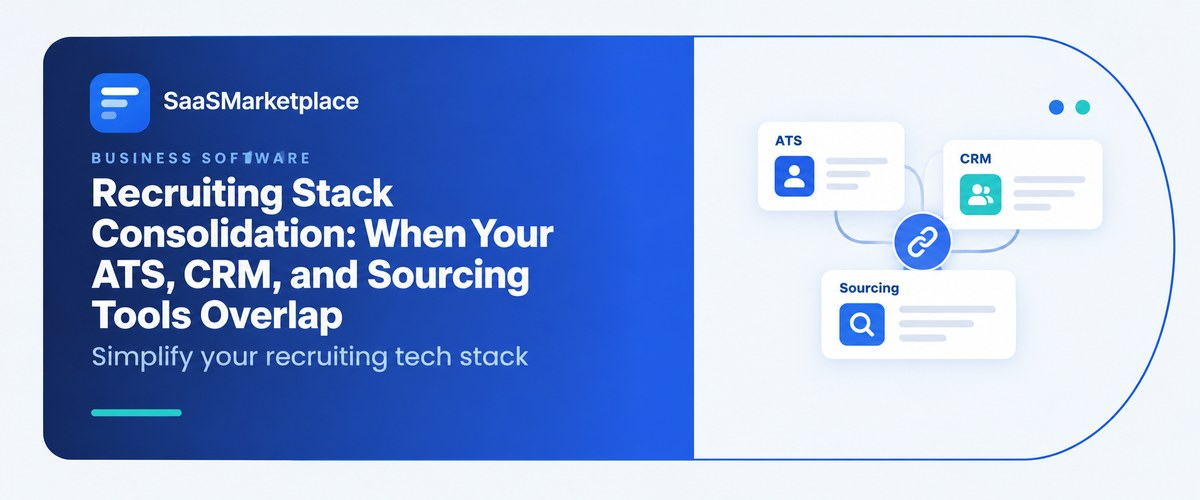
Recruiting Stack Consolidation: When Your ATS, CRM, and Sourcing Tools Overlap
-min.jpg)
In the American talent acquisition market, there is a crucial breaking point created by the bloat of the tech stack, a situation wherein older ATSs, CRMs, and AI-based outbound recruiting tools offer similar capabilities. In an environment of tighter talent acquisition budgets and the increasing need for greater efficiency, American organizations and agency desks are consolidating their fragmented solutions into Talent Intelligence Platforms. The objective here is not only to avoid paying multiple licensing fees but also to fix broken data integration from candidate sourcing to pipeline management and create a single source of truth for the entire process.
What is Recruiting Stack Consolidation?
Stack consolidation for recruiting involves the process of consolidating the recruiting tech stack of a company by combining different single-purpose software systems used in recruiting, such as applicant tracking systems (ATS), candidate relationship management systems CRM, outbound recruitment software systems, assessment software, and so on. In time, the recruiting process developed a very large tech stack because of the addition of different point solutions to address specific issues at hand. This process involved solving different issues related to recruiting by using different systems, each addressing just one issue.
In this regard, modern talent teams are equally influenced by the need for better organization as much as they are by the urge to cut costs. Using several different tools causes serious issues of data silos, where candidate profiles get copied, interactions are not being tracked across the platforms, and recruiters spend countless hours transferring the information manually. All these problems become irrelevant with the consolidation of recruiting technologies, thus saving money, time, and providing recruiters with a single source of truth regarding recruiting statistics.
Did you know?
That an average recruiting team of an enterprise utilizes from 6 to 10 various hiring tools, but up to 40% of them have features that directly coincide in use, which means that enterprises actually pay double or triple for such things as email sequences, rediscovery of candidates, and scheduling? Moreover, the fact is that recruiters spend about 3-5 hours a week just transferring information about candidates from one platform to another.
Why are US Recruitment Teams Struggling with Tech Stack Bloat?
1. Reactive Point-Solution Purchases
Whenever there were hiring spurts during periods of high growth, the TA teams purchased specific solutions to tackle isolated challenges. Rather than improving the outdated applicant tracking system (ATS), the TA teams invested in other solutions such as outbound email sequences, candidate assessment tools, artificial intelligence sourcing tools, and interview scheduling. This has led to the creation of a fragmented technology ecosystem with 62% of organizations using at least two to four different HR software solutions, while enterprise teams have up to ten solutions.
2. Confusing Feature Overlap
The lines separating software have been blurred significantly. Today, core ATSs include CRM and nurturing features. The sourcing extensions come with automated email drip campaign capabilities, and the candidate engagement tools develop AI sourcing capabilities. With each vendor developing new feature sets to compete against others, the TA team is forced to pay for the same functionality from multiple software providers, including email sequences and pipeline tracking.
3. Inefficient Technology and Loss of Efficiency
Less than four out of ten TA teams have software solutions that integrate seamlessly together. Disconnected technology causes significant data silos wherein candidates’ profiles are duplicated, data is not transferable between software, and recruiters spend about 3-5 hours each week transferring their data manually across different platforms.
4. Lock-in Vendors vs. Limited Budgets
At present, when TA budgets are constantly scrutinized, multi-year contracts that were signed during other more prosperous economic times cause lock-in on costly but underused software solutions. When there is pressure on the cost per hire and efficiency of the processes, handling dozens of vendor renewals with similar functionality becomes impossible.
How do you Spot Overlap Between your ATS, CRM, and Sourcing Tools?
- Dual Login Systems for One Task: Recruiters consistently recruit in a browser extension, initiate the outreach through another email sequencer system, and subsequently make a profile in the ATS for interview scheduling.
- Email / SMS Duplicate Campaigns: Candidates receive conflicting automated campaigns, one initiated by your CRM talent pool and another initiated by a sourcing tool campaign.
- Low Rate of Feature Adoption: Usage reports reveal that less than 20% of your team makes use of your customized point solution’s key features because the ATS / CRM handles everything well enough.
- Data Synchronization by Using CSV Export: Your team is constantly exporting the CSV files of one system to be uploaded into the other since two-way real-time integration isn't available or doesn't work properly.
- Golden Rule: If you have two tools which work on the same task for your team at 80% or more efficacy, cut out the specialized point solution and train your primary platform.
How does Duplicate Data Across Platforms impact Candidate Experience?
1. Spammy, Contradictory Outreach (Outreach Fatigue)
- Where candidate profiles are separated in your sourcing software and CRM, chances are that the candidate will be receiving more than one automatic email at once.
- Your candidate receives the automated We like your background email from the recruiting tool on the same day as an automated Your application has been reviewed rejection email in the ATS for some other role.
2. Candidate Repeat & Friction
- Where notes, previous interview scores, or resumes that are attached do not transfer between your CRM and main ATS system:
- Repeated Screening, The candidate is compelled to reiterate their background, their salary requirements, or career aspirations to the recruiter who is unaware of the previous discussions in the CRM or sourcing extension tool.
- Re-Entering Data candidates are prompted to enter information such as contact details, employment history, or resumes through application links since their existing talent pool candidate profile is not automatically linked to their application.
3. Poor Re-Sourcing Silver Medalists
- The candidate who went all the way to the last interview stage in the hiring process six months back as a silver medalist may still be sitting in your ATS with positive interview comments.
- When a recruiter uses an unrelated sourcing extension to look out for other potential candidates, the recruiter may do cold outreach to the same candidate using an automated I came across your profile on LinkedIn message.
- The candidate feels devalued knowing that the company does not even remember his/her recently completed long interview process.
4. Scheduling Problem and Drop-Offs
- If the status of interview scheduling is not universally synchronized, candidates often get reminder emails from the company about interviews that have been cancelled.
- Candidates can also miss interviews due to the failure of information regarding updates done in the ATS reaching the CRM calendar process.
Which Redundant Recruitment Software Features Should You Cut First?
- Phasing Out Single-Purpose Interview Scheduling Apps: Time to move away from standalone, per-seat interview scheduling tools. Today’s ATS and CRM systems come packed with built-in self-service scheduling, automatic calendar integrations, and interview follow-up features. These all-in-one platforms cover what you need, with no extra scheduling apps necessary.
- Browser-Based Email Finder and Scraper Add-Ons: Phase out the single-use email finding and scraping tools. Modern CRM platforms and LinkedIn Recruiter have stepped up their game, offering integrated sourcing tools so you can pull contact details, reconnect with candidates, and shoot off emails right in your browser. All that, without extra add-ons crowding your workflow.
- Email Drip Sequence Tools for External Email: There is no need to maintain different tools such as Gem, MixMax, or Lemlist since multi-channel email sequences are included in your sourcing platform or CRM.
- Conversational AI Chatbot and Pre-Screener Software: Stop using conversational AI chatbots and pre-screeners since ATS/CRM includes automated testing screening questions and online application as well as SMS prompts.
- Standalone Talent Rediscovery Tools: Get rid of the AI talent matching and discovery software when all you need is plugged into your platform to scan your former candidates. Enterprise-level ATS and CRM solutions offer such capabilities natively.
- Redundant Reporting & Dashboard Software: If your ATS or CRM has robust funnel tracking, hiring cycle time analysis, and recruiter productivity analysis tools, then you don’t need a third-party analytics package for your recruitment CRM process.
How do you measure the ROI of consolidating your Talent Acquisition Tools?
There are two types of measurement that you should pay attention to while evaluating the ROI of consolidating your TA stack: the tangible savings in terms of financial resources and indirect benefits associated with them. Here is how you can measure ROI according to key quantifiable and qualitative indicators:
- Direct Software Cost Reduction (Hard ROI): The formula for calculating cost savings here includes the difference between the ACV of your consolidated system and the sum of annual subscriptions, renewals, licensing, and additional charges of all redundant systems.
- CPH Savings: In order to see the improvements, start measuring the drop in the average cost of your recruitment efforts in dollars per hire for the 6-12 months after consolidation.
- Time-to-Hire/Time-to-Fill Speed-Up: To assess this improvement, measure the number of days from when a job opening is published to its closing via offer acceptance. Getting rid of all manual data transfer among ATS, CRM, and sourcing extension makes the process shorter.
- Recruiters' Productivity Improvement (Saved Time): In this case, you need to measure the amount of time saved by each recruiter weekly (usually it's 3-5 hours), and then multiply these saved hours by the hourly rate of your recruiters.
- Rediscovery Rate of Candidate Database: Track the number of open jobs filled by leveraging previous candidates (silver medalists and talent pools) that you already have in your system. The more rediscovery, the less money spent on external agencies and job ad posting.
- IT Support and System Integration Costs: Measure the decrease in support tickets from IT and HR Systems, API integration maintenance costs, and vendor management time to integrate the disparate systems and keep them secure.
- Candidate Conversion and Drop-Off Rate: Measure the increase in the candidate conversion rate from a first touch to the interview completion. It will remove confusing email invitations and broken calendar links, resulting in increased application completion rates and decreased drop-offs.

Pro-tip
Whenever you start a tech stack unification journey, make sure to set the expiration date for your contracts six to nine months ahead so that you can use the renewals as strong deadlines and not terminate point solutions before mapping all the fields of candidates' information into your main ATS/CRM.
Conclusion
Having a duplicate recruiting software stack is not an option anymore; it is a strategic requirement for the new age of talent acquisition. Reducing software redundancies and license fees between your ATS, CRM, and other recruiting platforms will save your company money, eliminate unnecessary administrative efforts, and ensure that the candidates' information stays consistent. In order to analyze, optimize, and switch your recruiting software tools into better-performing software solutions, visit SaaSmarketplace and find, compare, and purchase any business software.
FAQ's
You have overlap if your recruiters routinely log into multiple platforms for a single hire, use standalone browser extensions for features your main platform offers, or manually export CSV files to move candidate data between systems.
No, modern consolidated Talent Intelligence Platforms combine candidate sourcing, outreach sequencing, and pipeline tracking into a single ecosystem, usually improving candidate engagement by eliminating duplicate and conflicting outreach.
A full stack consolidation typically takes between 3 to 6 months, depending on contract expiration dates, candidate data migration requirements, and team training on the primary system.
If your current ATS lacks robust talent pooling and outbound messaging, evaluate whether upgrading to an all-in-one Talent Intelligence Platform is more cost-effective than paying for a separate CRM add-on and its associated integration costs.
Consolidation reduces costs by eliminating duplicate software licenses, lowering custom API integration maintenance fees, and boosting recruiter productivity by saving hours spent on manual data re-entry.