AI Invoice Matching: How Three-Way Reconciliation Works Without Manual Checks
-min.jpg)
Invoice matching through AI eliminates the need for human intervention in accounts payable by automating the three-way matching process. One typical process where the technology is used is that the AI system will automatically gather the invoices from various sources and use OCR to extract details of the items on each invoice and automatically match them with the respective POs and Goods Receipts. After it verifies that there is matching information about the number of units, unit price, and total value of the items across all three documents, it will highlight any inconsistencies, such as incorrect pricing and missing goods receipts, in the invoices.
What is AI Invoice Matching?
AI invoice matching is the name given to a process involving the use of artificial intelligence in the verification of supplier invoices against purchase orders and receiving documents prior to approving invoices for payment. Traditionally, invoice processes are conducted manually, whereby employees have to enter the information on the invoices, check for correctness of pricing and whether the goods have been received, a process which is costly, cumbersome and highly susceptible to human errors. AI invoice matching automates this whole process by automatically scanning all types of invoices, interpreting the context, and verifying the data in your accounting software.
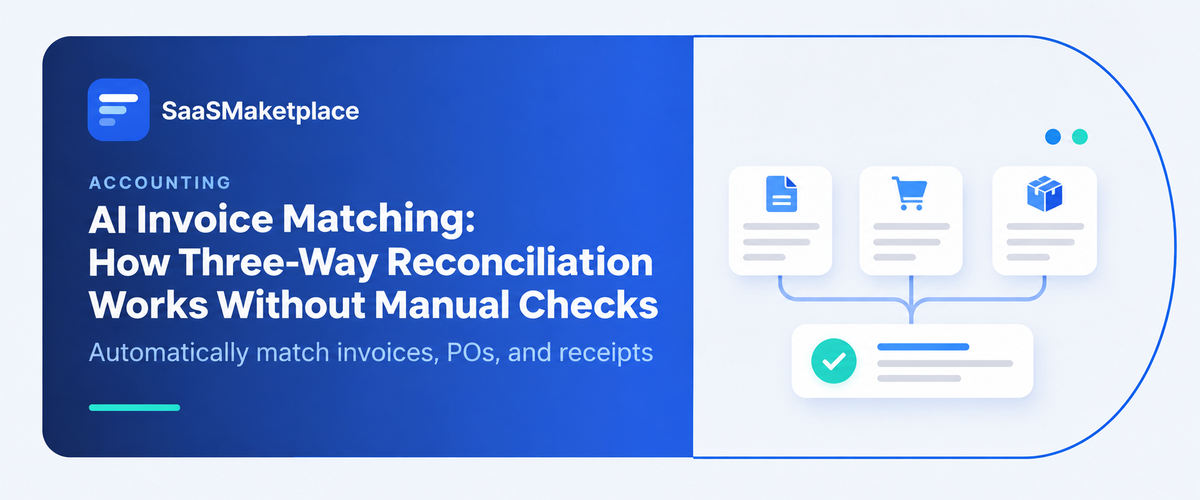
The key technology used is intelligent three-way matching, which refers to the matching of three vital documents, including the invoice, purchase order, and the receiving document. Machine learning algorithms automatically extract line items, prices, quantities, and payment terms and compare this information across all three documents. Should the information match as per pre-defined tolerances, then the invoices are automatically authorized and passed for payment processing without human intervention. Where there is an inconsistency like an increase in price, a missing item, or duplications in the invoice, then only the exception will be highlighted for human intervention.
Do You Know?
The traditional method of manual invoice processing can be expensive for organizations, ranging from $12 to $30 for each invoice and taking up to 15 days to process each invoice. With the application of AI-based three-way matching, the costs of organization processing are reduced by more than 80% to less than $3 per invoice. This is achieved within seconds compared to weeks, and also eliminates double billing.
Why is Manual Invoice matching a problem for US Businesses?
The conventional method of manual invoice matching keeps the accounts payable function mired in an unending cycle of repetitive data entry and paper-chasing. Staff spend a lot of time entering data from invoices into the ERP software and looking for purchase orders and deliveries to match them with. This process creates a lack of visibility of the cash flow, does not enable discounting opportunities, and does not utilize the abilities of skilled accounting staff for analysis because they have to be involved in mundane routine tasks.
Human errors always accompany large-scale manual matching and cost companies billions of dollars per year. If workers have to deal with numerous complicated line items each day, typing errors, mistakes in numbers, and oversight are bound to happen. It results in expensive problems such as duplicate payments, wrong payment of line items, and overpayment to suppliers because of unapplied discounts and wrong unit prices.
There is tremendous risk involved in the possibility of invoice fraud and bill padding due to manual processes. Such unscrupulous fraudsters take advantage of the weaknesses of the manual process by submitting invoices that are either false or overvalued because the AP staff does not have time to compare each item in the invoice with the real receipt. Moreover, failure to track invoices automatically leads to compliance issues, month-end closing difficulties, and ruins the company's relationship with the suppliers.
What is Three-way Reconciliation?
- Purchase Order (PO): Initial document produced by the buyer stating the purchased goods, unit price, and payment terms.
- Receiving Report (Goods Receipt): Document produced by the receiving department in the purchasing organization certifying the actual receipt of the goods.
- Vendor Invoice: Document produced by the vendor requesting payment for the delivery of goods or services.
- Quantity Verification: Checking that the quantity of goods stated in the invoice is equal to the actual receipt (Goods Receipt) and the PO.
- Price and Rates Verification: Checking that the unit price, taxes, delivery rates, and total stated in the invoice are exactly equal to the rate in the Purchase Order.
- Order Delivery: Ensuring that payment is not made for undelivered goods or those in poor condition to prevent payment of partial, incomplete, or damaged orders.
- Tolerance and Exception Management: Automatic detection of any deviation from the preset tolerance level (e.g., price difference) before payment of the funds.
How does AI Automate three-way Reconciliation?
1. Multi-Channel Data Ingestion and Extraction
- Document Capture: The AI system captures all new invoices that come in through multiple channels, including email, PDF files, EDI, or scanned paper invoices.
- Intelligent Data Capture: OCR technology is used to capture and parse all invoice data in unstructured form with NLP technology. This includes all metadata such as item, quantity, price, PO, tax, shipping cost, and vendor terms of payment without needing any strict template formats.
2. Autonomous Document Matching
- System Integration: AI systems work in connection with ERP or accounting systems to get PO and Goods Receipt (Receiving Report).
- Comparing Line Items: AI systems compare and map line items across all three documents.
- Invoice vs. PO: Checks for any agreement of unit prices, legal billing rates, and terms.
- Invoice vs. Goods Receipt: Checks for any agreement of the quantity as billed with physical receipts.
- PO vs. Goods Receipt: Checks for any agreement of the ordered delivery with original order parameters.
3. Intelligent Discrepancy & Tolerance Management
- Matching of Context: The machine learning technology will take care of all discrepancies that might arise in the form of language, abbreviations, item descriptions, and units of measurement, such as matching lbs with pounds or vice versa.
- Rules for Discrepancy Tolerance: Any discrepancy that falls within the following categories, such as discrepancies of a few cents, approved cost of freight charges, or taxes, is always accepted if below the threshold levels.
- Intelligent Discrepancies Route Management: In any case of discrepancies like surcharges, double invoicing, and under shipment, the intelligent AI system will recognize and route them to the respective procurement/accounts receivable manager.
What are the Benefits of Eliminating Manual Checks?
- Significant Cost Reduction: Saves up to 80% in terms of the cost of invoices as it removes manual handling of papers, manual work of data entry, physical storage, and postal charges.
- Increased Processing Speed: It reduces processing time for invoices from weeks to seconds that facilitates quick approvals and a seamless process of payments.
- Eliminates Human Errors: It removes human errors such as mistypes, mistakes in keying, incorrect payments for line items, and discounts missed due to manual keying.
- Prevents Fraud and Duplicates: It detects duplication of billing, fake invoices, changes in bank details, and increases in prices without approval before payment is made.
- Early Payment Discounts: Allows for payment discounts offered by vendors and saves penalty charges for late payment.
- Better Vendor Relationship: Helps in establishing better relationships with vendors because of on-time payments to them and better communication.
- Audit Ready: Automatically creates logs of all the transactions, approvals, and exceptions, which makes the system audit-ready.
- Better Visibility of Cash Flow: The finance leaders get visibility of the liabilities, expenses, and cash flow requirements without waiting for paper invoices.
- AP Staff Strategy: Provides flexibility for accounts payable staff to be relieved from redundant checks, giving them more time to work on strategy-related issues like negotiation and treasury management.
What Challenges do US Companies face without AI Invoice Matching?
- Overblown Operational Costs: Manual data entry results in a cost of 12-30 per invoice because of heavy staffing, physical handling, and additional overhead.
- Higher Rates of Mistakes: Manual data entry results in an error rate of 1-2%, which is expensive, resulting in typos, omission of line items, wrong payments, and non-applied vendor discounts.
- Duplicate Payments: Invoices go unchecked for duplicates, and duplicate payments are made as well as payments for items that are either not received at all or returned.
- Long Approval Processes: Approval processes last between 10 and 15 days, which creates payment delays and missed payment discounts and triggers late payment fees.
- Increased Vulnerability to Fraud: This is because criminals exploit weaknesses in manual processes via activities like phony invoicing, fake vendor registration, and falsified ACH entries.
- Poor Vendor Relationships: Delayed payments, invoicing issues, and loss of invoices cause bad relationships with the vendors.
- Poor Cash Flow Visibility: There is no clear picture for the finance team on outstanding obligations, causing inaccuracies in the sales forecasting for working capital.
- No Scalability: With more orders coming in, companies are required to have more AP staff members rather than automating this process via software solutions.
How do US Businesses Implement AI Invoice Matching?
Step 1: Understand AP Process Flow and Establish Tolerances
- Process Map: The accounting department creates a process map for the current AP invoice submission processes (email submissions, regular mail submissions, vendor portal submissions, and EDI) and benchmarks the performance measures for cost, time, error rate, and volume of invoices per month.
- Tolerance Levels: Organizations set their own tolerances for the STP process. A company allows for automatic approval of price and quantity differences under $5 or a 1 percent difference in price, whereas larger price or quantity differences are reviewed by a human.
Step 2: Integration of the Software into Existing Systems
- API Connection: The AI solution integrates through the API connection to the company's main ERP system and banking website.
- Database Syncing: The solution aligns the database of the master vendor information, purchase order tables, goods receipt information, and GL account hierarchy for all legal entities.
Step 3: Training and Configuration of Models
- Ingestion of Historical Data: Implementation teams input historic invoices, POs, and receipts into the system for training of machine learning models on vendor layout formats, line items, and descriptions.
- Configuration of Approval Flow and Logic: Routes of invoices and exception handling flow logic are built, taking into account the hierarchy of approvals inside the organization and delegation of authority matrix, as well as specific exception type (for instance, pricing issues need to be routed to the buyer while receiving discrepancies require forwarding to the warehouse manager).
Step 4: Launch of Pilot and Gradual Roll-out
- Start Pilot with Predictable Vendors: The piloting phases generally begin with a selected few predictable and repeatable vendors (e.g., utility services, subscription services like software-as-a-service, raw material suppliers) in order to have quick wins in processing.
- Prediction Validation and Model Fine-Tuning: During the first week(s), the staff from accounts payable validates predictions and confirms the extraction of the line items.
Conclusion
The application of AI technology for automated three-way matching enables accounts payable to become a profitable process, which saves money and effort while delivering a high degree of accuracy in financial transactions. The removal of manual checking not only preserves operating margins but also builds a relationship of trust with vendors through timely payments and provides the CFO with transparency concerning working capital. If you are ready to revolutionize your finance processes, then a SaaSmarketplace can be considered the right place to find the needed solution.
FAQ's
AI invoice matching automatically extracts data from supplier bills and verifies it against purchase orders and goods receipts to approve payments without manual intervention.
The system uses optical character recognition and machine learning to instantly cross-reference line items, unit prices, and quantities across the invoice, PO, and receiving report.
The platform automatically places the mismatched bill on hold and routes the specific exception to the appropriate manager for quick review.
Yes, modern AI tools connect directly via APIs to popular enterprise platforms like SAP, NetSuite, and QuickBooks to sync financial records seamlessly.
Automating three-way matching reduces processing costs by up to 80% per invoice while slashing approval times from weeks to just a few seconds.