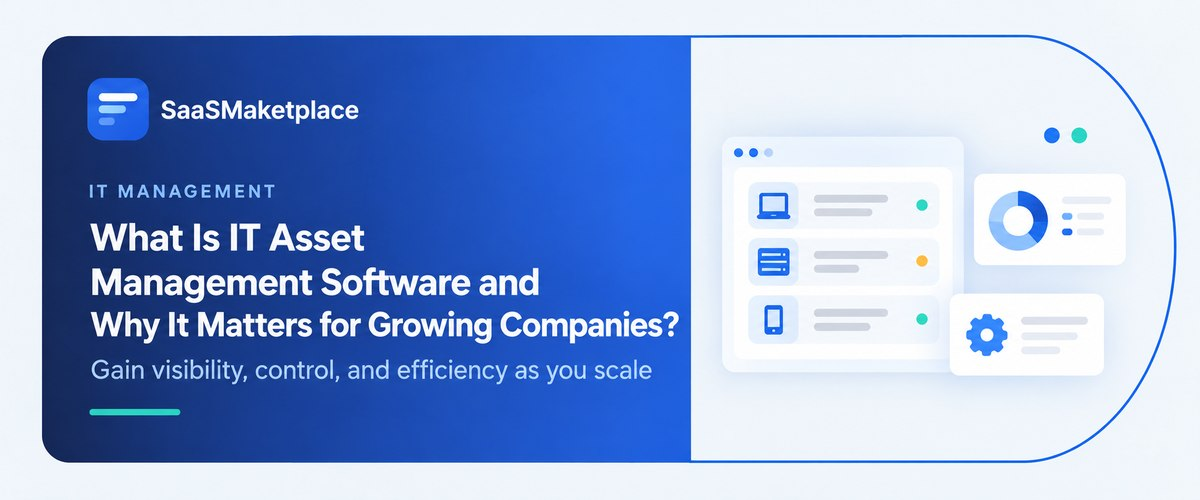
What Is IT Asset Management Software and Why It Matters for Growing Companies?
-min.jpg)
Ask a mid-sized company's IT lead how many SaaS licenses they're currently paying for, and watch what happens. Most won't know because they're bad at their job, but because nobody can track fifteen departments each quietly signing up for their own project management tool, their own file storage, their own AI writing assistant. Flexera's 2025 State of ITAM report puts a number on the damage: enterprises waste up to 30% of their IT budget on licenses that are unused or redundant. For an individual organization, that waste averages close to $19.8 million a year, even after accounting for improved tracking. That's not a rounding error. That's the entire IT budget of a mid-market company, evaporating into subscriptions nobody remembers signing up for.
IT asset management software exists to close that gap to give a company one accurate picture of every device, license, and cloud resource it's actually paying for, instead of piecing it together from five spreadsheets and a Slack thread. For growing companies specifically, this stops being optional at a fairly predictable point: right around when the headcount and the tool sprawl both outpace what one IT person can track from memory.
What Is IT Asset Management Software?
IT Asset Management (ITAM) software tracks and manages an organization's technology assets laptops, servers, software licenses, cloud subscriptions, mobile devices across their entire lifecycle, from the day they're purchased to the day they're retired. The goal isn't just "know what we have." It's knowing what you have, what it costs, who's using it, whether it's compliant, and whether you actually need it anymore.
That last part matters more than people expect. A lot of ITAM's real value shows up not in the inventory itself but in what the inventory reveals: the forty Adobe licenses assigned to people who left the company eight months ago, the security tool three teams are all paying for separately, the server nobody's touched since 2023 that's still racking up cloud costs.
How ITAM Software Actually Works
Discovery and inventory
The starting point is finding everything: automated network scans, agent software installed on endpoints, and increasingly, API connections into cloud platforms to catch resources that never touch a physical network at all. This is also where most organizations get their first uncomfortable surprise. One industry guide put the typical gap between what finance's asset register shows and what discovery tools actually find at somewhere between 15% and 25% of the total shadow IT, BYOD devices, and hardware still assigned to employees who left months ago.
License management and reconciliation
Once you know what exists, the software matches it against what you're actually entitled to under vendor contracts: how many seats you've paid for versus how many are provisioned versus how many are genuinely being used. This reconciliation step is where license waste actually gets caught, and it's tedious enough that almost nobody does it manually with any consistency.
Lifecycle tracking
Every asset gets tracked from procurement through retirement: warranty status, depreciation, planned refresh dates, and eventually secure decommissioning. A laptop that's three years old and slowing down isn't just an annoyance; it's a data point that should be feeding into next quarter's hardware budget.
Compliance and audit readiness
Software vendors audit their customers more than most IT teams would like, and getting caught unprepared is expensive. AssetSonar's research found only 18% of IT teams could produce audit evidence in under a week, while more than a quarter needed over a month. ITAM software exists partly to make that scramble unnecessary, keeping license and compliance documentation current instead of reconstructed under pressure.
Cost and vendor management
Beyond tracking, most platforms surface spend trends what you're paying per department, per vendor, per asset category turning IT costs from a lump sum finance sees once a year into something that's actually visible and actionable month to month.
Why This Matters More as Companies Grow
Here's the pattern that shows up again and again: a 20-person startup can manage its handful of laptops and SaaS subscriptions with a spreadsheet, and honestly, that's fine. Nobody needs ITAM software at that scale. But somewhere between 50 and 200 employees, the range shifts by industry the tracking problem stops being manageable by memory and one shared document. New hires get onboarded with ad hoc software purchases. Departments adopt their own tools without looping in IT. Remote and hybrid work scatters hardware across home offices instead of one building where someone could physically walk around and count it.
That's exactly the growth stage where shadow IT becomes a real cost rather than an abstract risk. Gartner puts shadow IT at roughly 30% to 40% of enterprise IT spending; Everest Group's estimate runs even higher, north of 50% in some organizations. Either number represents a company paying for tools its own IT department doesn't fully know about, which is a budget problem first, and a security exposure right behind it.
ITAM vs. the Software Categories It Gets Confused With
Fixed asset accounting software and ITAM overlap on the surface; both track "assets," but they're solving different problems for different audiences. Fixed asset accounting software exists for finance: depreciation schedules, book value, tax reporting. ITAM exists for IT operations: what's deployed, who's using it, is it secure, is it compliant. A laptop shows up in both systems, but for entirely different reasons, and the two rarely need to be the same tool. Better-integrated setups feed ITAM data into fixed asset accounting rather than maintaining the two completely separately.
Cybersecurity software, network security software, and cloud security software all depend on ITAM in a way that doesn't get talked about enough. You genuinely cannot secure an asset you don't know exists. A shadow IT laptop, an unpatched server nobody's tracking, a cloud instance spun up and forgotten these are exactly the blind spots that turn into breach headlines. ITAM isn't security software itself, but it's the visibility layer underneath effective computer security software, and a lot of security incidents trace back to an asset that simply wasn't on anyone's radar.
Help desk software and service desk software intersect with ITAM at the ticket level. When an employee submits a request for new hardware or reports a broken laptop, that ticket ideally connects to the actual asset record, its warranty status, its assignment history, and its location, rather than existing as an isolated conversation. Some platforms bundle both functions together; others integrate a standalone ITAM tool with an existing help desk or service desk system.
IT project management software comes into play specifically during ITAM rollouts and major refresh cycles. Migrating from spreadsheet chaos to a real ITAM platform, or running a company-wide hardware refresh, is itself a project with a timeline and stakeholders, and that project often gets tracked in whatever IT project management software the team already uses, separate from the ongoing operational use of the ITAM platform itself.
Comparing Spreadsheet/Manual Tracking vs Dedicated ITAM Software
|
Factor |
Spreadsheet/Manual Tracking |
Dedicated ITAM Software |
|
Best for |
Very small teams, minimal assets |
Growing or established companies with meaningful device/license counts |
|
Discovery method |
Manual entry, easily outdated |
Automated scanning and agent-based discovery |
|
License reconciliation |
Rarely done consistently |
Built-in, ongoing |
|
Audit readiness |
Reactive scramble |
Documentation maintained continuously |
|
Shadow IT visibility |
Essentially none |
Core function of the platform |
|
Cost |
Free, but hidden cost in waste and risk |
Licensing cost, offset by recovered license waste |
Common Mistakes Companies Make
- Buying the tool before defining the data model: One implementation guide put it bluntly: the naive approach buys software first and figures out the process later; the better approach defines what data actually needs tracking and reconciling before choosing a platform. Skipping this step tends to produce a tool nobody trusts because the underlying data was never cleaned up.
- Treating discovery as a one-time project: Running a single inventory sweep and calling it done misses the entire point; assets get added and retired constantly, and a static inventory is stale within weeks. Effective ITAM requires continuous or at least frequent rediscovery, not an annual audit.
- Ignoring the cloud and SaaS side of the inventory: Physical hardware is the easy part to track. Cloud instances, SaaS subscriptions, and API-connected services are where the real shadow IT tends to hide, and a platform or process that only accounts for physical devices misses a large share of the actual spend and risk.
- Not connecting ITAM data to security tools: Asset visibility that stays siloed from the security team defeats a lot of its own purpose. If cybersecurity software and ITAM aren't talking to each other, an unpatched or unmanaged device can sit invisible to both systems simultaneously.
When a Growing Company Might Not Need Dedicated ITAM Software Yet
A company under roughly 50 employees with a fairly simple, centrally managed device fleet and a short list of SaaS tools often doesn't need a dedicated platform yet a well-maintained spreadsheet, reviewed regularly, can genuinely cover the need at that scale. The signal to move on from that setup isn't a specific headcount number so much as a feeling: when nobody can confidently answer "what software are we paying for right now" without a multi-day investigation, that's the point where dedicated ITAM software starts paying for itself.
Conclusion
IT Asset Management (ITAM) software turns chaotic tool sprawl and untracked physical inventory into a single, actionable source of truth. By automating asset discovery, continually reconciling software licenses against usage, tracking the full device lifecycle, and enforcing audit readiness, ITAM directly tackles the estimated 30% of IT budgets lost to redundant, unused, or abandoned subscriptions.
Ultimately, the value of an ITAM platform relies on continuous discovery and cross-stack integration rather than static, one-time audits. As remote work and decentralized SaaS procurement continue to complicate corporate environments, connecting ITAM data directly to cybersecurity frameworks, service desks, and financial systems ensures that growing organizations can effectively eliminate shadow IT, optimize software spending, and secure every endpoint across their network.
FAQ's
Fixed asset accounting software tracks depreciation and book value for financial and tax purposes.
Usually not right away. Very small companies with a handful of devices and subscriptions can often manage with careful manual tracking.
ITAM provides the visibility layer that security tools depend on. An asset that isn't tracked can't be properly secured or patched, which is why unmanaged or shadow IT devices are a common root cause behind security incidents.
Shadow IT refers to hardware, software, or cloud services adopted without IT's knowledge or approval.
Pricing varies by vendor and is often based on the number of managed assets or endpoints.
Most established ITAM platforms offer integrations with common help desk and service desk software, connecting support tickets directly to the relevant asset record.
Continuously or as close to it as the platform allows. A single annual inventory sweep goes stale quickly given how fast assets are added, reassigned, and retired in most growing organizations.