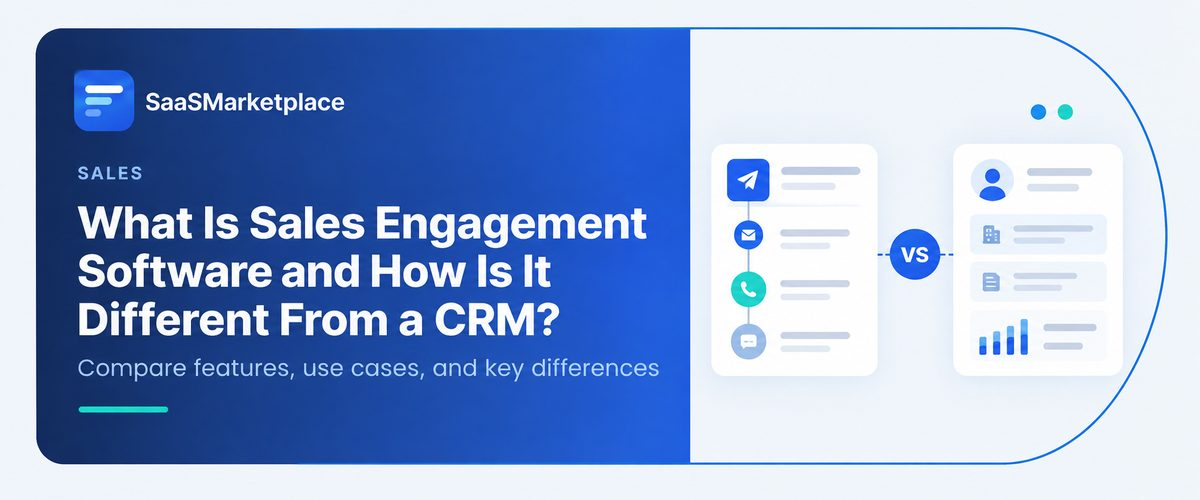
What Is Sales Engagement Software and How Is It Different From a CRM?
-min.jpg)
Ask ten sales leaders to define "sales engagement software," and you'll likely get ten different answers - and only five will get it right, in any case, describing their CRM software. The problem with this confusion is that it leads to people buying overlapping systems and buying the wrong tools: sales teams invest in a powerful engagement platform only to learn they didn't actually need it, or conversely, that their CRM software did something far more powerful than they realized. The short answer is that a CRM system stores and manages information about your customers, whereas an engagement system deals with the sequence in which you should contact those customers, and how your sales reps should approach each. The difference between the two fundamentally informs how your business has designed your sales technology stack.
Key Takeaways
- CRM software is a system of record; sales engagement software is a system of action
- Sales CRM software tracks deals and contacts, but rarely automates the outreach sequence itself
- AI CRM software adds prediction and scoring, but still isn't built to execute multi-touch cadences.
- Online CRM software and engagement platforms increasingly integrate, but they solve different problems.s
- Marketing automation software and marketing analytics software sit adjacent to this stack, feeding data in rather than replacing either tool.
Where CRM Ends, and Sales Engagement Begins
Here's where most of the mix-up starts. CRM software was built to answer a simple question: what do we know about this customer, and where do things stand? It logs contact details, deal stages, notes from past calls, and a history of every interaction. That's valuable, but a CRM on its own doesn't tell a rep what to do next Tuesday morning or draft the third follow-up email in a sequence.
Sales engagement software picks up exactly there. It's built around cadences: structured, often automated sequences of touches across email, phone, and social channels designed to move a prospect from first contact to a booked meeting. Teams that treat their CRM as if it handles this end of the job usually end up with reps manually tracking who's due for a follow-up in a spreadsheet on the side, which defeats the purpose of having a system at all.
How Sales CRM Software Keeps the Pipeline on Track
Sales CRM software is the place where pipeline and account history should be the single source of truth. When a deal moves from "qualified" to "proposal sent," this should be reflected in one place accessible to everyone (not just your personal email where you save the spreadsheet your rep sent you). Good sales CRM software also allows one to report on win rates by segment, average deal size, sales cycle length by product line, etc.
In terms of actual outreach, that's where engagement software excels, whereas sales CRM software tends to be more limited in its ability to plan and execute outreach sequences. Most CRMs allow you to mark an email as sent, but few allow you to build an intelligent twelve-step sequence spanning six weeks with varying intervals between steps based on whether the recipient opened your previous email or not. Some allow A/B testing of subject lines at scale.
AI CRM Brings Intelligence to the Sales Pipeline
AI CRM Software has somewhat narrowed the gap. Predictive lead scoring, flags of deal risk, and suggested next action items are becoming commonplace in mid-market and enterprise CRM systems. That said, prediction execution. Some companies think that with an AI CRM system, there is no need for an engagement platform; however, I think it's accurate to say that they solve two similar, but not the same, problems. While one can suggest what matters, the other has to solve the problem of high-volume outreach automation.
The Role of Online CRM Software in Distributed Teams
One of the logistical challenges of using online CRM software instead of locally installed programs is that it is easier to share data between remote sales teams who only interact digitally. At the same time, it becomes much easier to synchronize data between different programs, particularly if both are in the cloud and can communicate via API.
One common challenge many organizations face when integrating their systems is that they believe that because they have unified their online CRM and engagement system, there is no need to make modifications to how they use either. They then encounter bugs, inconsistencies, and difficulties stemming from both programs using slightly different data or terminology. This can be avoided by most organizations if they spend sufficient time deciding what data will be managed by which system ahead of installing the integration.
The Bridge Between Marketing and Sales Engagement
Marketing automation software operates one step upstream from both CRM and sales engagement platforms. It nurtures leads before they're sales-ready through drip email campaigns, lead scoring based on website behavior, and content downloads. Once a lead crosses a defined threshold, it typically gets handed to sales, at which point sales engagement software takes over the more direct, personalized outreach.
The handoff between marketing automation and sales engagement is where a lot of pipeline quietly leaks. Leads that marketing considers "sales-ready" often sit untouched for days if there's no clear trigger connecting the two systems. Businesses that wire this handoff carefully, where a marketing automation event directly kicks off a sales engagement sequence, tend to see faster response times on qualified leads.
Why Marketing Analytics Matters Beyond the CRM
Marketing analytics software does not address relationship or sequence management, but rather quantifies the extent of effectiveness throughout the funnel, which channels generate leads that close, where the drop-off occurs, and the type of content that correlates with closed deals. It is not a competitor to CRM or engagement tools but rather an often-missing component that determines whether an organization’s CRM and engagement efforts bear fruit.
Smaller companies tend to overlook the analytics layer, allocating less of their marketing budget towards it, focusing on CRM and engagement tools, assuming that the analytics layer is either superfluous or embedded within the dashboard. This approach works until executives ask which particular campaigns or tactics contribute to revenue, and the reporting tools are insufficient to provide those insights.
The Right Tools for the Right Stage of Growth
Few companies will need all six categories at once. A good rule of thumb is to start with whichever category you feel most competent in, or the one that is lacking. If you have high levels of outreach organization but low visibility in your pipeline, it might make sense to start with a CRM software. If your pipeline is well-organized, but individual sales reps struggle to keep up with the follow-ups, sales engagement software will probably be a better fit.
Most large businesses tend to use all of the aforementioned software types, usually within an ecosystem that uses a customer data platform or a CRM as the central unit. With that being said, it’s not recommended for smaller companies to jump into buying all of the aforementioned products at once. It’s much better to start with a CRM and the necessary tools for sales outreach, and then incorporate more software when the amount of outreach begins to affect the quality of sales on a case-by-case basis. The same goes for choosing between sales engagement and outreach software: buying one when you need the other will lead to tremendous amounts of wasted time and effort on switching between poorly integrated services.
Conclusion
The distinction is straightforward once it's spelled out: CRM software tells you what you know about a customer, sales engagement software tells you what to do about it next, and marketing automation and analytics tools feed and measure that whole process from the edges. Getting the stack right isn't about buying the most tools; it's about matching each tool to the specific gap it closes, and making sure the handoffs between them don't leak pipeline along the way.
FAQ's
Some CRM platforms now include basic sequencing features, but most lack the depth of cadence automation and multi-channel orchestration that dedicated engagement platforms offer.
For teams with enough deal volume to benefit from predictive scoring and risk flagging, yes. Smaller pipelines may not generate enough data for the predictions to be reliable.
Yes, cloud-based access is generally a requirement, not a nice-to-have, for distributed teams needing real-time shared data.
Marketing automation nurtures leads before they're sales-ready; sales engagement software takes over once a lead is qualified, managing the direct outreach sequence.
It tracks funnel-wide performance: which channels and campaigns produce leads that convert, rather than managing individual customer relationships or deals.