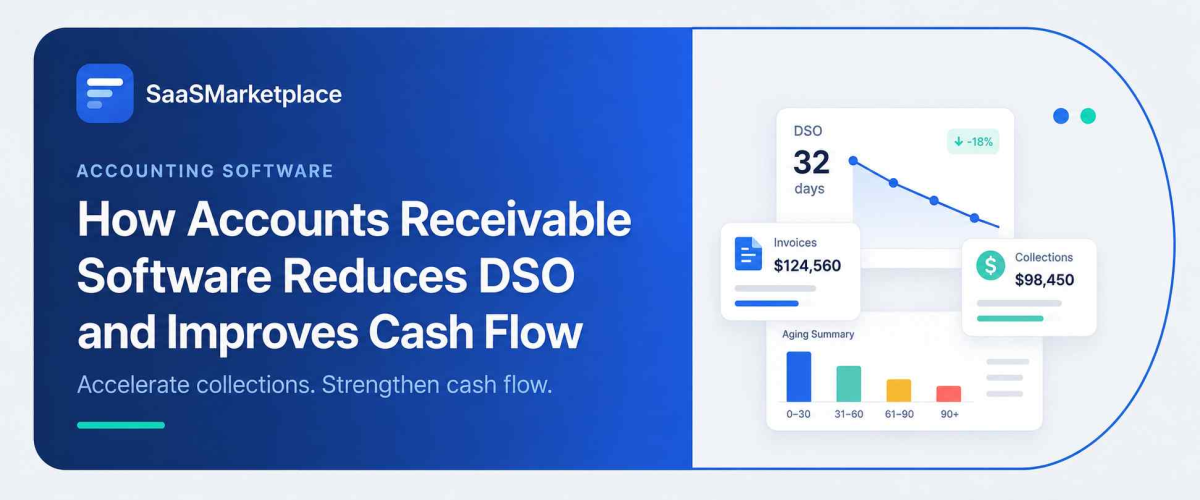
How Accounts Receivable Software Reduces DSO and Improves Cash Flow
-min.jpg)
The utilization of Accounts Receivable (AR) software helps in reducing the Days Sales Outstanding (DSO) and improving the cash cycle process by automating the process of order-to-cash in addition to eliminating any manual obstacles responsible for delaying payments. Instant billing processes leading to speedy invoicing and automatic reminders, modern AR platforms shorten the periods between issuing the invoice and receiving payment. Additionally, through automated cash application, payments received are sent to open receivables, allowing finance departments to see overdue accounts as soon as possible and collect money proactively. As a result, companies' payment cycles decrease, thus minimizing their credit risks while they get their revenue faster.
What Is Accounts Receivable Software and How Does It Work?
Accounts receivable (AR) software acts as a financial management platform that helps a business manage its entire order-to-cash process. For US businesses dealing with credit sales, it automates tedious processes such as communicating with customers and tracking orders. In addition, AR software has a digital tracking tool that connects to existing accounting software and processes incoming payments. By standardizing invoicing and collecting payments, AR software allows finance executives to have a complete view of cash flow.
The application functions by creating a self-operating stream of receivables that starts as soon as a sale takes place. First, it issues digital invoices that the program sends to buyers with automated links for ACH, credit, and virtual credit card payments. After that, automated dunning engines monitor the payment due dates and send timely reminders to the buyers before and after the payment deadlines expire. After the funds are transferred to the company’s bank account, cash application arises from AI and compares the payments to pending invoices, thus automatically registering the data in the general ledger.
Why Does DSO Matter and How Can Accounts Receivable Software Lower It?
DSO represents the average time it takes for a corporate entity to receive a payment post a commercial transaction or sale. The high level of DSO results in the time being trapped in the company’s balance sheet instead of being utilized to fund operations, payroll costs, or expansion.
In most companies where the cycle length increases up to 60-90 days, temporary financing and borrowing are vital, as companies have no other funding options to cover the costs of day-to-day operations. Accounts receivable solutions help decrease DSO by eliminating the reasons for payment delays experienced by companies that still use traditional accounting processes. Invoices reduce the time waiting before a payment is received due to the process of digital invoicing since all the required data is already in invoices, meaning less possibility for disputes. However, it does not stop there - self-service payment options make it even easier for buyers to pay for their purchases.
AR automation helps reduce DSO by days or weeks at a time via both decreasing friction in the processing and lowering the payment cycle. As the inflow of cash becomes faster, the liquidity cushion gets better, the necessity for debt gets smaller, and finance executives get the ability to foresee capital required for business development.
How Does Accounts Receivable Software Speed Up Collections?
With AR software, accounts receivable software are collected much faster, as the software takes care of all the steps that have to be taken to collect from debtors while removing the friction of making the payment from the buyer's perspective. In the past, when collections were done manually, collectors spent countless hours searching for overdue customers through aging reports, writing emails to late payers, and reconciling unjustified payments. The AR software eliminates this reactive method of collecting, replacing it with a structured, automated manner of sending collection reminders, emails, and account statements that depend on the date of payment. Since companies contact clients as soon as an invoice is overdue, they avoid their accounts becoming severely overdue.
Aside from automating contact processes, the latest AR platforms speed up the collection process by eliminating payment barriers and easing the resolution of disputes. By embedding payment links in digital invoices, companies enable clients to pay through standard channels (ACH, credit or virtual card) with a single click instead of waiting for paper checks and mail. In addition, client portals provide users with full access to their account history, the ability to dispute invoices, or to request a modification of a bill at any point. As a result, instant billing resolution and rapid payment acceptance make the payment mechanism work efficiently and decrease collection process time substantially.
What Automation Benefits Does Accounts Receivable Software Offer?
- Automation of Invoice Creation and Delivery: The software generates billing and invoicing automatically based upon sales orders, shipping documentation, or the CRM system and sends those invoices through email.
- Smart Dunning and Collection Sequences: Fixed reminders will be sent to customers through either e-mail or SMS, automatically triggered based on the date on the invoice, which makes sure reminders are sent without any action from the staff.
- AI-Based Cash Application: The AI system will automatically recognize incoming payments and match them with orders.
- Services for Payment Through Client Portal: The ability to pay invoices will be integrated into the system.
- Proactive Credit Management and Monitoring: Algorithms assess customer payment history and access third-party credit bureau information to change credit limits and notify of all high-risk accounts before sales.
- Centralized Dispute and Deduction Management: Disputes will be assigned to the correct account owner since the software automatically redirects the case in the event of a flagged discrepancy by the customer.
- Real-Time Analytics and Cash Flow Forecasting: Automated dashboards continuously gather aging reports, keep track of the collection efficiency index, and predict incoming cash flow in order to enhance the decision-making process.
How Does Accounts Receivable Software Improve Cash Flow?
Accounts receivable software enables businesses to manage cash flow proactively rather than reactively. This is because cash flow methods are burdensome processes that result in delayed invoices, unaccounted payments, and the frequent manual processes of contacting customers about unpaid invoices. With our accounts receivable software solutions, this challenge is removed through AI workflow automation that initiates with the issuance of a digital invoice with an integrated payment system and the automated reminders sent by the system to the customers. By speeding up cash collection cycles, liquid cash balances increase thus allowing companies to keep their operational capital intact.
AR applications assist cash flow management and effective data tracking, not only making collections speedier. The use of real-time cash application powered by AI enables the parsing of advice of payment and automatically matching the incoming payments by ACH, wire, or credit cards with outstanding invoices, which provides CFOs with a current view of available funds. Consequently, moving forward with precise predictive forecasting becomes much easier for executives, who can foresee cash shortages and minimize bad debts.
What Key Features Should You Look for in Accounts Receivable Software?
When identifying suitable accounts receivable (AR) software candidates, the most important features must be taken into consideration in order to smooth the manual processes, decrease mistakes, and shorten the cycle from order to cash.
- Automated invoicing: And e-invoicing ensure the establishment of digital invoices directly from ERP or billing and their immediate delivery in the preferred way by clients.
- Configurable dunning workflows: It gives way to the delivery of customized multi-channel payment reminders (e.g., via email or SMS) based on the creditors’ repayment conditions.
- AI-powered cash application: Removes delays in payment processing by linking the incoming payments (whether ACH, wire, check, or card) to the open invoices.
- Self-service customer: Payment portal allows the clients to enjoy a white-labeled web interface where it is possible to see the list of invoices, extract the statement, register a dispute, and make the payment.
- Automated Credit Risk Management: Assesses the creditworthiness of buyers by constantly analyzing data on customer payment history and feeds from external credit bureaus, thus enabling automatic adjustments of credit limits.
- Dispute and Deduction Tracking: Records, forwards, and monitors cases of discrepancies in invoices in a centralized dashboard, thus settling payment holds much quicker and maintaining stable communication.
- Seamless ERP and Accounting Integration: Provides two-way data synchronization with Dynamics to update the general ledger in real time.
What ROI and Business Outcomes Can Accounts Receivable Software Deliver?
- Significant DSO Decrease: Many companies experience a remarkable reduction in Days Sales Outstanding, with a decrease of around 10 to 30% within the first year, leading to a significant improvement in the conversion of stagnant receivables into cash flows.
- Lower Operating Expenses: Automating the billing and payment reconciliation processes proves effective in decreasing manual costs associated with Accounts Receivable by 60 to 80%, allowing the employees to focus on strategic financial wellness planning.
- Reduction of Bad Debt Write-Off: Automated dunning processes as well as constant monitoring of debts provide the possibility to eliminate overdue debts early enough, decreasing the bad debt provision by 20-50%.
- Reduction of Working Capital Borrowing Expenses: Quicker cash collection improves liquidity, allowing for decreasing dependency on costly short-term loans and saving on interest payments.
- Higher Collection Efficiency Index (CEI): Automation and standardization of the processes bring CEI indices closer to 100%, which means a larger share of total credit sales is collected on time.
- Faster Dispute Resolution: Opening centralized deduction tracking allows for routing customer invoice disputes right away, which helps to resolve the payment hold within days, not weeks.
- Better Customer Experience and Retention: Utilizing self-service portals and open digital billing enables both parties to minimize billing pains and billing-related problems.
What's Next for Accounts Receivable Software and Your Cash Flow Strategy?
- Autonomous Agentic AI Collections: Advanced technology platforms utilize agentic AI to follow through with customers on their own. AI does not stick to strict schedules, but rather monitors customers' languages and behaviors and changes its actions into something more effective.
- Predictive AI Cash Forecasting: Historical methods of predicting cash through spreadsheets are now mainly replaced with predictive algorithms. AI continuously analyzes micro-level buyer activities, seasonal effects, and the current economic situation to give precise invoice payment dates.
- Hyper-Personalized Risk and Credit Scoring: Traditional yearly credit evaluations are becoming outdated and being replaced by immediate risk frameworks. One key development in risk frameworks is that the software is able to change someone’s credit limit based on various data streams, such as general market indications, the probabilities of paying on time, and relevant information from third-party credit bureaus.
- Instant Settlements and Payments Systems in Real Time: Payment systems that are embedded into all transactions have gone from the standard card and ACH processing to immediate payment transfers. By bringing electronic bills and instant payments together in practice, it has significantly reduced the waiting period from two or three days.
- Collaborative B2B Portals: Collection is moving from uncomfortable emails to mutual customer-supplier portals. Today's modern portals allow users to file queries concerning their bills, change their invoices, create their own methods of payment, etc.
- AR as a Main Strategic Catalyst for Growth: Today, companies view accounts receivable not as a clerical job to perform in the back office. Finance officers start treating automated AR data as a resource for operating purposes by using it for improving customer onboarding conditions, allocating capital, and protecting profit from losses.
Conclusion
The use of Receivables Management software is considered the best tool for removing the bottlenecks in payments and making DSO shorter. With the help of automation instead of including manual work in the process, such as payments and sending invoices, as well as allowing customers to easily pay the invoices, the company will be able to turn credit sales into cash much faster. Want to learn more about a modern order-to-cash process? Explore SaaSMarketplace to examine the best solutions available on the market and choose the one needed for your organization’s operational needs.
FAQ's
DSO measures the average number of days it takes a company to collect cash after a sale, serving as a critical indicator of operational efficiency and cash flow health.
AR software lowers DSO by automating digital invoicing, sending pre-scheduled dunning reminders, and offering instant self-service payment options to buyers.
Accelerating cash collections converts outstanding receivables into liquid cash faster, reducing reliance on short-term debt to fund daily operations.
Yes, modern AR platforms provide centralized portals to log, track, and resolve billing disputes immediately before they delay payment schedules.
Most businesses see a full ROI within 6 to 12 months due to reduced operational costs, lower bad debt risk, and faster cash recovery.