How AI-Powered Legal Billing Software Is Changing Time Tracking for US Law Firms
-min.jpg)
AI-based legal billing tools are drastically changing how law firms in the US record time spent on their work, removing the limitations of manual time recording that relies on recollection. Traditionally, lawyers have depended on their memory or imagined the day’s activities at the end of the day, thus resulting in lost revenues caused by forgotten billable hours. Currently, AI time-tracking platforms unobtrusively work in the background and connect to various platforms used by law firms, legal practice management applications, document libraries, and communication systems, automatically registering their work, creating lengthy written descriptions, and naming the hours spent on particular cases. By recovering lost billable hours and minimizing manual operations, AI billing tools help US law firms improve revenue realization and comply with laws related to the Outside Counsel Guidelines (OCG).
What Is Legal Billing Software and Why Does It Matter for US Law Firms?
Legal billing software can be defined as a type of software that has been designed to automate and enhance the process of recording the hours that can be charged to clients and managing accounts, payments, and invoicing. Unlike generic software or spreadsheets, legal billing software has much more practical use for lawyers. It integrates all the necessary accounting functions, such as time tracking, trust accounting, and invoicing, into a single system. Because of the fact that all billable actions are linked to specific clients’ cases, the software allows recording and archiving all the hours that have been worked on the particular case and the expenses that have occurred.
In order for US law firms to ensure their profitable, trustworthy, and compliant operations, it is important to use dedicated legal billing software solutions. According to the American Bar Association (ABA), law firms adhere to strict laws governing client trust accounts (IOLTA). However, using advanced legal billing programs allows law firms to automate compliance processes in order to avoid violations of ethics that may cost them. Also, due to enforcing tough Outside Counsel Guidelines (OCG) and the LEDES format of billing, large corporate clients in the US cause many law firms to struggle and face delays in payments because they use traditional paper invoices. Legal billing software solutions eliminate many administrative bottlenecks and leaks of payables while providing firms with useful financial analytics, which helps them boost their realization rates and accelerate cash flows.
How Does AI-Powered Legal Billing Software Work for Time Tracking?
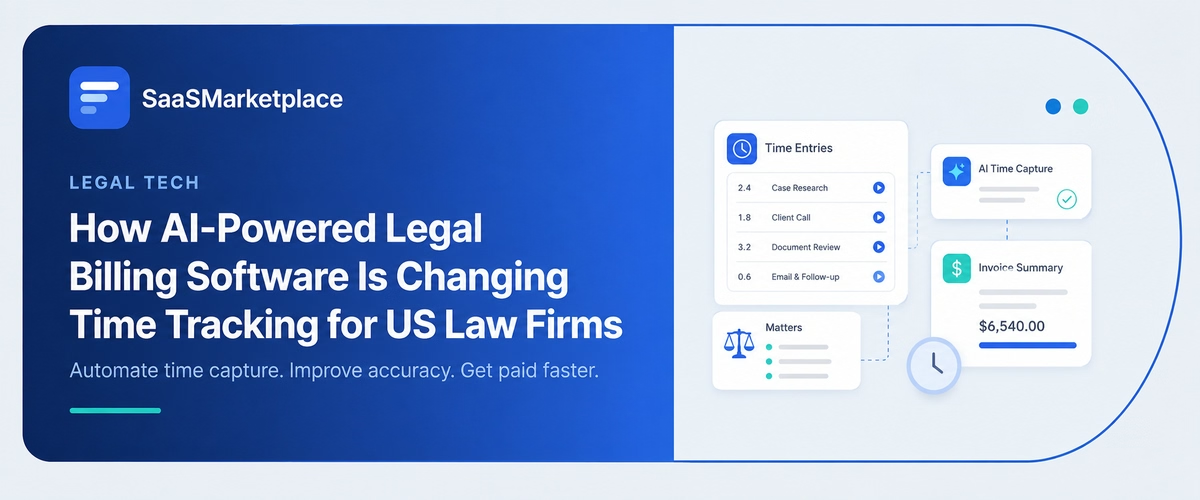
Software for legal billing that is powered by artificial intelligence works silently in a lawyer’s office, monitoring daily digital processes of the lawyer without requiring a manual start-stop timer. The software has background agents that integrate with the fundamental office applications, document management software, email programs, and video monitoring systems to keep track of every draft made by the lawyer, communication process, and several sessions of research. High-end machine learning algorithms analyze the active windows and all document information to associate every action with a certain client and provide a coherent time recording system.
After being captured, the information back on the client becomes available for natural language processing (NLP) to create professional narrative descriptions for the invoice. Rather than manually documenting worked on brief, the AI is able to create appropriate descriptions of every document and issue being researched, as well as an accurate amount of time spent on communications. The program continuously checks these entries against the client billing rules and OCG of the company and ensures that no block billing mistakes, non-billable flags, or unclear wording go to the partner for signing.
Eventually, the process transforms the time entry and time tracking from a mundane bureaucratic chore to a quick approval process. Lawyers peruse an automated stream of time entry information that has been pre-coded, and approve it or revise it in a matter of minutes, sending the confirmed hours to their billing system. By enabling the recording of all the billable tasks that get lost in the shuffle, including after-hours emails or minor edits, these firms prevent loss of revenues and rejected invoices, while ensuring full disclosure with their corporate clients.
What Problems Does Legal Billing Software Solve for US Law Firms?
- Heedless Billable Hours Leak: Resolves the issue of forgotten or unlogged time like brief client calls, late-night emails, or short document edits by using background automation to always keep track of billable time.
- Prevents OCG Violations: Eliminates rejection of bills, as well as line item write-downs for large companies, through automatic compliance checking of invoices against customer-specific rules, alerting on block billing, non-billable administrative work, and unauthorized billing and invoicing before handing in the invoices.
- Ensures Strict IOLTA Compliance: Saves law firms in the USA from a cascade of unethical violations and bar disciplinary actions by automating three-way account reconciliations and eliminating mixing revenues of the firms and clients' trust accounts.
- Enables Speedier Payment Processing and Cash Flow: Cities that have previously wasted hours waiting for the bill’s dispatching notice are relieved by automatic translation of their time logs into an e-billing format (like LEDES) and automatically receiving alerts associated with payments made online.
- Drastically Reduces Burden on Attorneys: The system saves money by eliminating time spent on old-fashioned manual methods, making the work of the administrative staff much simpler and quicker.
- Establishes Strong Client Relationship by Refining Billing Process: Clients are immediately receiving their billing as a result of the automatic billing process, thus boosting loyalty from their end.
How Is Legal Billing Software Improving Accuracy in US Firms?
The technology used for legal billing has made it possible to achieve much higher accuracy in US law firms through the transition of timekeeping from memory-based manual entry to automated, data-driven validation. Advanced software allows achieving accuracy at different levels of operation:
- Removes the Human Memory Issue: Passive tracking accurately records time-stamped entries of finished activities like email conversations, contracts being drafted, etc. This way, attorneys avoid misremembering things and erroneously estimating the time spent when filling the time sheet days later.
- Uniformizes Coding Systems: Algorithms used for the AI software adjust the coding of done activities to what FITS and LEDES coding requires. As a result, coding mistakes and subsequent rejection of corporate invoices are eliminated.
- Checks For Compliance With Billing Regulations: The newest software verifies the entries according to specific Client Billing Guidelines as time is recorded. It checks for non-compliance with certain activities or travel time before sending invoices to the clients.
- Produces Accurate Narrative Descriptions: Instead of depending on ambiguous and inaccurate entry notes like client call or brief prep, natural language generation uses technology to generate thorough and professional descriptions indicating the motion, document, or issues that were involved in that billing.
- Automates Trust Accounting Reconciliations: The software integrated into legal accounting software standards tracks retainer and client trust accounts automatically, which prevents mistakes in manual calculations and ensures compliance with state bar ethics.
What Features Should US Law Firms Look for in Legal Billing Software?
- Automated and passive time tracking: This function helps in monitoring background activities and records actions over emails, documents, and video meetings, without the requirement of manual operation.
- Compliance: The software will help in preventing the illegal combination of client money with operational cash by having built-in monitoring elements, like the three-party account reconciliation.
- Client guidelines and compliance with OCG rules: The software automatically checks time entries and detects block billing and unresolved activities, as well as unspecified narratives, before the invoices are sent.
- LEDES format and e-Billing: The software exports invoices online in the necessary forms, such as LEDES 1998B or REASON, which are widely used by many corporations and audit portals.
- Integrated online payment and transaction processing: The platform enables online payment processing via secure and fast click payment portals using debit cards or ACH and observing legal requirements regarding transaction fees’ separation.
- Custom rates and flexible business models: This function allows introducing alternative fee agreements, tracking contingencies, splitting the billing time, and setting fees depending on the specific lawyers/fields of specialization.
How Is Legal Billing Software Saving Time and Money for US Law Firms?
- Recovers Lost Billable Time: Boosts revenue by ensuring that micro tasks, such as phone calls, emails, and minor document modifications, are logged by legal practitioners at the end of working hours.
- Substantially Lowers Non-Billable Administrative Tasks: Saves hours for lawyers completing manual timesheets, managing receipts and writing invoicing reports.
- Increases Invoice and Cash Flow Speed: Provides for automating processes of invoice development and approval, ensuring faster sending of bills and quicker payments by clients through electronic payment channels.
- Avoids Time Write-Offs and Invoice Disputes: Allows for the real-time filtering of non-compliant time electronic health records based on the clients’ billing rules, thus avoiding future rejections and write-offs by the client before an invoice is sent.
- Precludes Coding Errors: Provides for the automation of LEDES template codes and task coding formats, eliminating a vast amount of administrative work and delays caused by mistakes in data entry.
- Decreases Operational Expenses: Brings together all functions related to time tracking, invoicing, trust accounting, and financial reports, thus eliminating the necessity of hiring additional administrative staff and cutting expenses on programming.
Which US Law Firms Are Adopting AI-Powered Legal Billing Software?
The tendency of law firms of different sizes in the US, from leading Am Law 100 companies to mid-sized litigation firms and specialized practices, to use AI-based tools for legal billing is very clear. Within the group of firms that can be considered pioneers in this respect, three main groups can be highlighted:
- Am Law 100 & 200 Corporate Firms: Those large organizations that handle complex cases seem to be the ones that are adopting such technologies. These organizations use AI systems for tracking time in order to manage many billable tasks at the same time through many timekeepers.
- Mid-Market Commercial & Trial Firms: These involve mid-sized groups of law firms ranging from 20 to 150 attorneys that leverage AI-based billing systems in order to compete with larger firms. With reduced costs of operations and by capturing billable time of the employees effectively, these firms improve their realization rates.
- Boutique & Specialized Practices: The specialized law firms operating in high-volume business environments apply the advantage of AI billing automation in their operations, as the specialization consists of many tasks and small communications.
Conclusion
The use of AI-driven legal billing software helps law firms in the US earn back lost revenue, adhere to compliance requirements, and overcome administrative problems by replacing manual logging with background automated capture. As law firms continue to modernize their processes, choosing the appropriate platform becomes crucial. Today’s legal practices depend on digital ecosystems that include SaaS Marketplace, a one-stop shop that enables firms to examine, analyze, and procure software solutions. Utilizing software hubs gives legal companies the ability to improve their billing practices, raise cash flow, and focus on providing quality legal services.
FAQ's
It uses background software agents to passively monitor digital activities across applications, automatically grouping work and drafting time entries without manual timers.
No, AI serves as an automated drafting tool that presents suggested time logs for attorneys to review, edit, and approve before client submission.
Yes, advanced algorithms cross-reference entries against client-specific rules to flag block billing, unauthorized tasks, or vague narratives before invoicing.
It captures easily forgotten micro-tasks such as quick client emails, phone calls, and document edits eliminating billable hours leakage.
Yes, built-in legal accounting safeguards maintain separate ledgers and automate three-way reconciliations to ensure full state bar compliance.