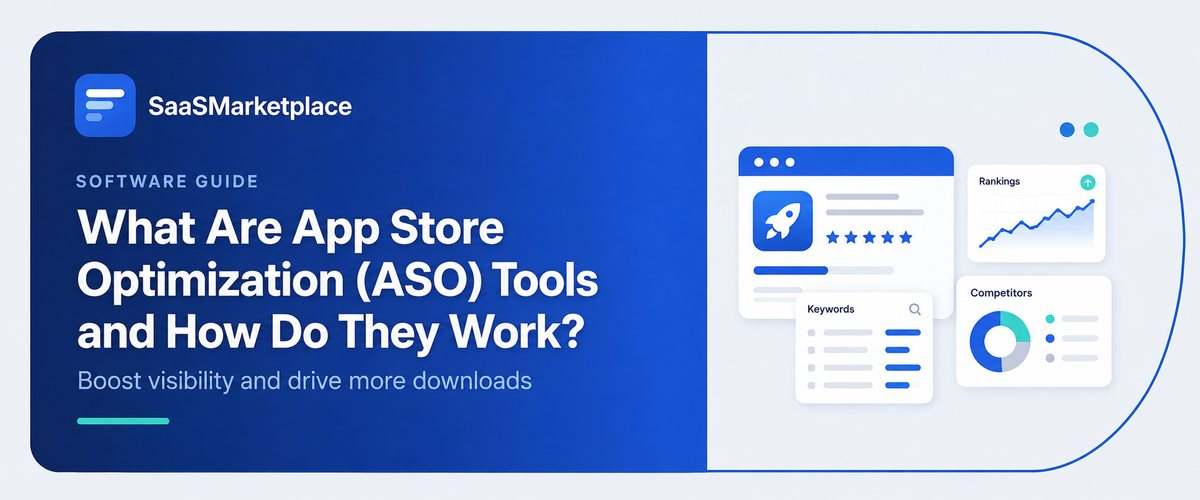
What Are App Store Optimization (ASO) Tools and How Do They Work?
-min.jpg)
Say a developer spends six months getting an app right. Downloads still won't budge. Why? Nine times out of ten, it's not the product; it's that nobody searching the App Store or Google Play ever crosses paths with it. App Store Optimization (ASO) Tools exist for that exact problem.
Point one at an app, and it'll watch where that app ranks for the terms people are actually typing, then flag whatever's pushing that rank up or down. Given how packed the U.S. mobile market is, that kind of visibility can outweigh the build quality itself. So what follows here covers what these tools actually do, where they part ways with web-focused SEO tools, and maybe more usefully, when a team can skip them entirely.
 Looking for App Store Optimization (ASO) Tools? Check out SaaS Marketplace’s List of the Best App Store Optimization (ASO) Tools in the USA for your business.
Key Takeaways
- ASO Tools watch app rankings inside the App Store and Google Play. Not the open web a different arena entirely.
- App Store algorithms care about install velocity, ratings, and update frequency. Backlinks? Barely register.
- Rank Tracking Software made for websites usually can't even read app store data. Two systems, two rulebooks.
- Keyword Research Tools: Software built for apps has to catch how people phrase things inside a store, shorter and blunter than how they'd search in a browser.
- Local businesses running an app haven't left Local Listing Management Software or SEO Software behind either; they're still handling everything outside the store.
Why ASO Became Its Own Category
The old assumption went something like this: if it works for ranking a website, it'll work for ranking an app. Wrong, and that wrong guess cost a lot of developers real downloads before anybody stopped to ask why. Search engines crawl the open web and index it, more or less freely. App stores don't play by those rules at all. They're closed systems. Apple and Google decide what bubbles up, and the signals behind that decision barely resemble how Google ranks a webpage.
Which is exactly why App Store Optimization (ASO) Tools split off into their own category rather than staying as an add-on bolted to existing web-ranking platforms. Think about what actually moves the needle for an app: title, subtitle, keyword field, screenshots, how many reviews it's racked up. None of that has a real equivalent in how a website earns its spot on Google.
How ASO Tools Actually Work
Most ASO platforms simulate a real search inside the App Store or Google Play from a given country, device, and language, then log where the target app shows up. Run that daily across a list of keywords, and what you get is a position history not unlike what web-based rank trackers produce, just aimed at a completely different environment.
There's more going on underneath, though. The platform is also watching things a browser search never touches: install velocity, uninstall rates, review sentiment, star ratings, how often the app gets updated. Apple and Google both read these as trust signals. An app with frequent updates and steady five-star reviews will often outrank a stagnant competitor using the same keywords in its metadata. Content and backlinks still rule the web. Inside the store, they barely register.
Here's the part that catches new teams off guard: keyword fields inside app stores are tiny. Apple caps it at 100 characters. So word choice matters far more per character than it ever does on a webpage; picking between two near-synonyms isn't a style call, it's a decision about how to spend a scarce resource.
ASO Tools vs. SEO Software
|
Feature / Aspect |
Dedicated ASO Software |
Broader SEO Software Suites |
|
Primary Target Platform |
Mobile app stores (Apple App Store, Google Play Store). |
The open web (Google, Bing, Yahoo search engines). |
|
Core Capabilities |
Metadata optimization (App Title, Subtitle, Keyword Field), A/B testing, app review/rating analytics, and store visual asset analysis. |
Technical website auditing, backlink analysis, web keyword research, and on-page content optimization. |
|
Ranking Factors Monitored |
Keyword placement in app metadata, conversion rates, app download velocity, retention, and ratings/reviews. |
HTML structure, domain authority, backlink profile, page speed, meta tags, and web user experience signals. |
|
Data & Tracking Focus |
App store ranking algorithms, in-app search volume estimates, category rankings, and featured app placements. |
Search engine result page (SERP) positions, web traffic estimations, click-through rates (CTR), and crawling errors. |
|
Best Suited For |
Mobile-first companies, app developers, and growth marketers managing dedicated mobile applications. |
Website managers, content marketers, and businesses focused on driving organic web traffic. |
Where Keyword Research Tools Software Fits In
Before anything gets tracked, somebody has to decide which terms are actually worth chasing. That's Keyword Research Tools Software's job, and inside an app store it behaves differently than it does on the web. App searchers type short. "Budget app." "Workout tracker." Not the longer, question-style phrasing common in web search.
A decent keyword research process for apps pulls estimated search volume per term, per country a phrase that's popular in the U.S. App Store might barely show up anywhere else. It flags difficulty too, so a small team isn't burning its limited keyword-field space chasing terms it was never going to win.
Skip the research and a developer ends up optimizing for words nobody types. Skip the tracking afterward and there's no way to know if any of it worked. The two are meant to run together most ASO platforms have folded basic keyword research straight into their rank tracking dashboards for that exact reason.
Rank Tracking Software for App Stores
Here's a tempting shortcut that doesn't actually work: pointing Rank Tracking Software built for Google straight at an app store. Nice idea, wrong tool. Web-focused trackers are built to query search engine results pages. App-focused trackers query the App Store and Google Play APIs instead and what comes back is a totally different kind of data.
There's also a wrinkle websites just don't have: category rankings. An app isn't only ranking for keywords. It's also sitting somewhere inside a broader category "Finance," maybe, or "Health & Fitness" and honestly, that category spot can drive more organic discovery than keyword search ever does on its own. Track both at once, and you're covered. A general-purpose web rank tracker was never built with that in mind.
Location still matters for U.S. teams too, the same way it does on the web. Position can shift state to state, sometimes city to city, for geographically relevant terms. The better ASO platforms let a team watch that at a granular level instead of relying on one blended national number that doesn't tell anyone much.
Local Listing Management Software and Apps
Surprising connection at first, but it's real. Take a business with a physical location and a mobile app a regional gym chain running a booking app, say. It still needs Local Listing Management Software for its Google Business Profile, Yelp, and Bing Places listings, completely apart from whatever's happening inside the App Store.
The two aren't the same tool, but they do reinforce each other. A clean, consistent local listing drives foot traffic and searches for the business name, and some of those same people go looking for the app afterward. Run that kind of listing management across fifty locations, pair it with ASO Tools for the app, and now two different discovery paths are both leading back to the same customer.
Common Mistakes U.S. App Teams Make
Treating app store visibility like a one-time setup task is probably the most common misstep. A developer fills out the keyword field at launch, checks rankings once, moves on. Meanwhile Apple and Google keep reweighting signals fresh reviews, competitor updates, install trends shifting week to week.
The opposite mistake happens just as often: checking rankings obsessively, several times a day, and reacting to what's really just noise. App store positions wobble for reasons that have nothing to do with strategy algorithm testing, regional server variance, a competitor running a temporary promotion. Chasing every wobble tends to waste more effort than it saves.
Then there's chasing high-volume keywords that don't line up with install intent mistake number three. Sounds great on paper, ranking for something broad and popular. Except if the people typing that term actually want something a little different, all that ranking buys is impressions. No downloads. Visibility that goes nowhere.
Here's one that usually doesn't show up until a few months in, once there's finally enough data to notice: the keyword field promises one thing, the screenshots deliver another. A team grinds on a term, ranks decently for it, and then can't figure out why nobody's converting. Nine times out of ten, the screenshots and preview video got built around the app's general pitch not around what someone typing that specific term was expecting to land on. Smaller teams run into this a lot, mainly because whoever handles keywords and whoever handles the creative are two different people, and nobody ever checks whether those two are even pointed at the same searcher.
When You Might Not Need ASO Tools Yet
A brand-new app with a handful of downloads and barely any reviews doesn't have enough signal for detailed tracking to matter yet. Rankings will be volatile no matter what Apple and Google haven't collected enough behavioral data to place the app confidently anywhere. At that stage, effort's better spent on basics: a clear title, accurate screenshots, getting that first wave of genuine reviews in.
Once there's a real user base and a review history, that's usually when ASO Tools start earning their keep. A team can finally tell whether a metadata tweak, a new screenshot set, or a review push actually shifted rankings instead of watching numbers move for reasons nobody can pin down.
Choosing the Right ASO Tool
A few questions cut through the noise pretty fast here. Handful of keywords for one app, or a portfolio spread across dozens of apps and markets which is it? Does the business need web-facing SEO tools on top of this, or is the app basically the entire product? And do U.S. regional quirks in search behavior actually justify tracking things down to the city level?
Pricing, too it's messier than most first-timers expect. Charge per app tracked, and costs pile up fast once a company's juggling several products. Charge by keyword volume or market instead, and suddenly it favors a developer running just one app in one country. The best move is mapping out real tracking needs before comparing plans, since whatever looks cheapest on the pricing page won't necessarily stay cheapest once actual usage starts.
Conclusion
App stores just don't run on the same rulebook as the open web. Treat them like they do, and it costs real downloads that's the entire reason App Store Optimization (ASO) Tools exist in the first place. A dedicated ASO platform, a module bolted onto a bigger web-ranking suite, or nothing fancier than solid keyword research and some patience which one fits depends entirely on where the app sits in its lifecycle right now. Get that part right, and it'll matter a lot more than any feature list a vendor waves around.
FAQ's
No. That category of tools tracks websites in search engines like Google. ASO Tools track apps inside the App Store and Google Play different ecosystem, different ranking signals entirely.
Ideally, yes. App searchers phrase things differently than web searchers do, and search volume for the same exact term can swing quite a bit between a browser and an app store.
Not accurately, generally speaking. App stores run on category rankings and behavioral signals that standard web-based rank trackers were never built to read.
Indirectly. It strengthens local search visibility for the business itself, and some of those searchers go on to find and download the app but it doesn't track app store rankings directly.
Weekly is plenty for an early-stage app. Daily monitoring starts making sense once there's a real user base and the team wants to see how specific changes move the needle.