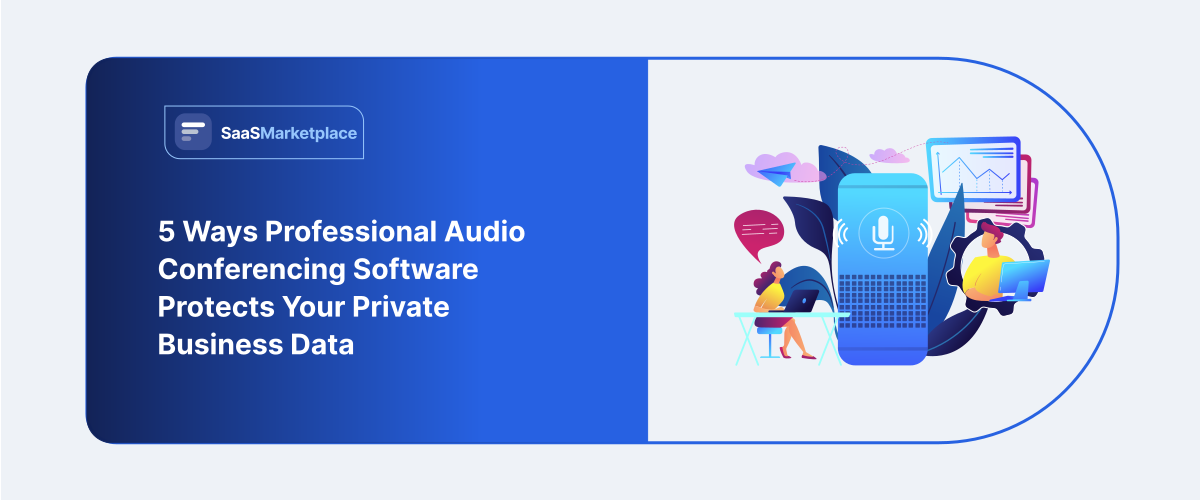
5 Ways Professional Audio Conferencing Software Protects Your Private Business Data
-min.jpg)
In today's world of online businesses, the virtual meeting room is the site of endless conversations regarding some of the most confidential and sensitive company information, such as secret product roadmaps and estimates of revenues. While standard chatting applications might work for informal catch-ups, they often lack the protection required to prevent corporate espionage and data leaks. Professional audio conferencing software solutions are designed especially to close these loopholes and make your ideas secure. By employing sophisticated security measures, these solutions ensure that your business information is protected from potential hackers.
What is Audio Conferencing Software?
Audio conferencing software enables remote team members, clients, and stakeholders to meet online, talk, and collaborate over the Internet and cloud telephony and IVRS security. It is like a modern virtual meeting room in which participants from various remote locations across the country can use the tool to call into a telecommunications meeting. However, unlike ordinary telephone calls, this software is designed to accommodate large numbers of participants and maintain high-quality communication through their noise canceling technology.
American companies rely on this technology to help facilitate their everyday work. Thanks to it, companies can save a lot of money as they don't have to incur expenses related to travelling. Modern technologies are more than just simple phone calls; they allow us to connect with various other products in the workplace and hence provide benefits such as automated meeting transcription, closed captioning in real time, and safe syncing of calendars. Thus, it turns out to be a safe place where one can arrange both public meetings and very confidential board meetings.
Why does Audio Conferencing Software matter for Data Privacy?
Audio conferencing software serves as an important means of safeguarding against threats to data privacy because virtual meetings can attract the attention of cybercriminals. When corporate executives have discussions that require them to disclose information about new financial statements, exclusive product designs, or other private HR matters, these communication sessions transmit voice data as digital packets across the internet. Unfortunately enough, consumer-grade software meant to carry calls can expose such packets to interception. By comparison, professional audio conferencing software allows transmitting streams of audio to users by encoding it, even though hackers may intercept the transmission and produce it in its regular form.
In addition to external hacking challenges, good software allows businesses to have complete control over who participates in the meeting. Features like mandatory meeting passwords, secure waiting rooms, or individual identification of users stop hackers from meeting bombing or spying on sensitive conversations. Other tools, such as forced attendance checking or immediate lockdown, ensure that once the right people are present, no one else can get in.
Adherence to stringent data privacy regulations is virtually infeasible without tailored conferencing software. Business solutions are designed to satisfy regulations, such as HIPAA for the healthcare sector or SOC 2 for general business security. They contribute transparency in terms of data management and guarantee the security of video, webinars, as well as transcripts and chat messages by saving all recordings on secure servers instead of processing them for commercial usage or letting them remain on vulnerable clouds.
Core Pillars of Secure Audio Conferencing Software
1. End-to-End Encryption: Data in Transmission
The protocol encrypts audio data on the originating speaker’s device and only decrypts it on the receiver’s device. Due to this, the audio is encrypted the moment it leaves the microphone, which prevents interception by eavesdroppers and ISPs, as well as the platform.
2. Multi-Factor Authentication: Identity Verification
MFA means that it is mandatory for users to prove their identity through at least two different methods, for example, a password with a one-time code, as it is required to enter a conference. Thus, hackers can’t gain access to meetings or phone calls with the help of stolen passwords.
3. Recording Access Control: Control of Data Accessibility
This feature allows administrators to completely control who can record the meeting, see transcripts, or download recordings. Instead of using public links, organizations can provide people with certain permissions and set mandatory passwords to avoid confidential information leakage.
4. Safe Cloud Storage and Data Residency: Stored Data
It ensures that the data, like meeting records, audio files, and user data, is stored in highly protected, encrypted clouds. It also helps US companies to choose where their servers are positioned, securing their confidential data.
5. Regulatory Compliance Framework: Legal.
Communication platforms have to comply with strict regulations of data protection, like HIPAA for healthcare CRM, GDPR for international privacy, and SOC 2 for security purposes. Following this framework confirms that the service provider undergoes numerous independent audits to protect you against legal problems and penalties.
How does Professional Audio Conferencing Software Protect Private Business Data?
The best audio conferencing software takes steps to ensure the safety of sensitive business information. To achieve this, it employs end-to-end encryption, which means that the audio signal is protected from the moment it is spoken. When employees discuss issues of a confidential nature, their audio is turned into garbled signals before being transmitted over the phone line. Because of this, even if the information is intercepted by hackers while being transmitted over the Internet, it will be meaningless for them.
Also, these enterprise-level systems impose strict access regulations to stop unauthorized access and leakage of information. Through the use of Multi-Factor Authentication (MFA), secure waiting rooms, and exclusive meeting PINs, the system ensures that only approved personnel are permitted in the discussion. Administrators can lock the meeting after all members join, thereby preventing unwanted guests from sneaking in.
Storing meeting recordings and transcripts on secure local cloud servers was in compliance with strict U.S. data residency laws. Professional systems are required to follow various regulations, including HIPAA and GLBA, among others. The systems are able to send important data without the risk of its being used for advertising.
Why is secure Audio Conferencing Software important for Data Privacy?
For American businesses operating in today's digital landscape, secure audio conferencing software is a critical safeguard against corporate espionage and interception threats. Standard phone calls and consumer-grade apps broadcast voice signals across public networks in fragmented, unencrypted packets, making them easy targets for bad actors looking to intercept proprietary information. Secure conferencing platforms utilize robust end-to-end encryption (E2EE) to seal these signals from the exact moment they leave a microphone, ensuring that even if data is intercepted in transit, it remains completely unreadable and useless to hackers.
Secure software prevents unauthorized access to meetings, a vector that accounts for significant corporate data leaks. In the U.S., corporate espionage and meeting bombing often occur when generic links are shared or compromised. Professional software mitigates this vulnerability by enforcing strict zero-trust identity verification, including Multi-Factor Authentication (MFA), secure waiting lobbies, and meeting-lock features. These controls ensure that only vetted employees are permitted in the virtual room, keeping your strategic, financial, and product roadmaps strictly private.
Secure audio software is indispensable for regulatory compliance in the highly scrutinized U.S. market. With the rapid expansion of comprehensive state-level privacy laws across the country (such as updated CCPA/CPRA regulations in California and new privacy frameworks launching nationwide in 2026), companies face heavy penalties for mishandling sensitive consumer or employee data. Secure platforms guarantee compliance with federal and state laws such as HIPAA for healthcare or GLBA for finance by keeping data residency domestic and preventing the unauthorized recording, storage, or external sharing of sensitive conversations.
What Security Features make Audio Conferencing Software Safe for Business Use?
- End-to-End Encryption (E2EE): Scrambles voice data during transmission so that only authorized participants can decrypt it, thus preventing eavesdropping at the network level.
- Multi-Factor Authentication (MFA): Requires the user authentication process to verify the access request using multiple verification methods, hence blocking access that leads to compromised passwords.
- Secure Waiting Rooms: Enables the host of the meeting to see every participant and decide who has the right to enter the call.
- Meeting Lock Controls: Allows the meeting host to lock the digital doors after all expected guests have arrived in the meeting, preventing anyone else from joining afterwards.
- Role-Based Sharing and Recording Authorization: Restricts the ability to record, transcribe, and share any documents during the call, thereby securing the intellectual property.
- Enterprise Compliance Standards (SOC 2 & HIPAA): Ensures that the software complies with strict federal standards and rules with regard to the sensitive data being processed.
Conclusion
Securing your company’s virtual communications is no longer optional in today’s hyper-connected market. By deploying professional audio conferencing software, organizations effectively shield their proprietary discussions, financial roadmaps, and client data from evolving cyber threats. Ready to upgrade your digital boardroom defenses? Visit saasmarketplace, the premier destination to discover, compare, and purchase enterprise-grade business software. Our platform streamlines your search, matching your organization with validated, compliant communication tools engineered to protect your private data and maintain operational integrity. Turn your virtual meetings into ironclad secure environments today.
FAQ's
No, because end-to-end encryption scrambles your voice data into unreadable code from the moment it leaves your microphone until it safely reaches the listener.
They place all incoming participants into a isolated digital holding area, allowing the meeting host to manually verify and approve each person before they gain entry.
MFA requires users to provide two forms of identity verification, ensuring that even if a hacker steals an employee's password, they still cannot breach the meeting.
They are stored in highly secure, encrypted cloud repositories that utilize strict data residency controls to keep your files isolated within specific domestic borders.
It proves the software vendor undergoes strict, independent security audits, ensuring your sensitive corporate and client data is handled in full alignment with federal privacy laws.