What Is Rank Tracking Software and How Does It Work?
-min.jpg)
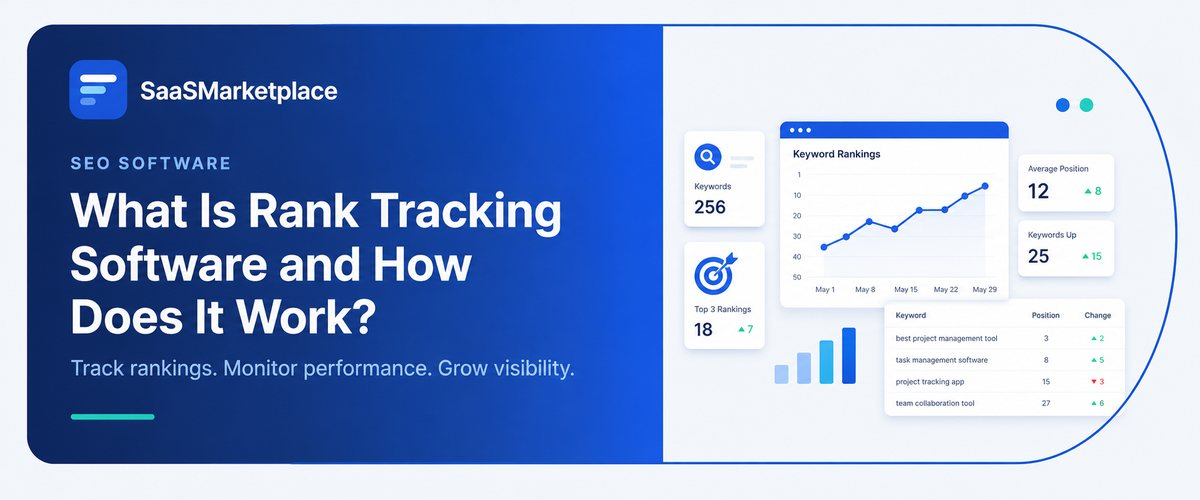
Try checking your ranking for the same keyword in three different tools. You'll almost certainly get three different numbers back. That's not some glitch; it's just the nature of the beast. Rank tracking software monitors the position of a site for a particular search query and displays its changes over time day, week, month so that the business owner can see if their SEO efforts are working or not. However, each provider uses a different set of locations and devices to do this, which is why the results are never going to match.
 Looking for Rank Tracking Software? Check out SaaS Marketplace’s List of the Best Rank Tracking Software in the USA for your business.
What This Kind of Tool Actually Does
At its core, this kind of software keeps asking one question, over and over: where does this page sit in the results for this term, right now, from this spot on the map? Run that check daily or weekly, and instead of a single snapshot, you end up with a trend line, and that's the part that actually matters.
One check by itself won't tell you much of anything. Rankings move around constantly: algorithm updates, a competitor doing something new, sometimes even the time of day plays a role. What you're really after is the pattern. Did the page climb after that content refresh went live? Did a competitor's redesign quietly bump everyone else down a notch? Without tracking things consistently, you'll never catch any of that in a way you could actually act on.
How It Works Behind the Scenes
Most systems mimic a real search initiated from a specific spot and gadget, subsequently recording where the goal link finishes within the outcome list. Perform this action over many, occasionally countless, times daily, and you end up with a repository of placement chronology you may divide by term, sheet, or rival whenever required.
This is the section where most individuals get confused: search outcomes are tailored to the user. An individual querying "plumber near me" within Austin encounters a totally distinct group of entries compared to another person entering the exact phrase in Boston, plus mobile outputs frequently differ from those on desktops even when the question remains identical. A properly constructed ranking monitor manages this situation by allowing configuration of a precise geographic area and hardware type for each term, rather than merely producing a single broad national figure that fails to align with what any actual searcher truly observes..
Rank Tracking vs. Broader SEO Software
|
Feature / Aspect |
Dedicated Rank Tracking Software |
Broader SEO Software Suites |
|
Primary Focus |
Single-purpose: Monitoring search engine rank positions, visibility, and SERP shifts. |
All-in-one: Comprehensive search marketing management across multiple disciplines. |
|
Core Capabilities |
Daily/real-time updates, local/geo-targeted tracking, mobile vs. desktop position splitting, and SERP feature tracking. |
Site auditing, backlink analysis, keyword research, content optimization, and rank tracking. |
|
Data Depth & Speed |
Higher update frequencies (daily or on-demand), granular geo-location tracking, and deep historical position data. |
Moderate tracking frequency (often weekly or basic daily), standard location metrics, and broader dataset integration. |
|
Ease of Use |
Specialized dashboards optimized specifically for monitoring keyword volatility and rank reporting. |
Consolidated dashboard reducing the need to switch between separate marketing tools. |
|
Best Suited For |
SEO specialists, agencies, and enterprise teams managing high keyword volumes across diverse markets. |
In-house marketing teams, generalists, and business owners who need an all-in-one SEO toolkit. |
Where Keyword Research Fits In
Rank tracking and keyword research are two separate jobs, but they constantly feed into each other. Keyword Research Tools Software is what helps a business figure out which terms are even worth chasing in the first place; search volume, competition, user intent- all of that comes from this side.
A rank tracker then tells you whether the site is actually showing up for those terms once the content's live. Skip the research, and you end up watching rankings for keywords nobody's actually typing into Google. Skip the tracking, and you'll never know if the research paid off at all. Most serious SEO setups run both together, often in the same platform, though plenty of teams do mix and match vendors depending on which tool handles each job best.
Rank Tracking for Mobile Apps
Websites aren't the only thing fighting for visibility these days. Mobile apps compete for rank inside app stores too, and that's a completely different game with its own rulebook. App Store Optimization (ASO) Tools track where an app lands for specific search terms inside the App Store or Google Play an environment that really doesn't behave anything like a traditional search engine.
App store algorithms lean much more heavily on things like install velocity, review sentiment, and how often the app gets updated, rather than backlinks or the usual content signals. A developer trying to grow their download numbers needs visibility into keyword rankings inside the app store itself not just how a landing page is doing on Google. Treating those two as the same thing is a pretty common mistake, and a fairly expensive one too.
Local Rankings and Multi-Location Businesses
For any business with a physical location or several rankings look totally different depending on where the search is coming from. A dentist in Phoenix cares about how they show up for people searching within a few miles of their office, not some blended national average that doesn't mean anything to a patient actually looking nearby.
That's where Local Listing Management Software comes in. It handles business listings across directories like Google Business Profile, Yelp, and Bing Places, keeping the name, address, and phone number consistent everywhere which has a direct effect on local rankings. A business running fifty locations needs to track each one separately, since doing well in one city tells you nothing about how things look three states over.
Common Mistakes Businesses Make
Checking rankings too rarely is one of the more common slip-ups. A business that glances at its numbers once a month misses the short-term swings that often explain what actually caused a shift a Google update, a competitor's new content push, maybe a technical issue on the site itself.
The flip side happens just as often, though. Checking several times a day obsessively tends to create anxiety over completely normal fluctuation that has zero real business impact. Positions wobble constantly for reasons that have nothing to do with SEO quality: server response variance, algorithm testing, or just how a crawler happened to hit the page that particular day.
Another recurring issue: tracking way too many keywords without any real sense of priority. A list of two thousand terms looks thorough on paper, but if only fifty of them actually drive meaningful traffic or revenue, the other 1,950 mostly just clutter up a dashboard nobody has time to sort through anyway.
When You Might Not Need This Yet
A brand-new site with barely any content or backlink profile probably doesn't need daily monitoring just yet. Rankings won't budge much until there's enough substance for search engines to actually evaluate, so checking frequently at this stage mostly just produces flat lines and false alarms.
Once a site builds up a real content library and starts gaining authority, things change. That's usually the point where a business can tell whether a specific move a new blog post, a technical fix, a link-building push actually moved the needle, rather than just watching numbers shift for reasons nobody can pin down.
Choosing the Right Tool
A few practical questions tend to clear up what actually fits a given business:
- Does the team need one all-in-one platform, or is dedicated tracking precision worth paying extra for?
- Is the business watching a handful of keywords, or several thousand across multiple markets?
- Does visibility matter mainly on the web, inside an app store, or both?
- Are there physical locations where local search accuracy genuinely matters?
There is no ideal tool for all customers as their requirements differ significantly. For example, it makes no sense to use the same instrument for an individual who manages twenty keywords for a company and an agency which handles several hundreds positions for fifty different clients since the former wants to optimize the former and the latter to manage multiple accounts.
It is also necessary to mention that the price may vary considerably as some software producers implement the cost per keyword policy. Others charge a flat rate per user or per project regardless of keyword volume, which tends to favor bigger teams tracking broad keyword sets. It's worth mapping out your actual keyword needs before comparing prices the cheapest-looking plan on the page doesn't always stay the cheapest once real usage kicks in.
What Good Reporting Actually Looks Like
A trend line on its own only tells half the story. The better reports layer in context flagging when a Google algorithm update happened, when new content went live, when a competitor made some major site change so a business can connect a ranking shift to an actual cause instead of just guessing.
Good tools also let you group keywords by intent or by page, instead of dumping everything into one flat list. Separating "buy running shoes online" from "how do running shoes fit" makes it obvious which content is driving actual sales and which is just building general visibility and that distinction matters a lot more than raw position numbers ever will on their own.
Conclusion
Rank tracking software exists to turn one ranking snapshot into a trend you can actually act on. Whether a business needs a standalone tracker, a feature tucked inside broader SEO software, dedicated ASO tools, or local listing management really comes down to scale and goals. Picking based on what you actually need not how many features a tool has tends to give the clearest picture of what's genuinely working.
FAQ's
Daily or weekly checks work well for most businesses; daily suits competitive keywords, while weekly is often enough for lower-priority terms.
No. Rank tracking software focuses specifically on keyword position over time, while SEO software is a broader category that often includes position tracking alongside audits, backlink analysis, and content tools.
Yes, generally. App Store Optimization (ASO) Tools track rankings inside app store search results, which follow different ranking factors than web search engines entirely.
Personalization, location, and device settings all affect what a manual search shows, while dedicated tracking software controls those variables to produce consistent, comparable data.
Yes. Local Listing Management Software keeps business information consistent across directories, which is a known ranking factor for local search results specifically.