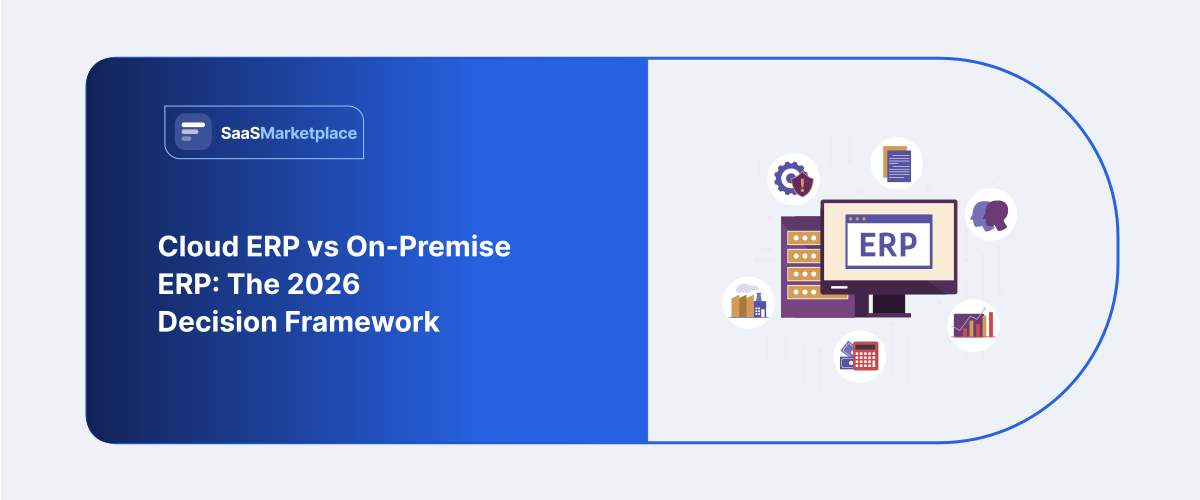
Cloud ERP vs. On-Premise ERP: The 2026 Decision Framework
-min.jpg)
Most US corporations in 2026 pick out the cloud for its decreased total cost of ownership and quicker time to market. Roughly 70% of contemporary ERP deployments now run inside the cloud, and near 79% of recent implementations pass that way. That statistic settles the trend. It does not settle your decision.

Looking for ERP software? Check out the SaaS Marketplace List of the Best ERP Software in USA for your business.
Plenty of companies have picked cloud because everyone else did, then spent two years fighting customization limits they never checked for. Others held onto servers out of habit and paid for a full-time administrator they did not need. This framework walks through cloud erp vs on premise the way it should be evaluated. By your constraints, not by the market's average.
Cloud ERP vs. on-premise ERP, compared quickly for 2026:
- Cloud ERP: Lower upfront cost, faster implementation, automatic updates, accessible anywhere, vendor-managed infrastructure
- On-premise ERP: Higher control, deeper customization, no internet dependency, better fit for tightly regulated industries
What Is Cloud ERP Software?
How Cloud ERP Works
Cloud ERP runs on the vendor's infrastructure. You reach it through a browser, they handle the servers, and updates arrive on their schedule rather than yours.
The practical effect is that your IT team stops thinking about hardware. No capacity planning, no patch cycles, no calls at midnight when a disk fails during month-end.
You are renting capability rather than buying equipment. That single shift is what drives most of the differences below.
SaaS ERP vs Hosted Cloud ERP
These two get treated as the same thing, and they are not.
True SaaS ERP software is multi-tenant. Everyone runs the equal version of the code, upgrades appear routinely, and customization remains internal guardrails the seller defines.
A hosted cloud is your own instance jogging on someone else's servers. It behaves more like on-premise erp software with a different electricity bill, which means more customization freedom and more upgrade responsibility.
When a vendor says cloud, ask which one they mean. The answer changes your upgrade path for the next decade, and it is one of the most overlooked erp deployment options in the whole evaluation.
What Is On Premise ERP Software?
How On Premise ERP Works
You buy a perpetual license, install the erp system on servers you own, and take responsibility for everything that follows.
Backups, security patching, disaster recovery, and version upgrades all sit down with your team. In change, the records never leave your construction, and the code may be changed as deeply as your builders are inclined to move.
Who Still Uses On Premise ERP?
Defense contractors with data residency clauses. Pharmaceutical manufacturers with validated systems that cost six figures to revalidate. Companies with twenty years of custom logic that no cloud tenant would tolerate.
There is also a quieter group. Businesses in rural areas where connectivity is genuinely unreliable, where an internet outage means production stops.
On premise growth has slowed to roughly 2% annually against cloud's 14.5%, but slow growth is not extinction. The remaining use cases are real ones.
Cloud ERP vs On Premise: Key Differences
Upfront Cost Comparison
Cloud starts small. Subscription fees, minimal hardware, and implementation costs that scale with complexity rather than infrastructure.
On-premise ERP cost begins with a perpetual license somewhere between $50,000 and $500,000, plus servers, database licenses, and networking. Capital approval alone can add months before anyone logs in.
For a company without existing data center capacity, that gap is decisive.
Ongoing Cost Comparison
The picture inverts after year one.
Cloud subscriptions in no way prevent it, and maximum contracts include annual uplifts of 3% to 7%. On premise ERP fees drop to upkeep at 15% to 22% of license value in keeping with the year, plus infrastructure and staff.
Research on 100-person mid-marketplace deployments suggests 5-12 months total land in more or less the equal neighborhood for each fashion. Cloud wins on predictability. On premise can win on raw arithmetic if you already employ the people to run it.
Implementation Timeline
Cloud deployments typically go live in one to three months for standard configurations. There is no hardware to procure and no environment to build.
On premise runs six to eighteen months. Procurement, installation, configuration, and testing all happen sequentially rather than in parallel.
Time matters more than most buyers weigh it. A system delivering value nine months earlier is worth real money.
Data Security and Control
This is where instinct misleads people. Servers in your building feel safer than servers in someone else's.
The data says otherwise for most mid-market companies. Major cloud erp software vendors employ security teams larger than the entire IT department at a 200-person business, and they patch continuously rather than quarterly.
Control is a different question from security, though. If a regulation requires you to prove where data physically sits, cloud erp vs on premise stops being a preference and becomes a compliance answer.
Scalability and Flexibility
Adding fifty users to a cloud tenant takes a phone call and a contract amendment.
Adding fifty users to an on premise erp system may mean new server capacity, more database licenses, and a capacity planning exercise. Growth that arrives faster than planned is exactly when you least want that project.
Seasonal businesses feel this most sharply. Cloud lets you scale up for peak and back down after.
Customization Capability
On premise wins here, clearly.
Direct database access and source-level modification allow workflows that no multi-tenant platform will permit. Manufacturers with unusual production logic often need exactly that.
The cost is upgrades. Every customization has to be retested and often rewritten each time you move versions, which is why some on premise systems sit five releases behind.
Internet Dependency and Uptime
Cloud requires connectivity. No connection means no ERP, though modern platforms publish uptime around 99.9% and most outages come from the customer's own network rather than the vendor's.
On premise keeps running through an ISP failure. For a warehouse or production floor where downtime halts physical work, that resilience is worth paying for.
Compliance and Regulatory Requirements
Most US regulatory frameworks now accept cloud deployment when the vendor holds appropriate certifications. HIPAA, SOC 2, and FedRAMP coverage is standard among major vendors in 2026.
Contracts are where problems appear. Some government and defense agreements still specify infrastructure your company must directly control, and no certification substitutes for that clause.
Cloud ERP vs On Premise Comparison Table
|
Factor |
Cloud ERP |
On Premise ERP |
|
Upfront Cost |
Low |
High |
|
Monthly Cost |
Subscription |
Maintenance only |
|
Implementation Time |
1 to 3 months |
6 to 18 months |
|
Data Control |
Vendor-managed |
Full control |
|
Customization |
Limited |
Deep |
|
Scalability |
Easy |
Complex |
|
Internet Required |
Yes |
No |
|
Auto Updates |
Yes |
Manual |
|
Best For |
SMB and mid-market |
Enterprise and regulated |
The 2026 Decision Framework
How to select between cloud and on premise ERP in 2026:
Step 1: Assess your present IT infrastructure and group Step 2: Calculate 5-12 months total value of possession Step 3: Evaluate information protection and compliance requirements Step four: Consider how speedy your enterprise desires to scale Step 5: Match deployment in your enterprise requirements
Step 1: Assess Your IT Infrastructure
Count the people, no longer the servers.
Do you rent a person who can patch a database at 2am on a Saturday? Is there a 2nd individual who can do it when the first one is on holiday? Is there a second person who can do it whilst the first one is on excursion? If the honest answer is no, on premise erp software will cost more than the quote suggests.
Step 2: Calculate 5-Year Total Cost of Ownership
Build the model over five years, not one. Include hardware refresh, IT salaries, electricity, backup infrastructure, and the internal hours your team will spend on maintenance.
Cloud looks expensive in a one-year view and reasonable in a five-year view. On premise does the opposite. Any comparison of cloud erp vs on premise that stops at year one is not a comparison.
Step 3: Evaluate Your Security Requirements
Separate what you have to follow from what makes you uncomfortable.
Write down the precise rules, settlement clauses, and audit necessities that apply to your enterprise. If none of them mandate physical infrastructure control, the cloud is on the table regardless of instinct.
Step 4: Consider Your Scalability Needs
Project headcount and transaction volume three years out, then double it and ask what breaks.
Companies expecting acquisitions, new locations, or seasonal spikes get more from cloud. Companies with flat, predictable operations lose less by staying put.
Step 5: Choose Based on Industry and Compliance
Industry norms exist for reasons worth understanding before you break them.
Talk to peers running similar operations at similar scale. Their answer on cloud erp vs on premise will tell you more than any vendor comparison chart.
Which US Industries Prefer Cloud ERP?
Professional services, software companies, retail and e-commerce tools, distribution, and most non-regulated manufacturing.
These businesses share a profile. Distributed teams, seasonal variation, restricted internal IT, and a need to move speedily. The first-rate cloud ERP software program for these sectors has a tendency to be NetSuite, Microsoft Dynamics 365 Business Central, Acumatica, or Sage Intacct, relying on whether or not inventory topics are covered.
Cloud ERP benefits are most visible here because the constraints that favor on premise simply do not apply. If you are shortlisting the best cloud erp software for a services or distribution business, start with those four and narrow by whether inventory and multi-entity accounting are part of the picture.
Most of these platforms are true saas erp software, meaning every customer runs the same version and upgrades arrive without a project attached.
Which US Industries Still Use On Premise ERP?
Defense and aerospace suppliers. Pharmaceutical and medical device manufacturers operating validated environments. Utilities and critical infrastructure. Large discrete manufacturers with decades of embedded customization.
Several of these are moving to private or hybrid cloud rather than staying fully on premise. The direction is clear even where the pace is slow.
Choose Cloud ERP If
Your IT team is small or fully occupied. You need to live within a quarter. Your growth is unpredictable, and your users are spread across locations.
You also have no regulatory clause that mandates physical control of infrastructure, and you would rather spend capital on the business than on servers.
That combination describes most US mid-market companies in 2026, which is why the cloud ERP benefits argument keeps winning.
Choose On Premise ERP If
Contracts or regulations require you to control the hardware. Your operations depend on customization no multi-tenant platform will allow.
You already run a capable infrastructure team, connectivity at your sites is genuinely unreliable, and you can absorb a large capital outlay without straining cash flow.
Conclusion
For most US companies evaluating cloud ERP vs. on-premise in 2026, cloud is the correct default. Lower entry cost, faster deployment, and vendor-managed security remove problems that mid-market businesses are poorly equipped to solve themselves. The premise remains right where control is a requirement rather than a preference. The mistake to avoid is treating this as a technology decision. Cloud erp vs on premise is an operating model decision, and it should be answered by your constraints, your team, and your compliance obligations. Everything else is preference dressed up as analysis.
FAQ's
Cloud costs less upfront, but a 5-year total cost of ownership often lands in the same range once staffing and infrastructure are factored in.
Cloud ERP typically goes live in 1 to 3 months, while on-premise implementations usually take 6 to 18 months.
Defense contractors, pharmaceutical manufacturers, utilities, and large manufacturers with heavy customization needs are the main holdouts.
Not typically, since major cloud vendors run larger security teams and patch more often than most mid-market IT departments can manage in-house.
On-premise allows deeper, source-level customization, while cloud ERP limits changes to vendor-defined guardrails.