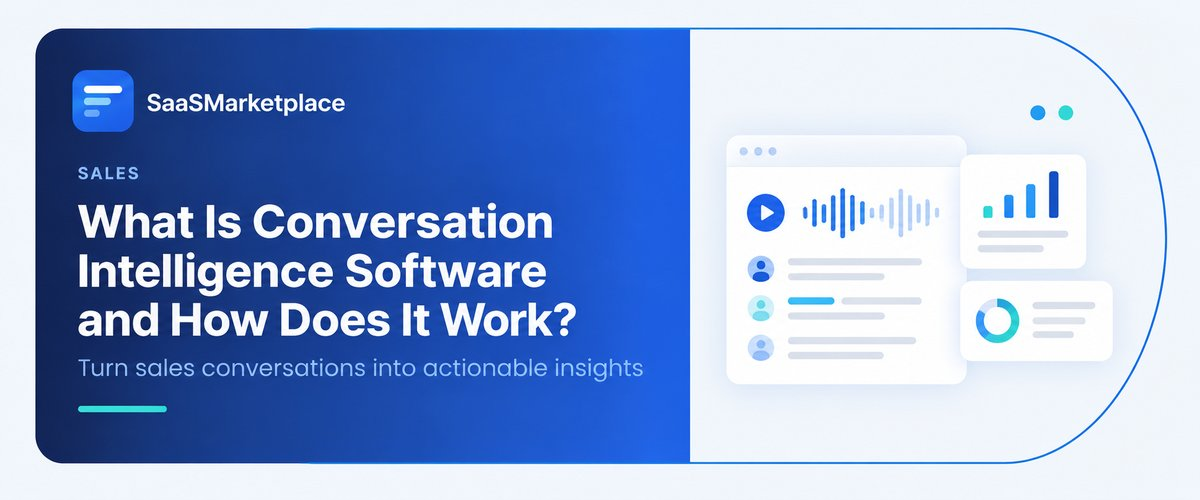
What Is Conversation Intelligence Software and How Does It Work?
-min.jpg)
Most sales managers still learn what happened on a call by asking the rep who was on it. That's a problem, because reps remember the parts that make them look good and forget the parts that explain why the deal stalled. Conversation intelligence software aims to fill up this void. Such programs record and transcribe sales team conversations and analyze their outcomes, picking up on subtleties that could be missed by a human listening along. Rather than having to guess what contextual clues may have influenced one representative's success over another, managers can simply let the technology sort through hundreds or thousands of calls. This article will discuss the technology, how it works, and where it fits into the existing ecosystem of sales CRM and marketing analytics tools usually seen in a revenue operations group.
 Looking for Conversation Intelligence Software? Check out SaaS Marketplace’s List of the Best Conversation Intelligence Software in the USA for your business.
Key takeaways:
- Conversation intelligence software analyzes calls, meetings, and chats to identify risks and opportunities automatically.
- It does this by first converting speech to text and then using natural language processing to extract meaning, and then applying pattern-recognition algorithms to detect insights.
- It's not a replacement for your CRM software it feeds insight into systems you already use, from sales CRM software to help desk software.
- The biggest adoption mistake is treating it as a surveillance tool instead of a coaching one.
What Conversation Intelligence Software Actually Does
At its core, conversation intelligence software listens. It listens to whatever audio or text you give itsales calls, customer support tickets, video conferences, sometimes even chat transcriptsand distills this into a usable, searchable form. Once a call has been converted into text, the software can analyze the conversation for specific insights: How much did each participant talk? Did the customer mention any competitors besides your own? Were prices discussed? How long was the customer silent after asking a difficult question?
None of these seem like particularly remarkable abilities. A person could do the same, maybe faster, maybe slower. The problem was that no one had time to listen to every customer conversation, so much valuable information was lost in a call that ended in seconds. People managed to keep track of some conversation highlights in a CRM software record if they remembered. All the nuance, the emotions, the exact wording of the customer’s concerns, was quickly abandoned
It is the ability to analyze hundreds or thousands of customer conversations at once that makes conversation intelligence software valuable. By listening to every conversation a sales team has, the program can highlight the most worrying, engaging, or risky calls depending on the user’s needs. Ten customer conversations to review instead of a hundred or more. This is an entirely different paradigm than trying to catch one conversation out of dozens that can serve as a sign of what to look out for in the others.
How the Technology Works, Step by Step
There is an assumption that conversation intelligence is “just AI listening to calls” and this is correct, but there are multiple steps between the raw audio and the insight that gets delivered to the user, so it’s worth breaking down the process into its component parts to discuss the advantages and weaknesses of the current technology.
Speech-to-Text and Transcription
The first step in any conversation intelligence tool is to convert speech to text, and modern tools are surprisingly good at executing this, even with accents, cross-talk, and other obstacles that might make the transcription less accurate but less accurate is not the same as wrong, and accuracy rates vary widely between vendors and between conversation types, based on the quality of the source audio. A conversation carried over a dodgy VoIP link will have a different quality of transcription when compared to a conversation recorded explicitly for the purpose.
Natural Language Processing and Speaker Separation
Once text exists, the system has to figure out who said what. Speaker diarization separating the rep's voice from the customer's matters more than people expect, because talk-time ratio is one of the most reliable predictors of deal outcomes. Reps who talk more than they listen tend to close less. NLP then scans the transcript for keywords, questions, objections, and sentiment shifts.
Pattern Recognition Across Calls
This is where the software earns its keep. A single transcript is just a document. The value shows up when the platform compares thousands of transcripts and identifies what winning calls have in common that losing calls don't maybe reps who ask about implementation timeline early close more often, or maybe deals that mention a specific competitor by name lose at twice the normal rate. These patterns get surfaced as dashboards, alerts, or coaching recommendations.
Integration With Existing Systems
None of this happens in a vacuum. The insights need somewhere to live, which is usually a CRM software platform the sales team already uses daily. Deal risk scores get pushed into opportunity records. Coaching flags land in a manager's queue. Call summaries auto-populate fields that reps used to fill in manually, often incompletely, after the call ended.
Conversation Intelligence vs. CRM Software
|
Feature / Aspect |
CRM Software |
Conversation Intelligence (CI) |
|
Primary Role |
System of Record: Tracks deals, contacts, pipeline stages, and activity history. |
Layer of Insight: Explains the "why" behind deal statuses and rep performance. |
|
What It Shows |
The Outcome: Tells you a deal is stuck in "Negotiation" for 3 weeks. |
The Context: Reveals why it is stuck by analyzing actual call transcripts, buyer objections, and rep responses. |
|
Core Capabilities |
Contact management, deal tracking, sales pipeline stages, task automation, basic reporting. |
Call/meeting transcription, sentiment analysis, topic/keyword spotting, coaching scorecards, deal risk signals. |
|
Primary Value |
Organizes operational workflow and keeps a structured log of customer data. |
Uncovers actionable conversation insights to improve sales coaching, win rates, and forecasting. |
|
Best Approach by Team Size |
SMBs / Small Teams: Prefer a lightweight CRM with a bolt-on CI integration for lower cost and maximum flexibility. |
Enterprise / Large Teams: Often prefer unified AI CRM software (all-in-one suite) to minimize logins and maintain clean reporting. |
Where It Overlaps With Marketing and Analytics Tools
Conversation intelligence doesn't stop at sales. Support teams use it to catch recurring complaints before they show up in churn numbers, and marketing teams mine call transcripts for the exact language customers use to describe their problems language that often works better in ad copy than anything a brainstorm produces.
This is where conversation intelligence begins to overlap with marketing automation software, as it provides call transcripts that can be used to retarget leads that came in via phone, which is a key application of marketing automation tools. It also overlaps significantly with marketing analytics software, as the qualitative information from conversations can give valuable context to quantitative information such as click-through rates and conversion rates.
A Common Mistake: Treating It as Surveillance
Here's something that shows up repeatedly once conversation intelligence tools go live: reps get nervous. If a platform is rolled out with no explanation beyond "we're recording everything now," teams read it as a monitoring tool built to catch them doing something wrong, and adoption suffers immediately. Reps start avoiding candid conversations with prospects, which defeats the entire purpose.
The teams that get real value from this technology usually introduce it as a coaching resource first. Managers pull clips from top performers and share them as examples rather than only flagging mistakes. Over the first few months, the tone shifts once reps see the software catching things that actually help them a missed buying signal they can follow up on, a question they forgot to ask that keeps coming up in lost deals.
The same caution applies on the support side. Teams running help desk software often plug conversation intelligence into ticket transcripts to catch agents who are technically resolving tickets but leaving customers frustrated in the process a distinction that resolution-time metrics alone will never surface. Framed as agent development, this lands well. Framed as a scorecard for firing people, it doesn't.
When It Might Not Be Worth It Yet
Not every team needs this right now, and it's worth saying so plainly. A sales org with two or three reps and a handful of calls a week doesn't have enough volume for pattern recognition to add much beyond what a manager could pick up by listening in occasionally. The cost of most platforms often priced per seat per month doesn't pencil out for that scale. Teams also run into trouble when they buy the tool before fixing basic call hygiene: if reps aren't consistently recording calls or logging them against the right deal in the CRM, the data going into the system is too inconsistent for the insights coming out to mean much.
Conclusion
The clearest signal that it's time to look at conversation intelligence software is when a sales or support leader realizes they're making coaching and forecasting decisions based on incomplete information a rep's self-report, a spot-checked call, a gut feeling about why a deal stalled. Once conversation volume is high enough that no one can realistically review it all manually, the math starts favoring automation. From there, the decision usually comes down to how tightly the tool needs to integrate with the CRM software and other systems already in place, and whether the team is ready to introduce it as a coaching aid rather than a monitoring system.
FAQ's
Most major platforms integrate with popular CRM software options, though the depth of integration varies some only push summary notes, while others sync deal scores and risk flags directly into records.
No. Support, customer success, and even marketing teams use it, often by mining the same call data for different purposes.
Accuracy has improved significantly, but it still depends on audio quality, accents, and background noise. Reviewing flagged transcripts occasionally is still worth doing.
It's a supplement, not a replacement. The software surfaces what to look at; a manager still has to interpret it and have the actual coaching conversation.
Many platforms now analyze chat and email threads alongside calls, particularly when integrated with help desk software or messaging tools.