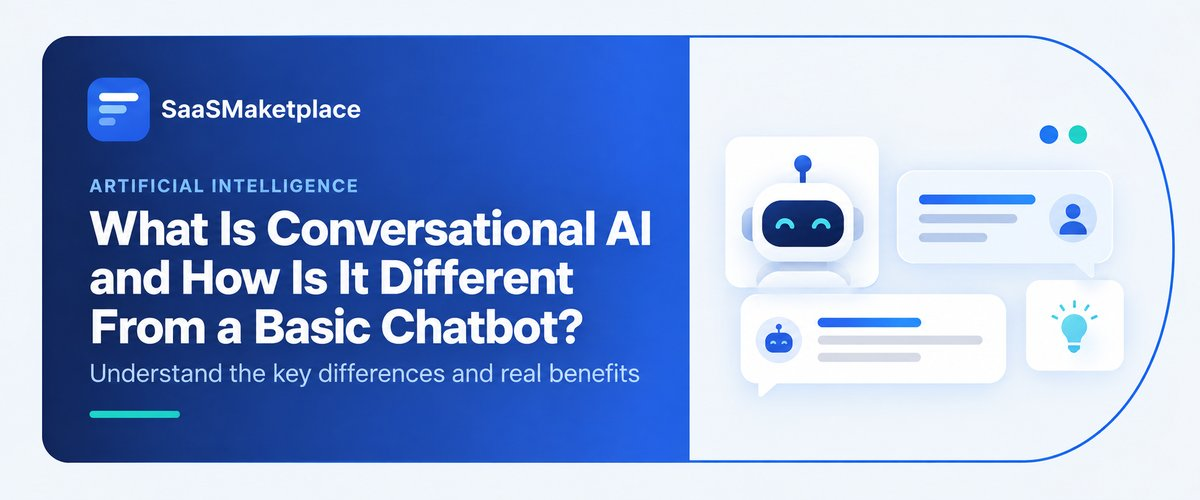
What Is Conversational AI and How Is It Different From a Basic Chatbot?
-min.jpg)
A law firm's intake bot can confirm an appointment time. A conversational AI system can understand that "actually, can we push it to next Tuesday since I'll be out of town" refers to the same appointment, adjust it, and confirm the change without the client repeating themselves or restarting the conversation. That distinction, small as it sounds, is the entire gap between a basic chatbot and conversational AI, and it's a gap that's easy to miss when both technologies get marketed under the same "AI chatbot" label.
Vendors use "chatbot," "conversational AI," and "virtual assistant" almost interchangeably in their marketing copy, even though the underlying technology and what it can realistically do inside a CRM software, help desk software, or accounting software stack is often very different. This guide breaks down the actual technical and functional differences, where each approach fits, and what to weigh before choosing one over the other.
What Is a Basic Chatbot?
A basic chatbot is a program that responds to user input using pre-set rules, decision trees, or keyword matching. It follows a fixed script: if the input contains certain words or matches a menu option, it returns a corresponding pre-written response. Ask it something outside its scripted paths, phrase a question slightly differently than it expects, and it typically loops back to "I didn't understand that" or routes to a human.
Rule-based chatbots are predictable, easy to audit, and cheap to build and maintain, which is exactly why they're still common for narrow, high-compliance tasks: confirming a password reset, walking someone through a return policy, or collecting a name and email before a callback.
What Is Conversational AI?
Conversational AI is the broader technology layer combining natural language processing (NLP), natural language understanding (NLU), machine learning, and dialogue management that allows a system to interpret human language, maintain context across a conversation, and generate responses dynamically rather than pulling from a fixed script. It's not a single product; it's the underlying capability that can power a chat widget, a phone system, or a voice assistant.
Where a rule-based chatbot matches keywords, conversational AI interprets intent regardless of exact phrasing. "I need to change my appointment," "can we move Tuesday's meeting," and "is it possible to reschedule" all map to the same underlying action for a conversational AI system, even though none of them share an obvious keyword.The system tracks what's already been said, applies that context to the next message, and can hand off to a human with the full conversation intact rather than starting from zero.
Grand View Research put the global conversational AI market at roughly $17.7 billion in 2026, with projections reaching close to $79 billion by 2033 at a compound annual growth rate near 24% a pace the research firm attributes largely to AI-powered customer support adoption, falling development costs, and demand for the same assistant to work consistently across a website widget, a mobile app, and a phone line at once.
The Core Differences
|
Factor |
Basic Chatbot |
Conversational AI |
|
How it interprets input |
Keyword matching, decision trees |
NLP/NLU to determine intent regardless of phrasing |
|
Context handling |
Little to none each message often treated in isolation |
Maintains context across the full conversation |
|
Handling unexpected input |
Stalls or defaults to a fallback message |
Interprets varied phrasing and adapts the response |
|
Improvement over time |
Manual someone edits the scripts |
Improves as it processes more real conversations |
|
Best for |
Narrow, repetitive, compliance-sensitive tasks |
Complex, multi-turn, personalized interactions |
|
Typical cost structure |
Lower upfront cost, flat licensing |
Higher setup cost, often usage- or resolution-based pricing |
|
Integration depth needed |
Minimal |
Usually needs deeper integration with CRM, help desk, or accounting systems to be genuinely useful |
Why This Distinction Matters for Software Buyers
The same gap shows up across other software categories:
- CRM software / online CRM software: A basic chatbot can capture a lead's name and email. Conversational AI can qualify that lead through a multi-turn conversation asking about budget, timeline, and use case and write structured data directly into the CRM record, rather than a single unstructured note.
- Accounting software / online accounting software: A chatbot can point a customer to an invoice PDF. Conversational AI can interpret "why does this month's invoice look different from last month's" and pull the actual line-item comparison, because it can hold that context across follow-up questions rather than treating each message as a fresh, unrelated query.
- Project management software: A chatbot might report a task's status if asked in the exact expected phrasing. Conversational AI can interpret "what's blocking the Q3 rollout" as a request spanning multiple related tasks and dependencies, not a single literal keyword match.
- Trust accounting software: In legal and real estate contexts, where recordkeeping precision is a compliance requirement, a rule-based chatbot's rigidity is often a feature it won't improvise around a regulated process. Conversational AI adds value mainly in client-facing intake and status inquiries, not in the ledger logic itself, which is exactly why firms in this space often keep the compliance-critical trust accounting workflows rule-based while layering conversational AI onto client communication.
- Business intelligence software: A chatbot can return a saved report. Conversational AI can interpret "how did the West region do compared to last quarter" as a natural-language query against the underlying data model, generating the comparison rather than requiring someone to build the report manually first.
What Businesses Commonly Get Wrong
- Assuming "AI chatbot" always means conversational AI: Vendor marketing uses the terms loosely, and a genuinely rule-based product can be sold under an "AI-powered" label if it uses any machine learning anywhere in its pipeline, even for something as narrow as spam filtering. It's worth asking directly during evaluation: does the system interpret free-form phrasing, or does it rely on matching against a defined set of intents and keywords?
- Deploying conversational AI where a chatbot would do the job: Conversational AI generally costs more to implement and maintain often priced per conversation or resolution rather than a flat fee and that investment is wasted on tasks that are genuinely narrow and repetitive. A password reset flow rarely needs the flexibility of full NLP; a rule-based chatbot handles it just as well for a fraction of the cost.
- Underestimating the integration work: Conversational AI's advantage of holding context and personalizing responses depends entirely on what data it can actually access. A conversational AI system with no connection to CRM software or accounting software can still hold a fluent conversation, but it can't reference a specific customer's account history, which is usually where the real value was supposed to come from.
- Expecting either technology to take action: This is the gap most buying guides skip. Both basic chatbots and conversational AI are, by default, read-only they can retrieve information and draft a response, but they generally can't independently update a CRM record, close a help desk ticket, or process a refund unless it's been specifically built and permissioned to do so. That distinction between systems that can converse and systems that can also act is increasingly the dividing line vendors are building toward next.
Small Business vs. Enterprise Considerations
Smaller teams often get more practical value from a well-configured basic chatbot than from a full conversational AI deployment, simply because a smaller volume of narrow, predictable requests doesn't justify the added setup and maintenance cost. Enterprises handling higher volumes, more varied customer questions, and deeper software integrations across CRM, accounting, and business intelligence systems tend to see the return that justifies conversational AI's higher implementation cost particularly when the same system needs to work consistently across chat, voice, and multiple product lines at once.
When a Basic Chatbot Is Still the Right Choice
Conversational AI isn't automatically the better option. If the use case is narrow, the phrasing is predictable, and the process is compliance-sensitive routine status checks, appointment confirmations, standardized intake forms a rule-based chatbot is often more reliable precisely because it won't improvise. Introducing conversational AI's flexibility into a process that depends on rigid, auditable steps can create risk rather than remove it.
Conclusion
The decision between a basic chatbot and conversational AI comes down to complexity, compliance, and ROI. A basic chatbot remains the most cost-effective, defensible choice for predictable, narrow, and high-compliance workflowssuch as standard intake, basic scheduling, and password resetswhere precision and auditability take priority over flexibility. Conversely, conversational AI is designed for complex, context-dependent, and multi-turn interactions across your CRM, help desk, and accounting stacks. While it carries higher implementation costs and requires deeper data integrations to deliver real value, it unlocks significantly higher efficiency for high-volume enterprises and dynamic customer service environments.
FAQ's
No. A chatbot is the interface that a user types or talks into. Conversational AI is the underlying technology (NLP, NLU, machine learning, dialogue management) that can power that interface.
In many cases, yes, particularly with platforms designed to layer an NLP engine on top of existing rule-based flows. The main cost is usually integration and retraining, not the interface itself.
No it typically sits on top of those systems rather than replacing them. Its usefulness for personalized responses depends on being connected to the CRM software, help desk software, or accounting software where the actual customer data lives.
Not really. Voice AI is conversational AI with speech recognition added at the input and speech synthesis at the output. The underlying understanding and dialogue management layer is the same one used in text-based chat.
Cost and predictability. Rule-based chatbots are cheaper to run and easier to audit, which matters for compliance-heavy or high-volume, low-complexity workflows where flexibility isn't actually needed.
The next step many vendors are building toward is agentic AI systems that don't just interpret and respond, but can take action directly inside connected software (updating a CRM record, closing a ticket, processing a refund) rather than only drafting a response for a human to execute.