What Is Distribution ERP Software and How Is It Different From Standard ERP?
-min.jpg)
Running a distribution business is rarely simple. You’re handling products that move across locations, teams that coordinate orders, and suppliers that must deliver on time. Then you add customer expectations, faster shipping, accurate fulfillment, fewer mistakes, and suddenly operations become complex. This is where Distribution ERP Software becomes important.
 Looking for Distribution ERP Software? Check out SaaSmarketplace’s List of the Best Distribution ERP Software in USA for Your Business.
The distribution-focused ERP software integrates the essential operational processes of a wholesale provider into a unified digital environment. The platform replaces separate applications for stock monitoring, transaction handling, and financial reporting so that employees can manage activities from the beginning to the end of a cycle. The objective of this technology is to maintain the consistency of stock levels, customer requests, procurement, and accounting data.
What Is Distribution ERP Software?
To understand Distribution ERP Software, it helps to step back and look at standard Enterprise Resource Planning systems. Traditional ERP software was built to manage general business activities like financial accounting, basic purchasing, and human resources. While helpful, standard platforms often lack the specific features required by high-volume wholesale operations.
Distribution ERP Software is a system specifically designed to help companies involved in distributing physical products. Unlike simple accounting systems, distribution ERP software helps manage orders, track inventory, organize suppliers, and optimize transportation effectively.
By deploying dedicated Distribution ERP Software, distributors replace fragmented point tools with a single source of truth. Every transaction, from a purchase order issued to an overseas supplier to a package scanned out the warehouse door, updates automatically across the system.
Do You Know?
According to industry research, businesses that replace manual stock management with an integrated Distribution ERP Software platform reduce picking and packing errors by up to 60% within the first six months of implementation.
Core Capabilities of a Modern Distribution ERP
A complete Distribution ERP Software solution bridges several core operational areas. Here is a breakdown of the primary functions built into these platforms:
1. Real-Time Inventory Management
Stockouts cause loss of revenue, and overstocking depletes working capital. Sophisticated inventory management capabilities enable businesses to maintain optimal stock levels based on extensive warehouse analytics. It becomes possible to get an accurate picture of stock status in different warehouses and bins at any given moment, consider available-to-promise inventory, track items shipped from the facility, and set reorder points for safety stock.
2. Streamlined Warehouse Management
Modern warehouse management offer a large variety of solutions to ensure that order picking, packing, and staging take place appropriately and as quickly as possible. They can help to plan the most optimal route to pick the goods, suggest the most beneficial packing method, and choose the best location for staging. By supporting barcode scanning and mobile devices, Distribution ERP Software reduces human picking errors, Speeds up order turnaround, and simplifies cycle counts.
3. Integrated Logistics Software and Tracking
It is essential to ensure that all delivery details are properly organized to avoid any disruptions and keep customers satisfied. Thus, drivers’ and carriers’ schedules need to be automatically updated when transportation documents are printed in the software. In addition, modern systems offer end-to-end delivery management solutions for controlling both private and public carrier operations, ensuring that everyone involved in the supply chain has up-to-date information about deliveries.
4. Comprehensive Supply Chain Management
The distribution process now involves more than just a warehouse and its immediate surroundings. By integrating supply chain features into distribution management software, it becomes possible to monitor purchasing activities, establish long-term relationships with vendors, and manage lead times based on the latest sales performance data.
5. Financial and Distribution Management
At its core, distribution management requires tight financial controls. ERP Distribution and Billing Modules ensure that the revenue side of the business is functioning correctly by processing all incoming invoices and tracking payments, as well as recording various expenses (freight, tariffs, insurance, etc.) to help understand the cost structure of each sold product.
How Distribution ERP Software Unifies Business Departments
A primary reason companies upgrade to Distribution ERP Software is to eliminate communication gaps between internal teams. Here is how connected Enterprise Resource Planning Software supports daily workflows across departments:
Sales and Customer Support
When a customer calls to place or inquire about an order, the executive does not have to contact the warehouse manager. Using Distribution ERP Software, they instantly view current stock levels, pending purchase orders, and precise tracking details while on the phone.
Operations and Purchasing
Procurement teams gain complete visibility into demand trends. Instead of guessing order quantities, they use automated forecasting tools within the ERP software to make data-driven purchasing decisions.
Logistics and Field Delivery
With distribution ERP software, logistics managers control and monitor carriers’ progress, track delivery costs, and optimize the transportation process. It eliminates manual distribution tasks by automating dispatching and reducing overall shipping costs.
Human Resources and Workforce Management
Consistent monitoring is needed to handle warehouse shifts, track driver hours, and supervise commission systems. By synchronizing payroll and administrative features with existing HR software, management can ensure that expenditures are controlled and only necessary expenses are processed.
Strategic Leadership and Project Management
When scaling down or expanding operations, for instance, when deciding to open a new warehouse or launch a new product line, executives can rely on a distribution ERP system’s analytics to monitor changes in income, order fulfillment, and operating costs.
Key Benefits of Upgrading to Distribution ERP Software
Companies that opt for the custom Distribution ERP Software implementation reap the following benefits:
- Reduced Operational Costs: Having automation reduces operational costs since the system eliminates manual processes that are prone to errors and increases administrative efficiency.
- Faster Order Fulfillment: It accelerates the order processing cycle as integrated systems such as warehouse management reduce the time taken to deliver goods to customers.
- Improved Inventory Accuracy: It enhances inventory management capabilities while avoiding losses associated with having excess stock on hand.
- End-to-End Visibility: Strong supply chain management tracking provides clear insight from supplier factories to final customer deliveries.
- Higher Customer Satisfaction: On-time shipments, accurate order fulfillment, and proactive communication build long-term client trust.
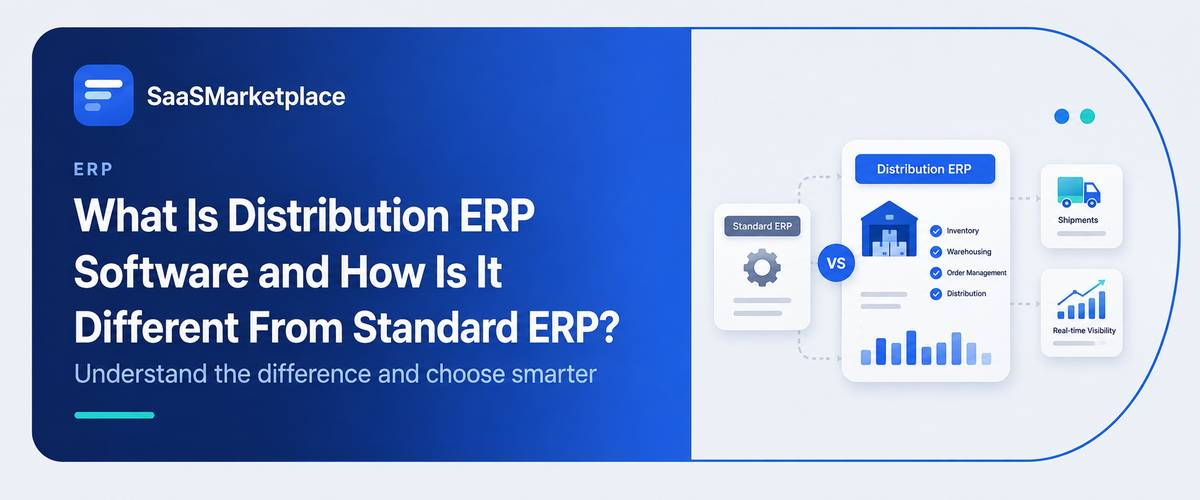
Distribution ERP vs. General ERP: What’s the Difference?
Some businesses use general ERP software that covers many industries. That can work, but distribution companies often need more specific workflow support. A distribution-focused Distribution ERP Software is usually built around:
|
Feature / Capability |
Standard ERP Software |
Distribution ERP Software |
|
Core Focus |
General business processes (finance, basic HR functions, and purchasing). |
End-to-end logistics and order management |
|
Inventory Tracking |
Basic stock counts and high-level inventory management |
Advanced warehouse inventory control and tracking |
|
Warehouse Operations |
Requires an additional third-party software for pick/pack/ship functions |
Can scan, batch pick, and stage directly into ERP |
|
Logistics & Freight |
Manual shipping and invoicing entries |
Native freight spend management, carrier comparisons, routing, and tracking |
|
Costing Analysis |
Basic cost accounting and invoice processing |
Landed cost accounting with duty, tariffs, and additional shipping costs breakdown. |
|
Target Business |
Professional services, software, and typical office equipment dealers |
Wholesalers, distributors, importers, exporters, and 3PL providers. |
The benefit is that your distribution team spends less time adapting the system to daily work and more time running operations effectively.
How Distribution ERP Software Improves Speed and Accuracy
Today’s demanding wholesale market requires organizations to become faster and more accurate with their operations. The use of fragmented spreadsheets, data entry, and independent software systems can introduce a higher risk of fulfillment errors, leading to stockouts, overstocking, and reduced profit margins. A reliable Distribution ERP Software can help companies reduce:
- Order errors caused by incorrect inventory
- Delays due to unclear stock availability
- Manual updates and spreadsheet reconciliation
- Rework when shipping and billing don’t match
- Reporting delays when data needs to be compiled
And it improves:
- Order cycle time
- Warehouse throughput
- Purchasing timing
- Customer response speed (when statuses are accurate)
- Decision quality (based on connected data)
What to Look For When Choosing Distribution ERP Software
Since you said “don’t write about tools,” this section stays vendor-neutral. Here’s a practical checklist for what to evaluate in any Distribution ERP software solution:
Must-have areas
- Strong inventory management with multi-location support
- Warehouse workflows connected to order fulfillment
- Support for supply chain management processes relevant to distribution
- Logistics workflows aligned with shipping and order status updates
- Clear reporting for operational and financial performance
Important for growth
- Ability to support new locations, new SKUs, and more complex order patterns
- Workflow controls for returns, adjustments, and exceptions
- Support for project management tracking when teams run operational improvements
Implementation reality check
- Ease of data setup (especially SKU and location data)
- Ability to map business processes (purchasing → receiving → picking → shipping)
- Training support for warehouse and operations teams

Pro-tip
Start your evaluation by mapping one full order journey end-to-end (purchase → receiving → inventory → picking → packing → shipping → returns). If your future ERP software can follow that journey cleanly, it’s far more likely to improve both supply chain management and daily accuracy.
Conclusion
A Distribution ERP Software investment can help you transform these distribution ERP challenges into opportunities to grow your business. This powerful system unifies inventory management, warehouse management, logistics software, and reporting tools to provide end-to-end supply chain insights. Modern-day ERP systems offer multiple benefits to companies that want to scale their operations while optimizing supply chains, automating order management processes, and streamlining day-to-day operations. Therefore, it is important to invest in the best distribution ERP software to transform your business operations and satisfy your clients’ needs today.
FAQ's
It is an ERP designed to connect distribution operations like purchasing, inventory, warehouse activities, and logistics.
It connects planning and supplier coordination with inventory and order execution so the supply chain stays visible.
Because accurate stock data drives faster order fulfillment and reduces costly mistakes.
Many systems include project-style tracking so teams can manage operational initiatives and rollouts.
It means shipping updates, delivery status, and order records stay aligned instead of being handled separately.