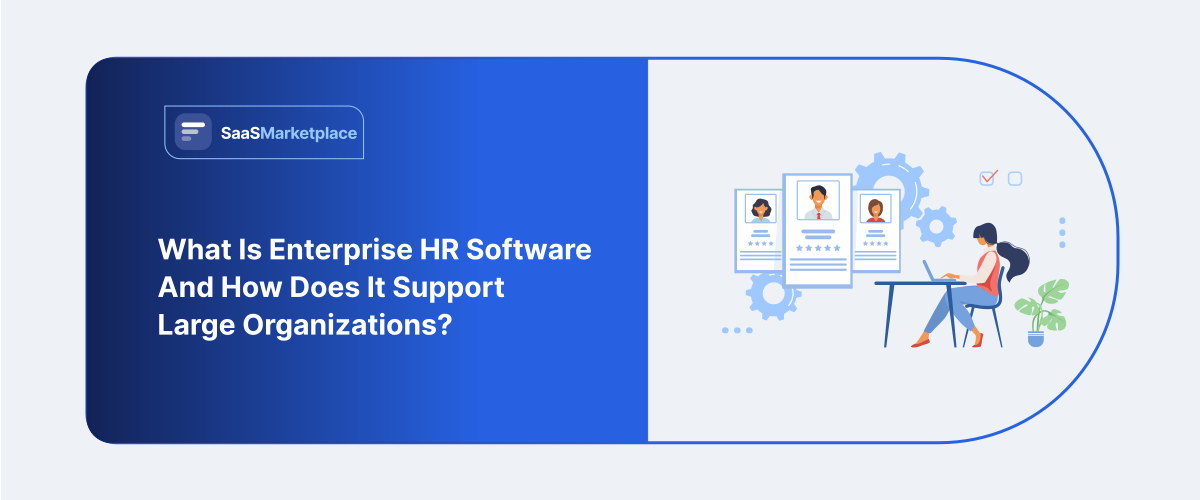
What Is Enterprise HR Software and How Does It Support Large Organizations?
-min.jpg)
Picture a company with twelve thousand employees spread across six states. What it's dealing with isn't the same kind of HR problem a fifty-person startup would face. It has a coordination problem. Payroll rules differ by jurisdiction. And benefits eligibility isn't the same for every employment type. A promotion in one division needs sign-off that looks nothing like the approval chain in another. At that scale, spreadsheets and disconnected tools don't just slow things down they create compliance risk that can turn into real financial exposure.
 Looking for Enterprise HR Software? Check out SaaS Marketplace’s List of the Best Enterprise HR Software in the USA for your business.
This category of platform exists to manage that complexity in one connected system rather than a patchwork of workarounds. It's a different category from the HR software a small business runs, built for organizations where thousands of people, multiple business units, and layered compliance requirements all need to function under one roof. This article looks at what separates enterprise-grade platforms from the rest, what large organizations actually use them for, and where companies commonly get the buying decision wrong.
Why Scale Changes Everything
A twenty-person company can run HR out of a shared spreadsheet and a handful of email templates, and it usually works fine; everyone mostly knows each other, and problems get caught before they spread. That approach falls apart somewhere between five hundred and a thousand employees, when informal knowledge stops being reliable and formal systems become the only thing holding processes together.
Many businesses assume growth is just "more of the same," but in practice, the jump from mid-size to large introduces categories of problems that didn't exist before: multi-country payroll compliance, union agreements that vary by location, executive compensation structures with their own approval workflows, and reporting requirements tied to public company disclosures. Software at this level is built specifically to hold all of that together without falling apart under its own weight.
What Enterprise HR Software Actually Does
At its core, it's a unified system managing the full employee lifecycle hiring, payroll, benefits, performance, compliance but built to handle volume, complexity, and variation that smaller platforms simply weren't designed for.
Managing Multi-Entity and Multi-Country Operations
Large organizations often operate as several legal entities, sometimes across different countries with completely different labor laws. Platforms built for this scale typically support it natively, letting HR teams manage a workforce in Germany and a workforce in Texas within the same platform, each following its own compliance rules automatically.
Supporting Complex Approval Workflows
A compensation change at a large company rarely gets approved by one manager. It moves through a chain direct manager, HR business partner, sometimes finance and the software needs to route it correctly every time without someone manually forwarding emails and hoping nothing falls through.
Handling Volume Without Breaking
Running payroll for fifteen thousand people, across different pay schedules, currencies, and tax jurisdictions, isn't just a bigger version of running it for fifty. It's a different technical problem altogether. Enterprise platforms are built with that scale in mind from day one, rather than being stretched to fit after the fact.
Integrating With the Broader Tech Stack
Large organizations run dozens of connected systems finance software, identity management, benefits administration, learning platforms. These systems are expected to integrate cleanly with all of it through APIs, rather than existing as an isolated island of data.
How It Differs From Other HR Platforms
It's worth being specific about how this differs from other categories, since the terms get used loosely.
Basic HR software often refers to a general tool covering core functions time tracking, basic records, simple reporting without the depth needed for complex organizations.An HRIS platform is mainly about storing and managing employee data as a system of record. Enterprise platforms do that too, but it's just one piece of a much bigger suite.
HRM software leans toward the people-management side: performance reviews, goal tracking, engagement, that kind of thing. HCM software casts a wider net, covering the whole employee lifecycle from recruitment to retirement. That broader scope is closer to what enterprise-grade platforms are built to handle.
Enterprise platforms usually fold HR analytics software right in, because at that size, organizations generate enough data that dashboards and workforce reporting stop being optional extras. Where a smaller company might add analytics as an afterthought, an enterprise deployment usually treats it as core functionality from day one.
The practical difference isn't really about features on a checklist most platforms claim to do most things. It's about depth, configurability, and whether the system holds up under real organizational complexity rather than breaking down once you go past a few hundred users.
Common Use Cases at Scale
Global payroll and compliance: Getting payroll right across multiple countries, each with its own tax codes, benefits mandates, and reporting rules, without a separate manual process for every single region.
Workforce planning across business units: When you're running dozens of departments, you need to see headcount, cost, and hiring trends across all of them at once, not one team at a time.
Succession planning: Enterprise platforms often include tools for tracking readiness and development paths for key roles, something that matters far more once an organization has hundreds of leadership positions to plan around.
Regulatory and audit reporting: Public companies and heavily regulated industries need to produce compliance documentation reliably, and platforms at this scale are generally built with audit trails and reporting built in rather than bolted on.
Employee self-service at scale: With thousands of employees, self-service portals aren't a nice-to-have they're the only realistic way to handle routine requests without HR drowning in tickets.
What Organizations Commonly Get Wrong
One issue that often appears during implementation is underestimating how long a proper rollout actually takes. Teams usually discover this after committing to an unrealistic timeline enterprise deployments involving data migration, integration testing, and change management across thousands of employees routinely take six months to a year, not the six weeks a sales deck might imply.
Another common mistake is buying enterprise-grade capability the organization doesn't actually need yet. A company with eight hundred employees operating in a single country doesn't necessarily need the full multi-currency, multi-entity feature set built for a Fortune 500 company. That unused complexity doesn't just sit there quietly, either it adds licensing cost and makes the system harder to configure for the simpler job actually in front of the team.
There's a reverse mistake too, and smaller companies make it just as often. They pick online HR software or small-business HR software that fits their current size fine but has nowhere to grow. Switching HR systems mid-growth is disruptive enough on its own; pick a platform with no headroom, and you're often back to square one, running the whole selection process again within a few years.
Evaluating Vendors Honestly
Sales demos are designed to impress, and vendors in this space have gotten very good at it. What looks like a polished dashboard in a demo doesn't always hold up once real, messy organizational data gets loaded in. Ask for references from companies your own size and industry, not just the logos on the vendor's homepage.
Configuration flexibility matters more than most buyers expect going in. If a platform can't bend to match existing approval chains, pay structures, or reporting hierarchies, the organization ends up changing its own processes to fit the software instead and that's often more disruptive than the problem the software was supposed to fix.
How the vendor handles support after implementation is worth checking too. Large deployments don't run themselves. New business units get added, regulations shift, integrations need upkeep, and a vendor that goes quiet after go-live is a real long-term risk.
Managing a Smooth Implementation
Even after picking the right platform, the rollout is its own project, and it's usually bigger than most internal teams expect going in.
Data migration is the first real test. Years of employee records, often scattered across legacy systems and regional spreadsheets, need to be cleaned and mapped before they can move into a new system. Skipping this step, or rushing it, tends to surface as broken reports and incorrect pay calculations months later, once it's much harder to trace back to the source.
Change management is another thing people underestimate. Getting thousands of employees and managers comfortable with a new system doesn't just happen because leadership signed a contract. Training, clear communication, and giving people a realistic amount of time to adjust all determine whether the rollout actually sticks, or whether people just find quiet workarounds.
Pilot with one business unit first. Teams usually discover that rolling out to a single division before going company-wide catches configuration issues while they're still small and fixable, rather than after they've affected every employee at once.
Keep the old system available briefly. Running parallel systems for a short transition window, even though it's extra work, tends to prevent the kind of data gaps that are painful to reconstruct after the old system is shut down for good.
After the first few months live, most organizations find that support tickets cluster around a small number of workflows, usually approval routing or benefits enrollment, and addressing those directly does more for adoption than any additional feature.
Key Cost Considerations
Pricing for platforms built for this scale is rarely a simple per-employee number. What you're actually paying for usually includes implementation fees, ongoing support tiers, and costs tied to whichever modules and integrations the company needs. Budget for the whole first year, not just the recurring subscription; implementation and data migration work can easily cost as much as the license itself in that first year. Smaller companies evaluating this category tend to underestimate the total cost of ownership. They focus on the sticker price and forget to account for the internal time IT, finance, and HR staff will spend on a rollout that can stretch across most of a year.
When a Smaller Platform Is Still the Right Call
Not every growing company needs to jump to this level of platform right away. A company operating in one country, with a fairly simple approval structure and no multi-entity complexity yet, might get several more years out of a well-configured HRM or HCM platform built for mid-size businesses, without taking on the cost and complexity of a full enterprise deployment.Really, the decision comes down to an honest look at where the organization is likely to be in three to five years, not just where it stands right now.
Conclusion
Enterprise HR software earns its complexity by solving problems that only exist at scale multi-entity operations, layered compliance, and workflows that would collapse under a simpler system. Paired thoughtfully with HR analytics software and the right HRIS software foundation, it gives large organizations one connected system instead of a patchwork of workarounds. The companies that get the most value are the ones that buy for where they're actually headed, not just for a feature list that looks impressive in a demo.
FAQ's
It's built for organizational scale and complexity multi-entity operations, layered compliance, and higher transaction volume that smaller platforms aren't designed to handle.
Generally once multi-country operations, complex approval chains, or regulatory reporting needs outgrow what a mid-size HRM or HCM platform can support.
Most platforms bundle HR analytics software directly, since large organizations generate enough workforce data that reporting becomes essential rather than optional.
Enterprise rollouts commonly take six months to a year, depending on data migration complexity and the number of integrations involved.
Rarely, once an organization passes a certain size or operates across multiple entities. It usually works only while the company remains structurally simple.