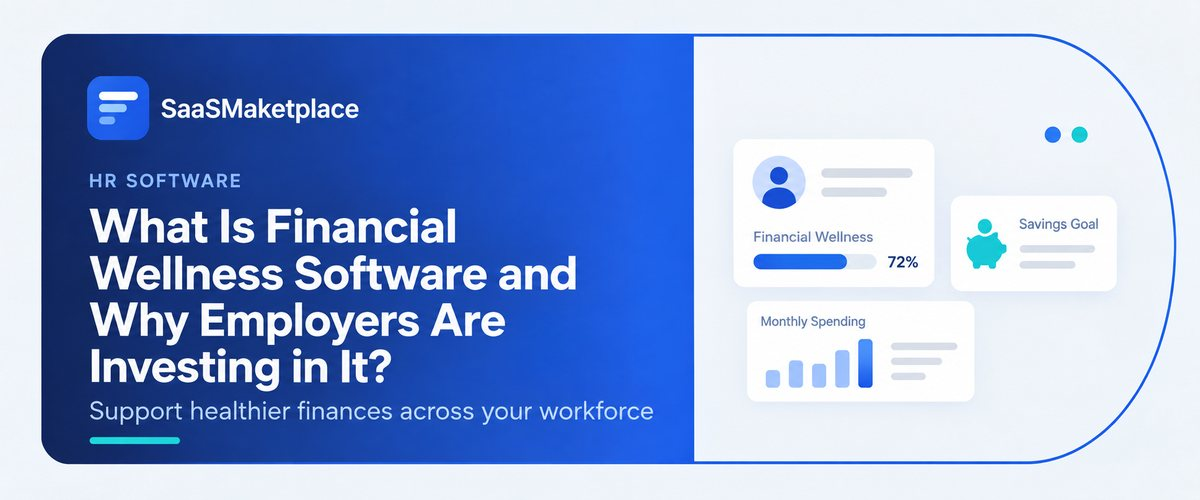
What Is Financial Wellness Software and Why Employers Are Investing in It?
-min.jpg)
A worker getting good pay might face a sudden car repair before needing cash loans, and that gap between money earned and being stable is why many firms now buy financial health tools for staff perks. Experts guess the market sits around maybe $2.3 billion up to $3.3 billion in 2026 based on scope used, with most study groups saying it could nearly double by the early 2030s. Big differences in numbers show less about true size and more about loose definitions of "financial wellness" found in reports; some list just software systems, others mix in advice, help, and training guides.
What's more consistent across the research is the reason employers are buying. Principal Financial Group survey data found that a large majority of both small and mid-sized employers and their employees agree financial wellness matters to overall well-being, and nearly 9 in 10 employees say it supports their decision to stay with an employer. For HR and benefits teams already managing HR software, payroll software, and a growing list of point solutions, financial wellness software is becoming less of an experimental perk and more of a retention tool with a measurable business case behind it.
What Is Financial Wellness Software?
Wellness finance tools are online systems aiding staff in handling private money matters such as spending plans, paying off loans, saving for emergencies, preparing for old age, and learning about funds, generally provided by work as perks next to medical coverage and pension schemes. In contrast to specific devices like 401(k) access points, these programs frequently merge many tasks onto one screen, sometimes adding guidance from people or growing computer help.
The category sits adjacent to, but distinct from, other software employers already run. It is not the same thing as financial CRM software, which is a tool financial advisors and wealth management firms use to track client relationships, portfolios, and communications a completely different audience and use case that happens to share overlapping terminology. Where financial CRM software helps an advisor manage clients, financial wellness software is aimed directly at employees managing their own money.
How Financial Wellness Software Actually Works
Financial assessment and onboarding
Most platforms start with some form of financial health assessment: income, debt load, savings rate, and financial goals, either through a guided questionnaire or, increasingly, a live connection to the employee's bank accounts via secure data aggregation services (the same underlying technology many budgeting apps use).
Budgeting and cash flow tools
Core functionality typically includes spending categorization, budget tracking, and cash flow visibility, letting an employee see, for instance, that recurring subscriptions are quietly eating a bigger share of take-home pay than they realized.
Debt management and payoff planning
Given how much employee financial stress research ties to debt specifically, most platforms include structured debt payoff planning tools, often comparing payoff strategies (highest-interest-first versus smallest-balance-first) and modeling how extra payments shorten a payoff timeline.
Emergency savings and goal-based saving
Many platforms now include automated emergency savings features, sometimes integrated directly with payroll software to let an employee direct a small, consistent amount from each paycheck into a separate savings account before it ever reaches checking.
Retirement and long-term planning integration
Because retirement contributions usually live inside a separate benefits system, better-integrated financial wellness software connects with existing payroll and benefits software to show retirement savings alongside day-to-day financial health, rather than as an entirely separate silo the employee has to check independently.
Coaching and financial education
Live coaching, on-demand video content, and increasingly AI-driven personalized financial insights round out most platforms. Mordor Intelligence's research on this market points to services and coaching as the fastest-growing component going forward, even though software delivery still accounts for the majority of current revenue, suggesting employers are learning that access to a dashboard alone doesn't reliably change financial behavior without some layer of guidance behind it.
Payroll and HRIS integration
The most functionally important, least visible part of the system is its connection back into existing payroll software and HRIS software. On-demand pay features, letting an employee access earned wages before the standard pay date, depend entirely on a live, accurate feed of hours worked and pay owed, which is why several major financial wellness vendors have spent the past year building deeper, bi-directional integrations directly into core HR software platforms rather than operating as a disconnected add-on.
Financial Wellness Software vs. Adjacent HR and Finance Categories
|
Category |
Primary Function |
Best For |
Limitation |
|
Financial Wellness Software |
Helps employees manage personal budgeting, debt, savings, and financial education |
Employers wanting to address employee financial stress as a retention and productivity lever |
Limited value without integration into existing payroll data |
|
Financial CRM Software |
Helps financial advisors manage client relationships and portfolios |
Wealth management and advisory firms |
Not employee-facing; serves an entirely different audience |
|
HRIS Software |
Centralizes core employee records |
Single source of truth for employment data |
Rarely includes personal financial management tools natively |
|
HCM Software |
Broader suite spanning HRIS, payroll, talent, and often benefits |
Enterprises wanting one system across the employee lifecycle |
Financial wellness is usually a bolt-on, not a core module |
|
Manages pay processing alongside benefits enrollment |
Companies wanting pay and benefits data in one connected system |
Financial wellness features, where present, are often basic compared to dedicated platforms |
|
|
Payroll Software |
Calculates wages, taxes, and deductions |
Accurate, compliant, on-time pay |
Needs a live integration for financial wellness tools like on-demand pay to work reliably |
Enterprise vs. Small Business Considerations
- Enterprise HR software: environments tend to adopt financial wellness software as part of a broader total-rewards strategy, often layering it on top of an existing HCM software suite and negotiating deeper integrations with payroll and benefits data across multiple business units or subsidiaries. Larger employers are also more likely to have the internal bandwidth to track program engagement metrics and adjust offerings based on which features employees actually use a step that survey data suggests many organizations still skip, given how often license adoption outpaces measurable behavior change. Because enterprise HR software stacks often already include multiple vendors, integration testing before rollout matters more here than at smaller companies.
- Small business HR software: buyers face a different calculation. Cost sensitivity and simpler implementation needs matter more here, and research on this market has specifically flagged implementation cost and low employee engagement as two of the more common reasons smaller employers hesitate to adopt financial wellness software at all. A 25-person company evaluating small business HR software additions needs a financial wellness tool that's simple enough to roll out without a dedicated benefits administrator managing it; otherwise, the perk risks becoming another underused line item in the benefits budget.
Why Employers Are Investing Now
A few converging factors explain the current momentum behind this category, beyond a general sense that employee wellbeing matters.
- Persistent employee financial stress: Survey research consistently finds a majority of employees report meaningful financial stress, and that stress has a documented relationship with workplace productivity and healthcare costs, which is part of why some employers frame financial wellness spending as adjacent to their broader wellness ROI case rather than a standalone perk.
- Retention pressure in a competitive labor market: With employee survey data showing a strong majority linking financial wellness support to their decision to stay with an employer, benefits and HR software leaders increasingly treat this category as a retention lever with a more direct line to business outcomes than some traditional perks.
- Payroll infrastructure finally catching up: On-demand pay and other real-time financial wellness features were technically difficult to deliver reliably until major payroll and HCM software platforms opened up the integration pathways that make live pay data accessible. The recent wave of financial wellness vendors partnering directly with major HR software platforms reflects that infrastructure only recently became available at scale.
- AI-driven personalization: Rather than generic budgeting tips, newer platforms use AI to tailor recommendations to an individual's actual spending and income patterns a shift multiple market reports identify as a major driver of renewed investment in the category, distinct from earlier generations of largely static, content-library-style tools.
What Businesses Commonly Get Wrong
- Buying licenses without measuring engagement: Multiple industry reports flag the same underlying problem: employers pay for financial wellness software seats without tracking whether employees actually use them or whether financial behavior improves. A platform with strong marketing claims but no usage-based reporting makes it nearly impossible to know if the investment is working.
- Treating it as a standalone perk rather than an integrated benefit: Financial wellness software that isn't connected to existing payroll software or HRIS software loses much of its practical value; generic advice is available for free elsewhere. The real differentiator is a live connection to actual paycheck and benefits data.
- Underestimating data security expectations: Because these platforms often connect to bank accounts and payroll data simultaneously, security and privacy diligence deserves real scrutiny during vendor evaluation. This is sensitive personal financial data, not generic HR records, and industry audits of the space have found meaningful variability in security practices across vendors.
- Assuming one platform fits every income and life stage: A financial wellness program built primarily around long-term investing content will underperform for a workforce dealing mainly with debt and paycheck-to-paycheck cash flow, and vice versa. Employee population and existing benefits mix should shape the buying decision more than a vendor's flagship feature list.
When Financial Wellness Software Might Not Be Necessary
Very small employers with a handful of employees and a tight benefits budget may get more practical value from directing that spend toward core HR software or payroll software improvements first, or from a lighter-touch financial education resource, rather than a dedicated financial wellness platform with per-employee licensing costs. The calculation shifts as headcount grows and turnover costs become significant enough that a documented retention benefit is easier to justify against the software's ongoing cost.
What to Evaluate Before Choosing a Platform
- Integration depth: Does it connect natively with your existing payroll software and HRIS software, or would features like on-demand pay require custom development?
- Engagement reporting: Can the vendor show usage data and behavioral outcomes, not just enrollment numbers?
- Security practices: How is financial account data secured, and what does the vendor's audit history look like?
- Population fit: Does the platform's feature mix of debt tools, savings automation, and investment education match what your specific workforce actually needs?
- Pricing model: Is it priced per employee per month regardless of usage, or structured around actual engagement?
Conclusion
Financial wellness software has evolved from a non-essential perk into a strategic retention and productivity tool that directly addresses employee financial stress. By unifying personal budgeting, structured debt payoff, automated emergency savings, and on-demand pay through live integrations with existing payroll and HRIS systems, these platforms deliver actionable, personalized guidance that static content libraries cannot match.
For employers, the true value of financial wellness software relies on real integration depth, high workforce engagement, and rigorous data security. To maximize return on investment, HR and benefits leaders must look beyond enrollment numbers, ensure the feature set aligns with their workforce's specific life stages, and select platforms that connect seamlessly into their core HR infrastructure.
FAQ's
They serve entirely different audiences despite similar names. Financial CRM software helps financial advisors manage client relationships and portfolios.
Not necessarily right away. Very small employers sometimes get more value from strengthening core HR software and payroll software first.
Budgeting tools, debt payoff planning, automated emergency savings, and some form of coaching or education tend to matter most, though the right mix depends heavily on the specific financial pressures your workforce faces.
Survey data shows a strong association between employees valuing financial wellness support and their intent to stay with an employer, though this is correlational survey data rather than a controlled causal study, and outcomes likely vary by how well the program is implemented and used.
Pricing is usually structured per employee per month, though because vendors provide different feature depth and support levels, it's difficult to generalize an exact figure worth requesting detailed pricing during evaluation rather than relying on public estimates.