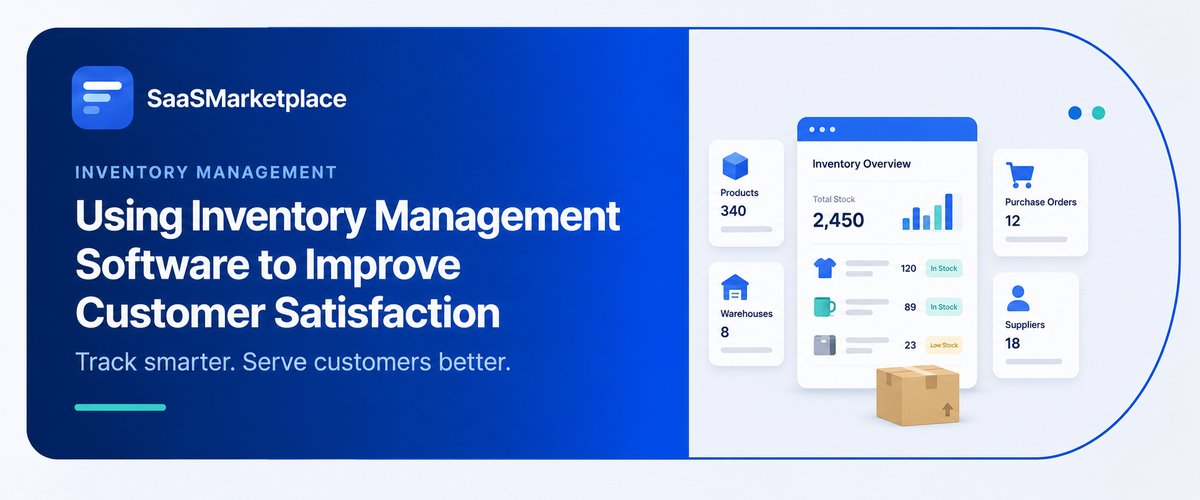
Using Inventory Management Software to Improve Customer Satisfaction
-min.jpg)
In the fiercely competitive world of retailing and e-commerce in the United States, utilizing inventory management software has become more than just a requirement at the operational level; it has become an essential requirement for the success of the operation. Customers expect to have an enjoyable experience, for example, receiving products on the same day or using convenient Buy Online, Pick Up In-Store (BOPIS) methods. Old-fashioned methods of keeping records by using spreadsheets lead companies to the negative experience that is known as inventory out of stock, delayed shipments, and lost customers. With modern inventory management software solutions, it becomes possible to see the inventory available and to be able to reorder items in case they are sold out.
How Does Inventory Management Software Reduce Stockouts for US Retailers?
In the U.S. retail industry, it doesn't take long to lose customer confidence due to stock shortages, as customers want a product to be available immediately, regardless of whether they purchase it in-store or online. Inventory management software solutions help avoid stock shortages by providing real-time data tracking across all sales channels. Thus, when a customer purchases a product through a company’s physical store, online store, or an online marketplace like Amazon.com, the stock levels will be updated in real time (thousands of locations). This allows retailers to avoid the limitations of manual updates, to have complete visibility of their stock levels, and to understand what their dynamic reorder point is at each given moment.
In addition to simply tracking items in stock, new warehouse management tools can utilize historical sales data and predictive analytics to predict demand spikes before they occur. By looking into elements such as seasonality, local shopping preferences, and advertising activities, including promotional offers, programs enable traders to acquire the necessary amounts of goods in advance for peak selling periods such as Black Friday or national holidays. In this way, retailers do not have to wait until goods are sold out and can distribute products in various warehouses and outlets to meet the demands of the customers without holding too much merchandise at the same time.
How Does Inventory Management Software Speed Up Order Fulfillment?
In the speedy US marketplace where Next-Day Delivery and same-day delivery have become the norms in transactions, the inventory management software helps fulfill orders by linking the online checkouts to warehouse operations. As an American customer clicks on an order, the software saves the goods instantly, assigns them to a nearby center, and creates the most efficient picking list. By erasing manual data input from the process, fulfillment teams do not have to wait and pack the goods in a matter of minutes after completion of purchase.
Inside the warehouse, the software helps workers or automatic pickers navigate their way to the locations of items most efficiently. Rather than requiring workers to walk all over the large site, the software organizes the picking into similar batches and suggests the most effective routes. One of the most important things that barcode scanning and RFID do is to increase speed. Workers can verify the correct item by scanning it and produce shipping labels for domestic shipments in less time.
As a result, retailers can avoid bottlenecks in the fulfillment process and improve their order-to-delivery time by coordinating the status of their inventory with the dispatch system of the carrier. Sending real-time updates and applicant tracking codes to customers allows them to always know the status of their orders and products.
How Does Inventory Management Software Improve Order Accuracy?
In the US market, the primary reason for wrong shipments and costly returns is human error when manual orders are entered and items are retrieved. The efficiency of inventory management systems is achieved through the elimination of human error as pick sheets replace them and use digital methods based on scanning. Orders sent from platforms like Shopify, Amazon, or Walmart Marketplace are then linked to the handhelds in the warehouse, leaving no detail about SKU, product description, or bin location out of the software’s reach. The system scans anything using barcode or RFID technology before items are packed.
The software utilizes barcode and RFID scanning validation to ensure accuracy on the warehouse floor before an item can be packed. During the picking process, each item’s SKU code is scanned twice by the pickers at the storage bin and the packing station, respectively. If the employee happens to take a wrong size, color, or variant of the product, the software will issue visual and audible alarms immediately, allowing the employee assistance program to correct the error before the box has been sealed or handed to the carriers.
The system goes beyond simply selecting the item, automating the completion of many complicated multi-item requests, like kits and bundles that are seen in retail stores across the US. Since the software keeps track of things like serial numbers, batch numbers, and expiration dates, buyers are guaranteed that orders will be packed exactly as requested, resulting in near-perfect shipping accuracy, reduced shipping costs, and complete satisfaction of American customers.
How Does Inventory Management Software Enhance Real-Time Visibility for US Businesses?
- Synchronization of All Channels Inventory: Enables instant product availability information for both e-commerce platforms and retail locations, preventing overselling.
- Mapping of Warehouses with Many Locations: Provides an integrated view of inventory in warehouses within the United States, third-party companies, and back areas of the stores.
- Tracking Inventory with Bin-By-bin Accuracy: Identifies the exact location of each SKU in terms of aisle and shelf, thus allowing greater efficiency of work in warehouses.
- Tracking of Orders in Real Time: Monitors orders of clients from the purchase point through delivery with an online transportation company.
- Control of Incoming Logistics: Monitors the positions of orders and containers before they arrive, ensuring that their processing is seamless.
- Automatic Notification of Reordering of Products: Sends alerts related to low inventory in stock or generates orders automatically once there is an insufficient amount of the products in stock.
- Sales Forecast Tools: Provides the procurement department with real-time data on turnover of products and deadstock.
How Does Inventory Management Software Support Faster Returns and Exchanges?
- Automated Self-Service RMA portals: This allows American customers to log into an exclusive portal where they can choose the reason for return and generate the return shipping label immediately.
- Fast warehouse scanning: Allows warehouse staff to scan packages as they come in and match their returns to the original order.
- Immediate restock or quarantine: Offers the warehouse staff advice on whether to send the return back to the inventory, to the refurbished inventory, or keep it in quarantine for checking.
- Instant real-time holds: Holds replacement items right away when the customer requests to make an exchange, so that they don’t sell out by the time the original item is on its way back to the warehouse.
- Automated refund triggers: Connects directly to the payment data processor, so that refunds can be processed as soon as the return item passes the scanning procedure.
- Integration of omnichannel BORIS: Supports Buy Online, Return In-Store, as it enables store staffing to scan online orders at the actual point of sale and update national inventory in real time.
- Data collection on the returning trends: Gathers information on product defect rates, sizing issues, and reasons for returns, thereby allowing retailers.
How Does Inventory Management Software Help US Businesses Scale Without Losing Service Quality?
As businesses in the US move from being a local single store to national omni-channel operations the challenge of keeping up service standards. The modern inventory management solution serves as the core control center that helps companies expand their business to new heights without compromising their speed, precision, and customer trust.
- Seamless Scalability Through Many Locations and Modes: A cloud-based inventory management system gives a business the ability to activate extra distribution points and 3PLs in its logistics process without juggling separate inventory records.
- Fast Delivery with Automated Order Routing: The system automatically tells where to deliver orders depending on their location and current sales trends to ensure that products reach customers as quickly as possible and to keep delivery expenses low.
- Prevention of Overselling: With a single source of stock data, inventory figures from websites, retail, and wholesale portals can be synchronized in a matter of seconds, which eliminates stockouts and order issues during rapid growth periods.
- Data-Driven Demand Forecasting: The software analyzes purchasing behavior and seasonality of sales in certain areas before the demand for certain SKUs increases.
- Standard Operations: Homogenized digital workflows like barcode and RFID scanning ensure that footage for inventory picking and packing remains accurate during busy times.
- Automation of Supplier Orders: The built-in automation processes purchasing orders automatically, which allows a company to beat the bottleneck problem by maintaining adequate volume scope.
- Uniform service: Tracking notifications and return processes are automated and perform smoothly with the increase.
Conclusion
Investing in contemporary inventory management software is a way to promise satisfaction to customers. With manual mistakes replaced by automated accuracy, visibility, and speed, US companies fulfill the needs of today’s consumers every day. Selecting the right solution to receive all advantages is extremely important. Choose SaaSMarketplace, an easy-to-use site for choosing, reviewing, and acquiring any business software that suits your requirements. Invest in your technology now to turn logistical problems into a lasting benefit.
FAQ's
It prevents stockouts, accelerates order fulfillment, and ensures high order accuracy so customers receive the exact products they ordered without delays.
Yes, modern platforms sync seamlessly across e-commerce channels, POS systems, and marketplaces to maintain accurate real-time stock levels everywhere.
It automatically updates stock counts instantly across all sales channels the moment a purchase occurs, preventing double-selling.
It automates return label creation, streamlines warehouse scan-ins, and triggers instant refunds or exchanges upon item receipt.
Businesses of all sizes benefit, from small online stores seeking to eliminate manual errors to enterprise brands managing multi-warehouse networks.