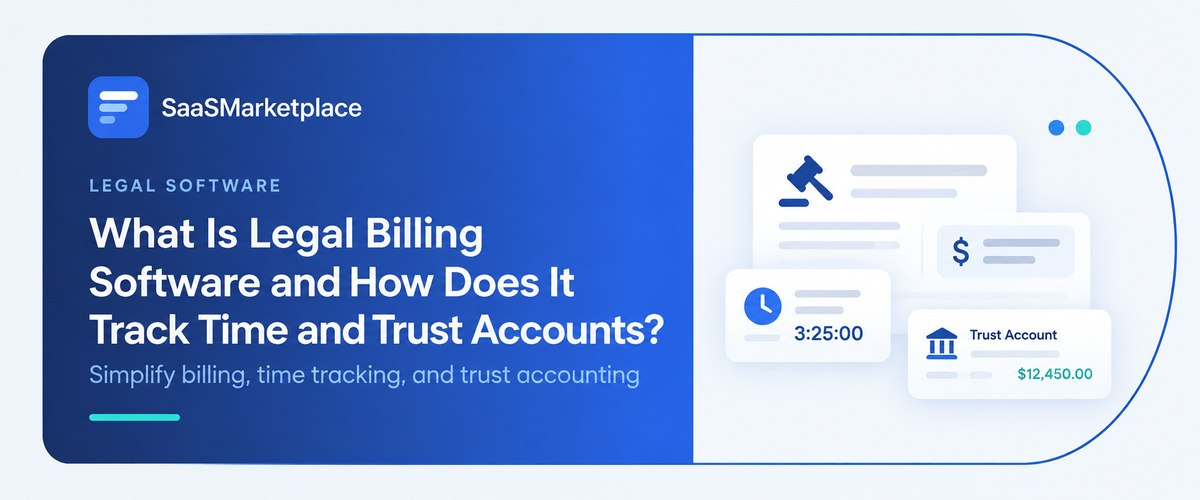
What Is Legal Billing Software and How Does It Track Time and Trust Accounts?
-min.jpg)
A lawyer who bills by the hour can expect to spend close to six hours of an eight-hour day doing non-billable work. According to Clio’s 2025 Legal Trends Report, the average law firm has a 38% utilization rate, which means that of the average eight hours per day spent working, a lawyer could only capture three hours of billable work in a day. The rest of one’s time is wasted on things such as intake calls, planning cases on a legal pad, checking a text on their phone between meetings, and any other tasks that fall through the cracks of invoicing. That gap is not really a time-management problem. It's a systems problem and it's the exact problem this kind of software was built to close.
 Looking for Legal Billing Software? Check out SaaS Marketplace’s List of the Best Legal Billing Software in the USA for your business.
This category of practice management technology helps law firms record time, generate accurate invoices, and manage client funds held in trust, all while satisfying the strict recordkeeping rules that apply specifically to attorneys. It sits at the intersection of two things every firm has to get right: getting paid for the work performed, and never touching client money the wrong way. What the software actually does, how time tracking and client fund management work under the hood, what separates a general invoicing tool from one built for law firms, and how to evaluate whether a platform will actually hold up under a bar audit.
What Is Legal Billing Software?
Legal billing software consists of specialized applications that capture time, invoices, and trust (IOLTA) accounts for law firms, often including generalized billing components plus regulatory features mandated by the state bar (e.g., three-way reconciliation, client fund segregation, matter accounting).
These differ substantially from broader invoicing tools such as QuickBooks or FreshBooks, which are based in two principles unique to lawyers: the billable hour as a granular, defensible unit of work, and the client trust account, a fiduciary holding managed by counsel for a client but not owned by one.
A general contractor invoicing a client for a kitchen remodel doesn't need to prove, to the penny, that every dollar in a bank account belongs to a specific client and was authorized before it moved. A lawyer holding a settlement check or a retainer does. That distinction is why the category exists separately from mainstream accounting or invoicing software, and why firms that try to force-fit QuickBooks alone into managing client trust funds often run into compliance problems within a year or two.
Why This Matters More Than It Used to
Three things have changed the stakes around legal billing in the past few years, and they're worth understanding before looking at features.
- Billing models are diversifying: Hourly billing is still dominant, but it's no longer the only model firms use. In 2024, more than half of firms billed both hourly and flat fees, and only 41% billed exclusively by the hour, with 59% of firms billing flat fees exclusively or in addition to an hourly rate (Clio, 2025 Legal Trends Report). Software that only handles a single hourly rate per timekeeper doesn't fit how a growing share of firms actually charge clients anymore.
- AI is entering time entry and invoice review from both sides: On the law firm side, AI-assisted time capture is starting to reduce the mental overhead of reconstructing a day's work at 6 p.m. One controlled study found that using AI-assisted practice management software reduced the active mental focus required for calculating billable hours by 72% compared to a manual, spreadsheet-based process (Clio, 2025 Legal Trends Report). On the client side, corporate legal departments are increasingly using AI to scrutinize incoming invoices for guideline violations before they ever get paid which raises the bar for how clean a firm's own billing needs to be before it goes out the door.
- Oversight of client trust funds has gotten stricter, not looser: State bars have been tightening enforcement rather than relaxing it. California's CTAPP program, for example, now requires attorneys to complete an annual self-assessment and certify their trust handling practices, with the 2026 renewal cycle deadline set for March 30 and involuntary inactive enrollment as a consequence for uncured noncompliance. That's a meaningfully higher bar than "keep good records and hope for the best."
How the Software Actually Works
Most platforms are built around three connected layers: time and expense capture, billing and invoicing, and safeguarding client funds. They're designed to work together so that a dollar entered once as a time entry or a trust deposit flows through to an invoice or a ledger without being manually re-keyed.
1. Time and Expense Tracking
- Timers tied to matters: Attorneys start a timer when they open a matter file, take a call, or begin drafting, and the system logs the duration automatically rather than relying on end-of-day reconstruction.
- Passive time capture: Newer platforms track calendar events, emails sent from a matter-linked inbox, and document edits in the background, then suggest time entries the attorney can approve or discard closing the gap between work performed and work recorded.
- Multiple rate structures per matter: A single case might involve a partner billing at one rate, an associate at another, and a paralegal at a third. The software needs to apply the correct rate automatically based on who's doing the work, not force manual rate lookups.
- Expense tracking: Filing fees, court reporter costs, travel, and other client-chargeable expenses get logged against the matter so they appear on the same invoice as the time.
A practical example: A four-attorney litigation boutique used to have associates log time in a shared spreadsheet at the end of each day. By the time entries were reviewed for the monthly invoice run, at least a few hours per attorney per month had simply been forgotten a deposition prep call here, a quick document review there. After switching to a system with calendar-linked and email-linked time suggestions, the firm recovered close to an extra billable hour per attorney per week, not because anyone worked more, but because less of the work they were already doing went unrecorded.
2. Billing and Invoicing
- Rate and billing-guideline enforcement: Corporate clients often impose strict billing guidelines (no more than X hours for a task type, no billing for travel, block-billing prohibited). Better platforms flag entries that violate a client's specific guidelines before the invoice goes out, rather than after the client's own review software rejects it.
- LEDES formatting: Corporate legal departments and insurers frequently require invoices in LEDES (Legal Electronic Data Exchange Standard) format a standardized structure that lets their e-billing systems automatically ingest and audit legal invoices, since it is required by most corporate legal departments and insurance companies for billing review and payment processing. A firm that does any meaningful volume of insurance defense or corporate work without LEDES capability will eventually hit a wall.
- Batch invoicing and approval workflows: Invoices can be generated in bulk at month-end, routed to a supervising partner for review, and adjusted (write-downs, write-offs) before finalization.
- Client payment portals: Integrated online account often supporting both operating-account and trust-compliant payment methods tends to speed up collections. Flat-fee billing arrangements, in particular, tend to get paid faster than hourly work.
3. Managing Client Trust Funds
- Individual client sub-ledgers: Every client with funds in the trust account gets a running ledger showing deposits, disbursements, and current balance separate from every other client's funds, even though the money physically sits in one pooled bank account.
- Three-way reconciliation: This is the core compliance mechanic, and it's worth explaining precisely because so many firms get it wrong. Three-way reconciliation means matching three numbers, on the same date, every month: the bank's statement balance for the trust account, the firm's internal ledger balance, and the sum of every individual client sub-ledger. If all three don't match exactly, something is wrong a misapplied payment, a missed deposit, an unauthorized disbursement and it has to be found and corrected before it compounds. Software automates the comparison and flags discrepancies immediately rather than at the year-end audit, when the error might be months old and much harder to trace.
- Earned-fee transfers: When an attorney bills against a retainer held in trust, the software should support moving exactly the earned amount from the trust account to the operating account, with a documented trail never allowing an attorney to draw against unearned funds.
- Disbursement controls: Every check or transfer out of trust typically requires matter-level documentation (payee, purpose, authorizing signature) rather than a simple withdrawal.
Time Tracking vs. Trust Accounting: What Each One Actually Protects
|
Factor |
Time Tracking |
Managing Client Trust Funds |
|
What it protects |
Firm revenue work performed but not billed is revenue lost forever |
Client funds errors here are ethics violations, not just bookkeeping mistakes |
|
Primary risk if done poorly |
Under-billing, missed revenue, inconsistent utilization |
Commingling, shortages, bar discipline, potential disbarment |
|
Governing standard |
Internal firm policy and client billing guidelines |
ABA Model Rule 1.15 and state-specific fiduciary rules |
|
Typical cadence |
Daily entry, reviewed at invoicing |
Monthly three-way reconciliation, minimum |
|
Consequence of failure |
Lost profitability |
Regulatory sanction, even without client harm or intent |
Small Firm vs. Enterprise: Different Needs, Different Tools
Solo and small firms :
- Mid-size firms : multi-timekeeper rate management, approval workflow for invoices prior to sending to clients, reporting for managing partners on utilization by practice group and realization rate.
- Enterprise firms and corporate legal departments: LEDES compliance, integration to outside counsel guidelines and e-billing portals of their clients (or matter budgeting and spend tracking, for in-house departments), and often a separate e-billing review layer separate from the main time and billing system.
- Mid-size firms : usually need multi-timekeeper rate management, approval workflows for invoices before they go to clients, and reporting that lets managing partners track utilization and realization by practice group.
- Enterprise firms and corporate legal departments: need LEDES compliance, integration with outside counsel guidelines and e-billing portals used by their clients (or, for in-house departments, matter budget tracking against outside counsel spend), and often a dedicated e-billing review layer separate from the firm's core time-and-billing system.
Common Mistakes Firms Make When Adopting Billing Software
- Choosing software before mapping current billing workflows: Firms that skip this step often end up trying to force their existing process into a tool that assumes a different one, rather than evaluating tools against how they actually work.
- Underestimating the training curve for time entry habits: The best time-tracking software doesn't help if attorneys don't build the habit of starting timers or reviewing suggested entries. Adoption, not features, is usually the actual bottleneck.
- Not verifying compliance features against their specific state's rules before buying: Requirements for handling client funds vary somewhat by jurisdiction (reconciliation frequency, record retention periods, notice requirements), and "IOLTA support" as a marketing claim doesn't guarantee it meets a specific state bar's exact standard.
- Ignoring realization and collection rates once billing is automated: Automating invoice generation doesn't automatically fix under-realization (billed work not matching worked value) or slow collections those need active management and reporting the software should support, not replace.
- Failing to migrate historical trust ledger data cleanly: A migration that leaves gaps in client fund history creates exactly the kind of discrepancy a future bar audit will flag.
When You Might Not Need Dedicated Billing Software
Here is the direct truth on this matter: a tiny operation with little movement in the trust account- perhaps one person handling estates who charges mostly fixed rates and keeps money no longer than several daysmight discover that pairing standard invoice tools with a simple record book, checked closely by an accountant knowing lawyer fund rules, works fine. Specialized programs made just for legal groups pay their price only when time-based billing gets hard, the amount of trust money grows big, or client payment rules demand so much detail that doing it by hand leads to mistakes. When none of these things happen first, waiting makes sense.
The Near-Term Future of Legal Billing Technology
A few developments are worth watching rather than reacting to immediately:
- AI-assisted time reconstruction will keep improving: drawing on calendar data, document activity, and communication logs to suggest entries but the attorney review step isn't going away, both for accuracy and for the ethical requirement that billed time reflect work actually performed.
- Billing model flexibility will keep expanding: as more firms adopt flat fees and hybrid arrangements. Software still built around a single hourly rate per timekeeper is increasingly a poor fit for how firms are pricing engagements.
- E-billing scrutiny from clients will keep tightening: As more corporate legal departments deploy AI-driven invoice review, firms with cleaner, guideline-compliant billing practices from the outset will see fewer rejected invoices and faster payment cycles.
Conclusion
Legal billing software bridges the crucial gap between performing legal work and getting paid accurately while staying compliant. By automating time capture, enforcing client billing guidelines, and ensuring strict three-way trust account reconciliation, these platforms protect both firm revenue and bar standing. While solo practices with simple fixed fees might survive on basic tools, growing firms using hourly or hybrid models need dedicated legal billing software to eliminate unbilled hours, accelerate collections, and navigate increasingly strict regulatory oversight with total confidence.
FAQ's
This type of software focuses specifically on time tracking, invoicing, and managing client trust funds. Legal practice management software is broader, typically including case management, document storage, and client communication alongside billing. Many vendors offer both as one integrated platform, but some firms use separate best-of-breed tools for each function.
Not exactly. IOLTA is a specific type of pooled trust account where interest earned is directed to legal aid programs rather than to individual clients, used for nominal or short-term client funds. Trust accounting is the broader practice of managing any client funds a lawyer holds, whether in that kind of pooled account or a separate interest-bearing account for a client with substantial funds.
Most state bars require this reconciliation monthly, though a small number allow quarterly reconciliation. Firms should confirm the exact requirement with their specific state bar, since rules and enforcement mechanisms (like California's CTAPP self-assessment) vary by jurisdiction.
Some platforms serve both ends of the market, but pricing, feature depth (especially around LEDES and multi-office reporting), and complexity scale significantly. A solo attorney and a 100-attorney firm typically need different tiers or entirely different products, even within the same vendor's lineup.
It needs to be investigated and corrected before moving forward common causes include a missed deposit, a bank fee charged directly against trust funds (which itself can be a compliance issue), a data entry error, or an unauthorized disbursement. Bar examiners generally treat incomplete or inaccurate records as a discipline issue on their own, separate from whether any client funds were actually lost.