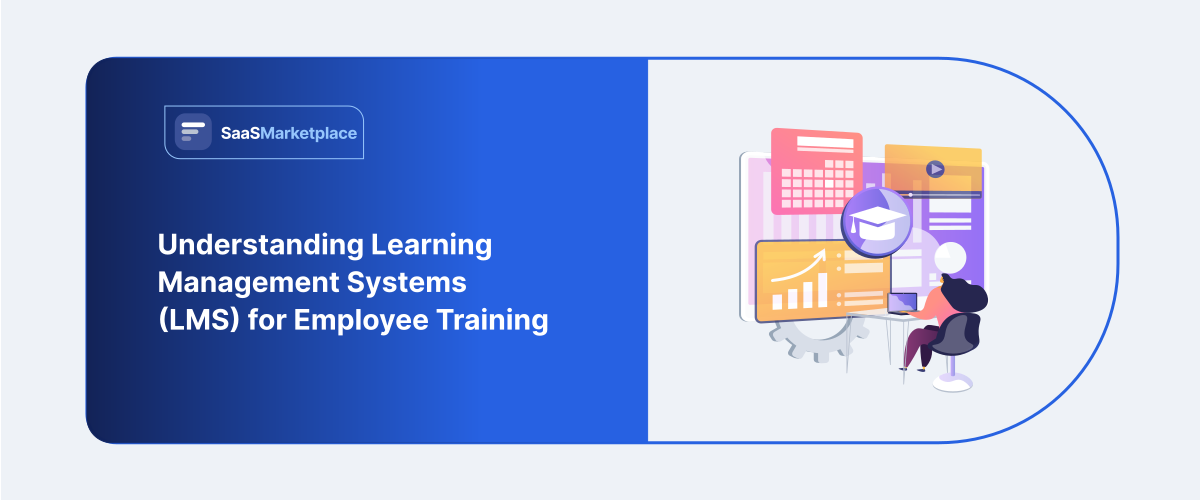
Understanding Learning Management Systems (LMS) for Employee Training
-min.jpg)
An HR director at a regional logistics firm in managing compliance instruction via a shared folder containing PDF files and a sheet listing those who accessed them. This functioned adequately enough until an OSHA inspection requested evidence showing each warehouse worker finished a particular safety unit inside the previous twelve months.She had the spreadsheet. She didn't have anything that proved completion beyond someone's word that they'd read the file. That gap is what pushed her company toward an LMS, not a desire to modernize training for its own sake.
 Looking for Learning Management Systems (LMS)? Check out SaaS Marketplace’s List of the Best Learning Management Systems (LMS) in USA for your business.
That's a more honest starting point than most vendor pitches offer. Companies rarely adopt learning management systems because training felt exciting to digitize. They adopt them because tracking, proving, and scaling training manually eventually breaks down in some specific, uncomfortable way an audit, a new-hire class too large for one-on-one onboarding, or a compliance requirement nobody can verify was actually met.
What an LMS Actually Is, Beyond the Marketing Definition
A learning management system is software that hosts, delivers, tracks, and reports on training content for employees. That's the textbook definition, and it's accurate as far as it goes, but it undersells what actually changes once a company adopts one.
The real shift is in accountability. Before an LMS, training completion is usually tracked through some combination of sign-in sheets, email confirmations, and manager memory none of which holds up well under scrutiny, whether that scrutiny comes from a regulator, a lawsuit, or simply a new VP asking whether anyone can prove everyone finished the training. An LMS answers that automatically, with a timestamped record showing exactly who completed what, when, and how they scored on any attached assessment.
The second shift is in scale. A company onboarding five new hires a month can manage training manually without much strain. A company onboarding fifty a month, or running mandatory annual compliance training across a workforce of a thousand people, hits a point where manual tracking simply can't keep pace not because anyone's careless, but because coordination overhead grows faster than the workforce does.
Why This Matters More for Certain US Industries Than Others
Regulatory pressure is the clearest driver, and it hits some industries far harder than others. Healthcare organizations need to document HIPAA training. Manufacturing and warehousing companies need OSHA compliance records. Financial services firms carry their own layer of mandatory training tied to bodies like FINRA. In each case, the training isn't optional, and neither is the proof it happened. An auditor asking for records six months later isn't interested in a manager's recollection that everyone did the training.
Beyond compliance, workforce distribution has pushed a lot of US companies toward LMS platforms almost by necessity. A company with employee scheduling spread across multiple states, or working remotely, can't rely on in-person sessions the way a single-location business might. An LMS becomes the only practical way to deliver consistent training to someone in a Dallas office and someone working from home in Portland, without either version drifting from the other over time.
There's also a cost angle that gets less attention than compliance but matters just as much in practice. Instructor-led training does not scale cheaply since each session requires someones time, be that an inside trainer or external consultant, and repeating identical content many times over a larger staff accumulates quickly. An LMS allows a firm to construct training one time and distribute it to hundreds or thousands of workers at a small fraction of marginal expense, although the initial outlay for creating quality material is genuine and frequently underestimated.
Core Capabilities Worth Understanding Before Evaluating Vendors
Content hosting and delivery is the foundation, and it's more nuanced than just uploading videos. A decent LMS needs to support multiple formats video, PDFs, SCORM-compliant courses, interactive quizzes and deliver them reliably across devices, since a meaningful share of frontline and field employees performance complete training on a phone rather than a desktop.
Tracking and reporting is where the actual value tends to concentrate, more than most companies expect going in. Beyond simple completion tracking, a good system shows which employees are behind on required training, which modules have unusually high failure rates, and how long employees typically spend on a given course. That last metric matters more than it sounds a course everyone finishes in ninety seconds probably isn't teaching anything, however good the completion numbers look.
Certification and compliance management matters enormously for regulated industries and barely at all for others. Automatically flagging an expiring certification, or blocking access to certain job functions until required training is complete, turns an LMS from a nice-to-have into something closer to a legal safeguard. A retail company running basic customer service training has little use for this. A healthcare system or a construction company absolutely does.
Assessment and skills validation goes beyond confirming someone clicked through a course. Quizzes, scenario-based assessments, and in some systems manager sign-off on practical demonstrations, confirm learning actually happened rather than just content being viewed. Companies that skip this layer often discover, well after the fact, that completion rates looked great while actual skill retention didn't.
Integration with existing HR systems tends to get underestimated during evaluation and then becomes a real headache during implementation. An LMS that doesn't sync cleanly with a company's HRIS for onboarding triggers or departmental reporting usually ends up requiring manual data entry somewhere, defeating a good part of the original purpose.
How Different Types of US Employers Actually Use LMS Platforms
Big companies usually operate full systems handling rules, leader growth, and skill paths, often using tools such as Cornerstone OnDemand, SAP SuccessFactors, or Workday Learning. For those groups, the LMS is often just one part inside a wider HR tech stack, meaning connection counts nearly as much as the actual learning material provided.
Mid-sized companies, roughly the 200-to-2,000-employee range, usually land somewhere more focused on solid compliance tracking and decent onboarding automation, without the full leadership-development suite a Fortune 500 company might build. Platforms like TalentLMS, Docebo, or Absorb LMS tend to fit this segment well, offering enough depth without enterprise-level cost and implementation timelines.
Small businesses, a category underserved by a lot of LMS marketing aimed at larger companies, often need something considerably simpler: a way to deliver a handful of required courses and track completion, without a dedicated administrator running the platform full-time. For a lot of small employers, the honest answer is that a lighter tool or sometimes just well-organized video content with a simple quiz and completion tracker covers what they actually need.
Franchise businesses and multi- location employers, especially within retail and food service sectors, encounter a similar challenge: maintaining uniform training across many sites, frequently for staff with rapid turnover rates, where speedily training newcomers is just as vital as meeting regulations. Learning management systems designed for this group usually emphasize rapid onboarding processes and mobile-centric access rather than the advanced analytical capabilities that bigger corporate learning typically require.
What Genuinely Improves, and Where the Limits Show Up
Consistency improves substantially, and it's usually the first benefit companies notice. Training delivered through an LMS doesn't vary based on which manager ran the session or how tired the trainer was that day. Every employee gets the same content, same order, same assessment attached.
Documentation and audit-readiness improve just as much, and for regulated industries this alone often justifies the cost. Producing a complete training record in minutes, rather than reconstructing one from emails and sign-in sheets under audit pressure, changes the entire relationship a compliance team has with its own program.
What doesn't automatically improve is actual learning quality. An LMS is a delivery and tracking mechanism, not a content strategy. Many businesses assume migrating existing training material into an LMS will improve outcomes on its own, but poorly designed training stays poorly designed once uploaded it just becomes better-documented poor training. The platform tracks completion. It doesn't fix content that was confusing or outdated to begin with.
Engagement is a similarly stubborn problem.Staff forced to click through a compulsory class will do so anyway, no matter how advanced the system becomes. Firms noticing genuine interaction gains typically invest in superior material creation with the platform shift, rather than just shifting old boring slides into a prettier container.
Common Mistakes Companies Make When Adopting an LMS
Most common error involves purchasing platform prior to defining exactly what training requires tracking and why. Firms occasionally choose full-featured enterprise LMS since competitor utilizes one, without initially verifying if their specific training requirements warrant such complexity or expense.
Another error, often seen when implementing, is underestimating the work needed to move content. Teams often discover, after signing a contract, that existing training materials aren't in a format the new system handles well, and that building genuinely effective courses takes considerably more time than uploading a folder of old slide decks.
Rolling out a new LMS without clearly communicating why it matters, or without making login and access genuinely simple, tends to produce low adoption in the first few months regardless of how good the platform is. Employees who find a system confusing to log into will find workarounds, and those workarounds usually look like the old spreadsheet-and-email system quietly continuing in parallel.
The software tracks and documents completion reliably. It can't guarantee the training content meets a specific regulation's actual requirements that verification still needs someone with regulatory expertise reviewing the content, not just confirming it got uploaded and assigned.
Deciding Whether a Full LMS Makes Sense Yet
A small business with under fifty employees and no significant regulatory training burden may not need a dedicated LMS platform yet. A well-organized set of training videos with a simple tracking spreadsheet, or a lightweight tool built for smaller teams, can often cover the need without the cost and administrative overhead of an enterprise system.
The more useful test is this: an LMS earns its cost once manual tracking starts creating real risk or real friction a compliance gap nobody can prove was closed, a growing workforce outpacing what one HR person can manually track, or onboarding delays that are actually slowing down new hires getting productive. Below that point, simpler tools usually serve the business better. Above it, the cost of not having proper tracking tends to show up eventually, often at the worst possible moment, like during an audit or a lawsuit.
Conclusion
Companies getting real value from an LMS are generally the ones that identified a specific problem first a compliance gap, a scaling issue, inconsistent training quality rather than adopting the technology because it seemed like the modern thing to do. The platform itself doesn't create good training. It creates a reliable, documented way to deliver whatever training a company has already invested the effort to build well.
The honest takeaway: An LMS handles tracking, consistency, and scale. It does not fix content quality by itself, and firms viewing the system as total solution instead of partial one often finish with documented training where people learn little from it.
FAQ's
An LMS adds structured tracking, reporting, assessments, and often compliance management on top of content delivery, while a basic video library just hosts content without those tracking layers.
It depends on regulatory burden and workforce size. Businesses with minimal compliance training needs and under fifty employees often do fine with simpler tools, while regulated industries or fast-growing companies tend to see faster returns.
Cornerstone OnDemand, SAP SuccessFactors, and Workday Learning are common at the enterprise level, while TalentLMS, Docebo, and Absorb LMS tend to serve mid-sized companies well.
No. It reliably tracks and documents training completion, but the training content itself still needs review by someone with regulatory expertise to confirm it actually meets the relevant requirements.
Buying a platform before clearly defining what training needs to be tracked and why, which often results in paying for enterprise-level complexity that a simpler tool could have handled.