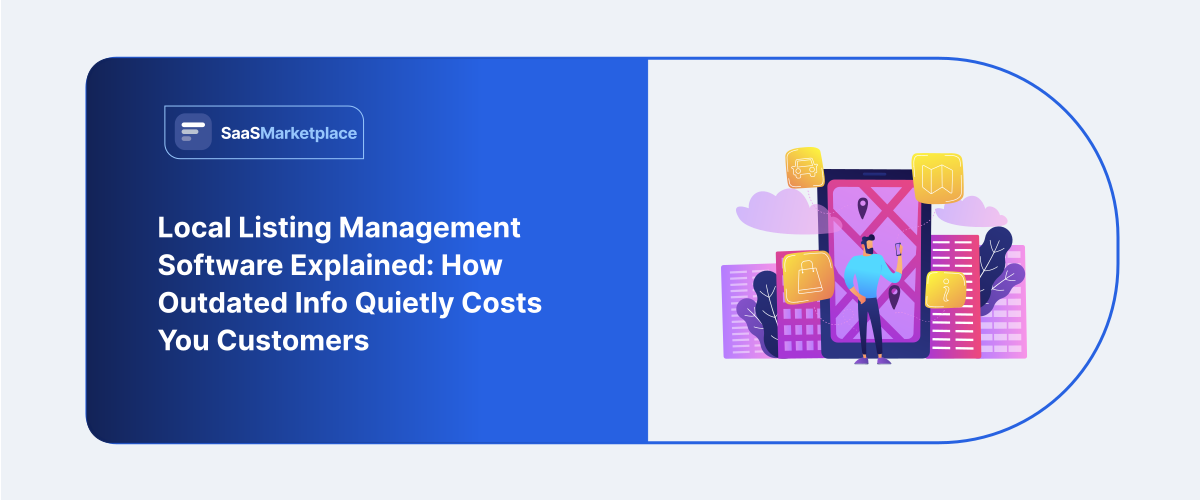
Local Listing Management Software Explained: How Outdated Info Quietly Costs You Customers
-min.jpg)
A customer searches for a business on Google, finds an address that's actually three moves ago, calls a phone number that was disconnected two years back, and shows up during hours that changed last spring. They never call again. The business didn't lose that customer to a competitor with a better product.
 Looking for Local Listing Management Software? Check out SaaSmarketplace’s List of the Best Local Listing Management Software in USA for Your Business.
It lost them to outdated information sitting quietly on a directory nobody remembered to update. This is exactly the kind of problem local listing management software exists to prevent, and it's a problem that tends to compound quietly across dozens of directories at once, not just the one or two a business happens to check.
What Is Local Listing Management Software?
Local listing management software is a platform that automates the process of distributing, monitoring, and correcting business listings across dozens or hundreds of online directories from a single business dashboard, instead of a business manually logging into each individual platform to update its hours or address. At a practical level, this kind of software does three things well. It pushes accurate business information out to major directories and platforms in bulk rather than one at a time.
The software continuously observes entries in directories to detect modifications; those external platforms occasionally edit data without notifying the owner of a company. It identifies entries that are not identical, entries that appear twice, and information that is no longer current. The software highlights those issues so staff can fix them before the errors lower the number of potential consumers who can find the company.
Core Capabilities of Enterprise Listing Software
Evaluating a platform requires looking past simple profile setup. A high-performing local listing management software environment should deliver long-term protection and analytics across four key operational areas.
1. Robust Directory Sync Technology
Modern directory management relies on direct API connections rather than slow, manual submissions. Built-in directory sync technology streams updated business details directly to major map providers, mobile navigation apps, social networks, and industry-specific directories simultaneously. This ensures that when a store updates its holiday hours, those changes reflect everywhere instantly.
2. Automated NAP Consistency Audits
Search engine algorithms place high trust in consistency. Name, Address, and Phone number integrity across the web directly influences map placement. Using local listing management software allows organizations to run continuous NAP consistency audit protocols. The platform scans external networks, highlights mismatched records, and overwrites incorrect data automatically.
3. Integrated Google Business Profile Optimization
Because a primary portion of nearby customer searches happen directly on map interfaces, direct profile management is mandatory. Enterprise software simplifies Google Business Profile optimization by allowing teams to publish updates, upload location photos, post promotional announcements, and manage secondary service attributes at scale across hundreds of storefronts.
4. Direct Citation Distribution Networks
Beyond main search engines, regional buyers consult smaller local directories, vehicle navigation hubs, and voice platforms. The technology utilizes an extensive system to distribute citations; this process ensures that the details of a company remain functional and provable on platforms specific to an industry, plus on directories for a specific geographical neighborhood.
Why NAP Consistency Actually Matters for Local SEO
NAP, meaning name, address, and phone number, is the foundation local SEO gets built on. Search engines cross-reference NAP details across every directory a business appears on, and mismatches, even small ones- a missing suite number, an old area code, an abbreviated street name- can quietly undermine how trustworthy that listing appears. NAP consistency sounds like a small technical detail, but it's genuinely one of the more overlooked factors behind inconsistent local search performance.
This becomes a bigger issue the more locations a business has. A single-location shop might have a handful of listings to manage. A multi-location business can easily have thousands of individual listings across all its locations and directories, and manually keeping all of that accurate becomes essentially impossible without dedicated software behind it.
Do you know?
A meaningful share of local businesses have at least one duplicate or outdated listing they don't even know exists, often created automatically by a data aggregator years earlier. These forgotten listings can actively work against local search rankings, since search engines see conflicting information even if the business itself never touched that particular directory.
Key Features Worth Looking For in Local Listing Management
When comparing local listing management software, a handful of features tend to matter more than the rest:
- Bulk distribution to major directories and data aggregators, essentially automated citation building
- Continuous monitoring for changes or inconsistencies across listings
- Duplicate listing detection and merging
- Review aggregation across major platforms in one dashboard
- Multi-location support with location-level visibility for larger businesses
- Reporting connecting listing accuracy to actual local search rankings
- Direct integration with Google Business Profile for faster updates
Not every business needs all seven immediately, but as location count grows, each one starts mattering considerably more.
Building a Measurable Performance Framework
To track return on investment, business leaders must look beyond raw listing count. Tracking clear key performance indicators (KPIs) helps gauge how improved digital placement converts into physical business visits.
|
Metric Category |
Key Performance Indicators |
Primary Strategic Purpose |
|
Data Health |
NAP accuracy score, active duplicate count |
Measure overall consistency and profile security |
|
Search Visibility |
Map pack impressions, branded vs. unbranded search ratio |
Evaluate overall local search visibility and discovery rate |
|
Customer Action |
Driving direction requests, click-to-calls, website visits |
Quantify direct online-to-offline customer conversion |
|
Reputation Quality |
Average rating, response velocity, sentiment score |
Monitor brand trust and local customer satisfaction |
By configuring customized dashboard views inside your local listing management software, regional managers can track immediate operational metrics while executive leaders evaluate long-term brand expansion across territories.
Aligning Local Listing Strategy with Business Growth
Technology alone does not guarantee local market dominance. Establishing an effective local listing management protocol requires connecting directory updates with daily operational workflows.
Unifying Review Aggregation Workflows
Customer Feedback built directly into directory profiles heavily influences local conversion rates. Top-tier software for managing directories includes a single location to collect reviews - those workflows gather written reactions from many sources into one digital folder. The employees are able to answer the comments quickly. By doing so, they increase the level of happiness among consumers and demonstrate to search algorithms that the company is active.
Executing a Hyperlocal Digital Strategy
Reaching nearby consumers requires messaging that resonates on a neighborhood level. A modern hyperlocal digital strategy uses localized photos, specific service descriptions, and branch-specific promotional codes. Deploying custom fields inside your local listing management software makes it easy to showcase localized offerings without creating messy data records.
How Local Listing Management Software Changes Daily Operations
The actual change focuses on removing a hidden limitation on how easily consumers can find a company. Many owners do not perceive this limitation. Instead of someone manually checking a dozen directories every few months, updates propagate automatically and get monitored continuously in the background.
Companies that gain real value from local listing management software weave data accuracy directly into their overarching brand management strategy. They recognize that basic contact info serves as essential infrastructure; without it, even the most sophisticated local SEO campaign falls short on the directories customers check first.
Common Mistakes When Managing Local Listings
Even solid local listing management software can underdeliver if it's used carelessly. A few mistakes come up again and again:
- Setting up listings once at launch and never revisiting them as the business changes locations, hours, or phone numbers
- Ignoring duplicate listings because they seem harmless rather than actively confusing to search engines
- Updating the primary Google Business Profile but forgetting smaller, secondary directories entirely
- Treating listing management as separate from broader local SEO instead of foundational to it
- Choosing software based on directory count alone without checking actual data accuracy and update speed

Pro-tip
Never use tracking phone numbers directly as your primary directory contact line without proper dynamic call tracking setups. Mismatched phone numbers across secondary directories destroy search engine trust. Always keep your primary, local geographic landline static across every local listing directory
How to Choose the Right Local Listing Management Software for Your Business
Start with how many locations you're managing and how often your business details actually change. A single-location business mostly needs reliable distribution and monitoring, while a multi-location business needs strong bulk management and location-level reporting that scales without adding proportional manual work for every new site opened.
From there, shortlist a few local listing management software options and check how directly each one connects to major platforms rather than relying entirely on slower third-party data aggregators. If broader search visibility matters too, compare how it complements your existing SEO software, since listing accuracy and local search rankings are closely tied together.
Price matters, but the more important question is how quickly and reliably updates actually propagate across directories. A cheaper tool that takes weeks to correct a wrong phone number isn't actually solving the problem.
Conclusion
A lost customer rarely shows up as a clear signal that something's wrong. In many cases, a consumer attempts to visit a location, dials a telephone number that is no longer in use, or relies on hours of operation that are incorrect. This consumer does not return to the company. The software removes this distance between the company and the consumer, maintaining correct data where consumers and search engines search. Consistency supports marketing activities like paid advertisements, unpaid articles, and verbal recommendations.
FAQ's
It distributes observes and fixes data for companies across digital directories to keep listings accurate everywhere.
Search engines use matching business details across directories as a trust signal that affects local search rankings.
Not always, though even one business benefits from monitoring, since directories can change listings without notice.
Fairly common, especially for businesses that have moved or rebranded, and they often go unnoticed without monitoring.
Many platforms also aggregate reviews across directories, since reviews and listing accuracy both affect local visibility.