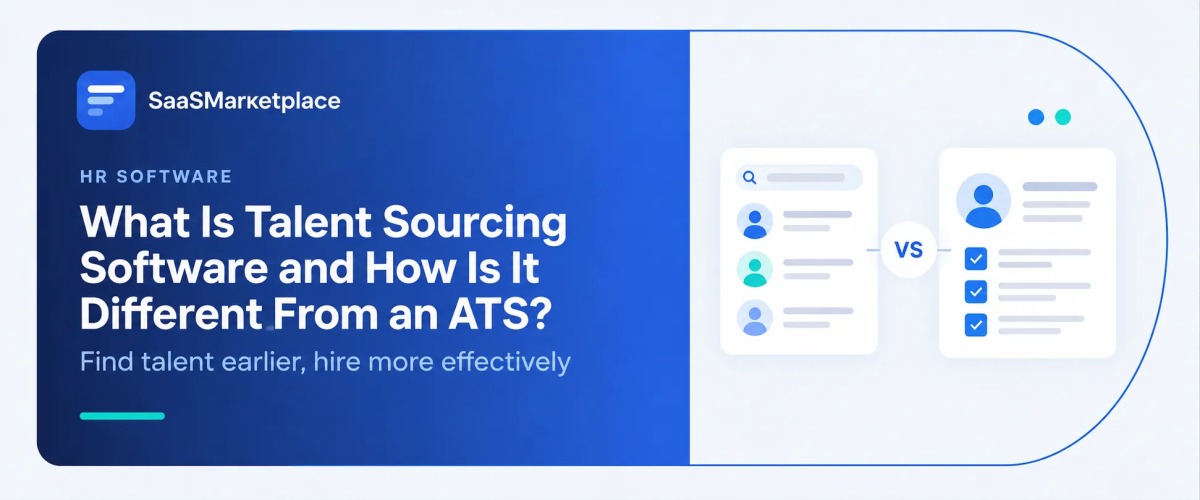
What Is Talent Sourcing Software and How Is It Different From an ATS?
-min.jpg)
A hiring manager posts an open role, ninety resumes show up in a week, and somehow none of them are quite right. That's not usually a sign the job posting failed; it's a sign the company is relying entirely on inbound applications for a role where the strongest candidates aren't actively looking at all. This is where talent sourcing software and an applicant tracking system, or ATS, start to matter as genuinely different tools rather than interchangeable recruiting software. One finds and engages people who haven't applied anywhere. The other manages the people who have. Both sit under the broader category of HR software, but understanding which problem each one solves matters more than most buying guides admit, and getting the sequence wrong is a common, expensive mistake.
What Talent Sourcing Software Actually Is
Talent sourcing software focuses on outbound recruiting; it identifies possible candidates who are not currently looking for work, then contacts them to check interest before any official application happens. The tool scans professional networks, portfolios, and open candidate information to find individuals whose history fits a position needs, orders them by suitability via AI matching logic, and handles the contact steps after.
The underlying logic looks closer to sales prospecting than traditional HR administration. A sourcing tool doesn't wait for someone to apply; it identifies who'd likely be a strong fit and starts a conversation. That's a meaningfully different function from managing candidates who show up on their own, and it's why sourcing platforms increasingly get compared to CRM software rather than to conventional recruiting tools.
What an ATS Actually Is
An applicant tracking system handles the organized, inbound portion of recruitment, including job ads, received applications, resume analysis, interview timing, manager comments, offer documents, and legal file storage. It serves as the official data source for all individuals within a firm's selection queue, no matter their entry point.
ATS does not really mind if an applicant came from a job board, a referral by a staff member, or a sourcing campaign. Work begins when a person enters the pipeline: making sure the individual keeps moving toward interviews, ensuring hiring managers stay aligned, and maintaining compliance within the process plus documentation.
The Core Structural Difference: Inbound vs. Outbound
This is the distinction most competing content states without explaining. An ATS exists because companies need a structured way to process people who choose to apply. Talent sourcing software exists because a meaningful share of strong candidates never apply to anything; they're employed, not actively looking, and only reachable through direct outreach.
Referral and passive-candidate hiring together represent a substantial share of quality hires at many companies; referred employees alone commonly account for somewhere between 30% and 50% of new hires at organizations running structured referral programs. That's a meaningful signal that a large portion of good hiring doesn't happen through the "post and wait" model an ATS is designed around, which is exactly the gap sourcing software is meant to close.
How Talent Sourcing Software Works Day to Day
- Candidate discovery: Sourcing platforms scan professional networks and public profiles for people matching specific skills or experience criteria, using AAI-assistedranking so a recruiter isn't manually reviewing hundreds of profiles one at a time. A software company hiring for a niche backend engineering role, for instance, might use this to surface engineers with the right combination of languages and system experience across companies where that skill set is common, rather than waiting for one of them to happen to apply.
- Outreach and follow-up sequences: Once a candidate is identified, the software manages personalized messaging and follow-up timing, tracking who's opened a message, responded, or gone quiet, functionally similar to a sales outreach cadence. The messaging itself still needs a human touch; a generic, obviously templated outreach message tends to get ignored by exactly the kind of experienced, in-demand candidate a company is trying to reach.
- Talent pool management: Strong candidates who aren't right for a current opening get tagged and organized for future roles, so recruiters aren't starting from zero every time a new position opens. This is particularly valuable for companies that hire the same type of role repeatedly a healthcare staffing firm sourcing nurses, for example, benefits enormously from maintaining a warm pool rather than restarting outreach for every new opening.
Where the ATS Takes Over
Once outreach succeeds, or once someone applies directly, the ATS becomes the operating system for everything that follows. A properly configured ATS has been shown to reduce average hiring cycle length meaningfully; some industry research puts the improvement as great as a 60% reduction in time-to-hire compared to unstructured processes, and teams using one consistently report finding higher-quality candidates than those relying solely on unmanaged inbound applications.
This is precisely why the two tools are sequential rather than competing. Sourcing fills the top of the funnel with candidates who wouldn't otherwise be there; the ATS manages everything from first interview to signed offer.
Comparison for Talent Sourcing Software vs. ATS
|
Factor |
Talent Sourcing Software |
ATS |
|
Direction |
Outbound: finds passive candidates |
Inbound: manages active applicants |
|
Core function |
Search, outreach, talent pool building |
Screening, scheduling, offer management |
|
Best suited for |
Hard-to-fill and senior roles |
High-volume applicant management |
|
Primary data output |
Candidate discovery and engagement metrics |
Pipeline stage, time-to-hire, compliance records |

Pro-tip
Before evaluating vendors, map out where your current hiring actually breaks down: too few qualified applicants, or too many applicants moving too slowly through the process. That answer decides which tool you need first.
Where This Connects to the Broader HR Software Stack
Recruiting technology doesn't operate on its own. Once someone is hired, their information typically moves into HRIS software or a broader HRM software system, which holds ongoing employment records: role, tenure, reporting line, personal data. Neither sourcing tools nor an ATS are designed to serve as permanent employee records; their job ends once someone accepts an offer.
Larger organizations frequently run recruiting as one module inside a broader HCM software suite, where sourcing, applicant tracking, onboarding, and payroll software share the same underlying system. This is especially relevant for enterprise HR software buyers managing hiring across multiple departments or locations, where disconnected recruiting data creates real reporting gaps.
HR analytics software is where sourcing and ATS data actually become useful for decision-making: time-to-fill by channel, cost-per-hire, and which sourcing campaigns are converting into actual employees rather than just clicks. Without that layer, a company can run both tools competently and still have no clear read on what's working.
Do You Know?
A growing number of platforms now include HR chatbot software to handle first-round candidate questions and interview scheduling automatically, along with an HR employee mobile app so new hires, particularly in field, retail, or warehouse roles, can complete onboarding steps without needing desktop access on day one.
Common Buying Mistakes
- Buying sourcing software before fixing a broken ATS: Adding more candidates to a pipeline that already can't move people through interviews efficiently just makes the underlying bottleneck worse. A team that takes six weeks to schedule a second-round interview won't fix that problem by generating more first-round candidates; it'll just have a longer backlog of frustrated people waiting.
- Treating employee referrals as a sourcing strategy on their own: Referral schemes work yet fail for applicants beyond current firm connections, where specific sourcing instruments provide value. Firms where staff mainly recognize peers like them will retain recruiting thin segments of the marketplace via referrals solely, regardless of how good scheme operates.
- Letting sourcing and ATS data live in disconnected systems: If outreach metrics and pipeline records stay unlinked, then determining exactly which sourcing drives actual hiring rather than mere activity turns out to be quite hard. One recruiter could dispatch two hundred outreach messages and receive twelve replies, yet lacking a link between that data and final hires means there is no method to know whether those twelve individuals were truly suitable candidates or merely the simplest ones to contact.
- Assuming AI sourcing removes the need for human evaluation: Skills-based, AI-assisted matching widens the candidate pool meaningfully, but it doesn't replace structured interviews or eliminate the need for a recruiter's judgment about cultural and role fit. Technology narrows a list; it doesn't make the final call.
- Underestimating the setup and tuning period: Sourcing platforms typically need real configuration, defining the right search criteria, building outreach templates that don't sound automated, and training the matching algorithm on what "good fit" actually means for a specific company. Teams that expect strong results in the first week are often disappointed, not because the tool doesn't work, but because it hasn't been given enough real usage data yet to perform well.
Who Doesn't Need Dedicated Sourcing Software Yet
A small company hiring occasionally, for roles where qualified candidates regularly apply on their own, often doesn't need a separate sourcing platform. Many ATS products include basic sourcing features already, which is usually sufficient until hiring volume grows or a company starts competing for scarce, specialized talent where inbound applications alone aren't producing strong candidates. Buying dedicated sourcing software before that point tends to mean paying for capability that goes mostly unused.
Where the Category Is Heading
Two developments are shaping this space heading into the next few years, though it's worth treating both as emerging trends rather than settled facts. The first is deeper integration between sourcing tools and applicant tracking systems, with vendors increasingly building both functions into a single platform rather than expecting companies to stitch two separate tools together. The second is more sophisticated AI matching that draws on skills data rather than job titles or years of experience alone, which broadens candidate pools but also raises new questions about how that matching logic should be audited for fairness. Neither trend eliminates the underlying distinction between finding candidates and processing them; it just makes the boundary between the two functions less visible to the end user.
Questions to Ask Before Buying
- Does the tool integrate with the HRIS or HCM software already in place, or will hired candidates require manual re-entry?
- Does its analytics actually break down performance by sourcing channel, or only report aggregate time-to-fill?
- If interview volume is high, does the platform offer HR chatbot software for scheduling and first-round screening?
- For distributed or frontline hiring, is there a usable HR employee mobile app, or does everything assume desktop access?
- How is pricing structured, and does it scale sensibly if hiring volume grows significantly?
Conclusion
The distinction between talent sourcing software and an ATS isn't a matter of one being better than the other; they solve different halves of the hiring problem. A company that can't find qualified candidates needs sourcing capability. A company drowning in unprocessed applications needs a stronger ATS. Most growing organizations eventually need both, connected closely enough that outreach data actually informs pipeline decisions, and vice versa. The practical first step isn't picking a vendor; it's being honest about which side of the funnel is actually broken.
FAQ's
No. Sourcing software finds and engages passive candidates who haven't applied anywhere. An ATS manages candidates once they're already in the hiring pipeline.
Not usually right away. Many small businesses get sufficient sourcing capability from features built into their existing ATS or general HR software, and only need a dedicated platform once hiring volume or role difficulty increases.
Primarily through candidate matching and ranking potential candidates by how closely their skills and experience align with a role, which reduces the manual work of reviewing large numbers of profiles individually.
No. An ATS handles inbound applicants effectively but isn't built to identify or engage people who aren't already looking. For roles where strong candidates rarely apply directly, sourcing software fills a gap an ATS isn't designed to address.
Once a candidate is hired, their information typically transfers from recruiting tools into HRIS or HCM software for ongoing employment records and workforce management, since recruiting platforms aren't built to serve as permanent employee data systems.
It depends on what's actually limiting hiring. If the bottleneck is genuinely a shortage of qualified applicants for specific roles, sourcing software can be worth the cost even for a small team.
Less so than for specialized or senior roles. High-volume, entry-level positions typically generate enough inbound applications that the ATS side of the process matters more than outbound sourcing.