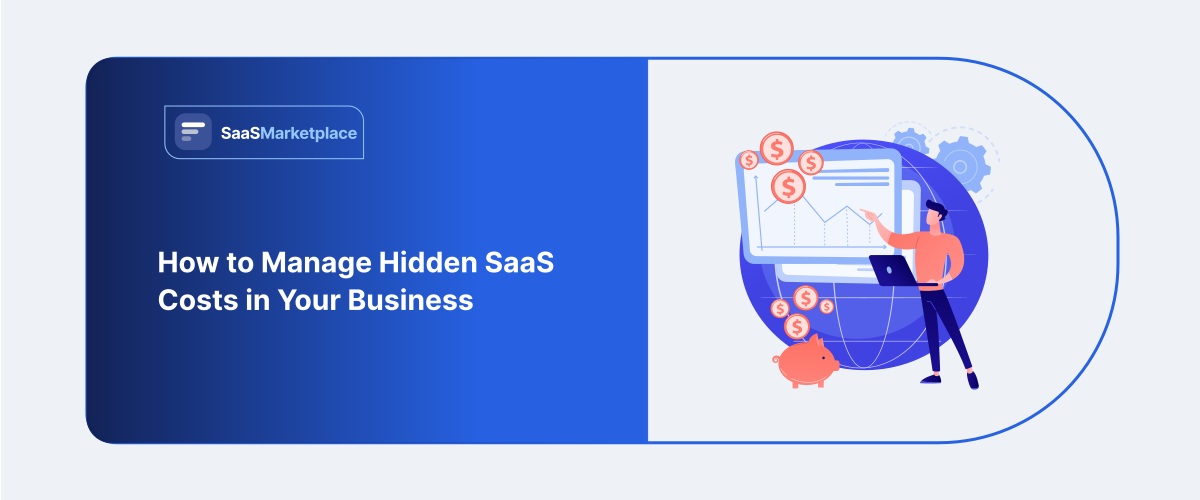
How to Manage Hidden SaaS Costs in Your Business
-min.jpg)
A finance director at a mid-sized logistics company once pulled up the corporate card statement expecting a dozen or so software charges. She found forty-three. Nobody on her team could say with any confidence what half of them did, who'd approved them, or whether anyone was still using them. That story isn't unusual. It's close to the default state for any company that's grown past the "everyone uses the same three tools" stage.Service software was meant to simplify budgets. Fixed monthly charge, zero initial license fees, adjust capacity whenever required. For a lot of organizations, it's worked out the opposite way.
Subscriptions billing multiply across departments, nobody owns the master list, and the real cost of running the business on software ends up well above whatever number shows up on the "software" line of the budget. That gap is what people mean by hidden SaaS costs: the charges, inefficiencies, and risks sitting just outside the visible subscription price. They seldom appear on one invoice. Rather, they manifest as empty chairs, redundant software, unexpected renewals, and the time staff waste moving among systems that fail to communicate with one another. None of this is about slashing every tool in sight. It's about actually knowing what you're paying for, and why.
Why SaaS Costs Become Hidden in the First Place
Most companies don't set out to lose track of software spend. It happens gradually, almost as a side effect of how SaaS tends to get bought.
A marketing team signs up for a design tool on the company card. A sales rep expenses a prospecting add-on. An engineering lead spins up a testing environment that quietly turns into permanent infrastructure. None of those acquisitions go via identical approval routes; therefore, none end up on the same spreadsheet. Finance sees the aggregate spend on the statement, rarely the reasoning behind each line item.
Procurement teams built around traditional software licensing often aren't equipped to catch any of this. Traditional licenses got negotiated once a year, in bulk, by someone whose actual job was negotiating software contracts. SaaS tools get bought in small increments, by whoever needs them that week, on a credit card, through a free trial that converts to paid almost by accident.By the time someone finally audits the full picture, the company might be running fifteen tools doing roughly the same job across different departments each with its own renewal date, its own support contact, its own price quietly ticking upward.
Where the Real Costs Hide
Unused and Underused Licenses
This is the most common culprit, and usually the biggest one. Someone joins a project, gets added to a tool, wraps up the project, and never gets removed. Multiply that across a company of a few hundred people, and you're paying for dozens of seats nobody's opened in months. The tricky part: license waste is invisible unless someone goes looking for it. Most SaaS platforms won't flag "this seat hasn't been used in ninety days" on their own. Someone has to pull that report manually, tool by tool, exactly the kind of task that keeps sliding to next quarter.
Auto-Renewals Nobody Is Watching
SaaS contracts are built around retention, not friction. Annual plans auto-renew by default, often with built-in price bumps vendors like to call "standard adjustments." No calendar reminder thirty or sixty days out, and the company's locked into another year at a higher rate, sometimes for a tool that's already been half-replaced by something else. Smaller companies overlook this often, mainly because renewal management tends to fall on whoever happens to own the vendor relationship at the time. That ownership shifts every time someone changes roles or leaves.
Overlapping Tools Across Departments
Marketing, sales, and customer success frequently end up each paying for a separate tool doing some version of the same job: email automation, analytics, project time tracking. Nobody chose this on purpose. Each team solved its own problem in isolation, and nobody stepped back to ask whether three tools were really necessary to do the work of one. There's a second cost here too. If groups operate across separate systems, one person must later fix the data mismatch, which consumes actual time despite low tool costs.
Tier Creep
Vendors design pricing tiers to nudge customers upward, by design.An organization begins with a middle-level package, requires a single capability restricted to the subsequent higher level, and promotes the whole account solely to access iteven when merely two individuals interact with that function. After twelve months or so, the firm pays for resources they rarely utilize, purely since moving up seemed simpler than discussing terms.
Integration and Implementation Costs
The sticker price on a SaaS platform rarely covers the cost of actually getting it running inside the business. API connections, custom fields, data migration, staff training all of it takes time, and time carries a dollar value even when it never shows up on an invoice. Teams usually discover this after the fact, once the vendor's "quick setup" turns into weeks of configuration work.
Support and Add-On Fees
Premium support tiers, extra storage, additional user roles, priority onboarding these arrive as optional extras, easy to say yes to one at a time and easy to lose track of in aggregate. A tool that looked like $40 per user a month can quietly become $65 once every add-on gets factored in.
Building a System to Find and Control These Costs
-
Start With a Full Software Audit
There's no shortcut around this step. Someone has to pull together a complete list of every active subscription billing not just the ones finance already knows about, but everything purchased through expense management, department budgets, and personal cards that got reimbursed later. Many businesses expect the audit to turn up a handful of surprises. In practice, it usually turns up a lot more than that. The first audit tends to be the most uncomfortable one, mostly because of how decentralized the buying process turns out to have been.
-
Assign Real Ownership
Each instrument requires single individual responsibility not a unit, a human. This keeper monitors consumption, handles the renewal day, and chooses if the tool keeps its spot in the layer. Lacking a named keeper, accountability drops into space among groups, and that space is precisely where concealed expenses reside.
-
Track Usage, Not Just Spend
Knowing what a tool costs is only half the picture. The more useful question is what it costs per active user, per month, weighed against how much value that user actually gets out of it. A $10,000-a-year platform used daily by fifty people is a completely different proposition than the same platform used occasionally by five. Most SaaS platforms have some form of usage reporting built in, even when it isn't obvious. Pulling that data quarterly rather than waiting for the annual renewal to think about it gives a business time to act on what it finds.
-
Centralize Purchasing Decisions
This doesn't mean routing every $12 tool through a six-week approval process. It means having one visible system, even a shared spreadsheet, where new subscriptions get logged before purchase. Visibility is the goal here, not bureaucracy. A lightweight process people actually follow beats a strict one that gets quietly ignored.
-
Negotiate Before Renewal, Not After
Suppliers anticipate resistance when renewals arrive, and usually possess greater flexibility than their published lists imply, particularly regarding yearly or longer-term agreements. Delaying discussion until the official notice arrives places the company in a poor bargaining stance. Beginning talks between sixty and ninety days early allows space to evaluate other options, which frequently serves as the primary tool for securing improved pricing.
-
Consolidate Where It Makes Sense
Once overlapping tools have been identified, consolidation can cut both direct costs and the hidden cost of managing multiple systems. It isn't always the right move, though. Sometimes a specialized tool genuinely does its job better than an all-in-one platform, and forcing a switch just to save money can end up costing more in lost productivity than it saves in subscription fees. Weigh functionality first, price second.
-
Use a SaaS Marketplace or Management Platform
When firms operate over several dozen applications, manual monitoring fails to scale effectively. A software-as-a-service exchange or management system may unify buying processes, identify idle credentials automatically, monitor expiration dates, and occasionally secure improved pricing via combined purchase volumes. Such systems incur separate subscription fees, meaning calculations only succeed for enterprises possessing sufficient software spending to warrant them, usually after a firm oversees fifteen or more active instruments.
Why Some SaaS Tools Are Worth Keeping
Not every expensive tool is a wasteful one. Some platforms are priced high because they do something genuinely difficult, and do it well replacing them with a cheaper alternative can end up costing more in lost efficiency than it saves in subscription fees. Controlling unseen SaaS expenses does not involve operating the smallest software stack at all. Rather it requires ensuring each dollar paid represents a conscious decision instead of an overlooked one. A useful gut check: if a tool vanished tomorrow, would anyone notice within a week? If the honest answer is no, that's a strong signal it's worth a second look. If the answer is an immediate yes, the conversation should be about optimizing the plan, not eliminating the tool.
Conclusion
Hidden SaaS costs rarely trace back to one dramatic mistake. They build up slowly, through small approvals nobody questioned and renewals nobody flagged. Companies that get ahead of this aren't necessarily spending less on software they're spending on purpose. They know what they're paying for, who's using it, and why it's still on the books. Getting there takes a real audit, clear ownership, and a habit of checking usage before the renewal date forces the conversation. None of it is complicated. It just takes someone actually doing it, on a schedule, instead of waiting for the credit card statement to raise the alarm.
FAQ's
Any expense tied to software that isn't obvious from the subscription price alone unused licenses, tier upgrades, integration work, support add-ons, and renewal price increases all fall into this category.
Once a year at the minimum. Quarterly usage reviews catch waste much earlier, though, and keep it from compounding into a bigger problem.
Usually not until a company is managing a significant number of paid tools. Below that threshold, a shared spreadsheet with clear ownership tends to do the job more cost-effectively.
Unused or underused licenses, most consistently, mainly because they stay invisible unless someone actively checks usage data.
Not necessarily. Consolidation makes sense when tools serve the same core function at similar quality. It makes less sense when a specialized tool performs meaningfully better than a general one, even at a higher price.